
Transport Ministry pushes fare package amid oil price surge
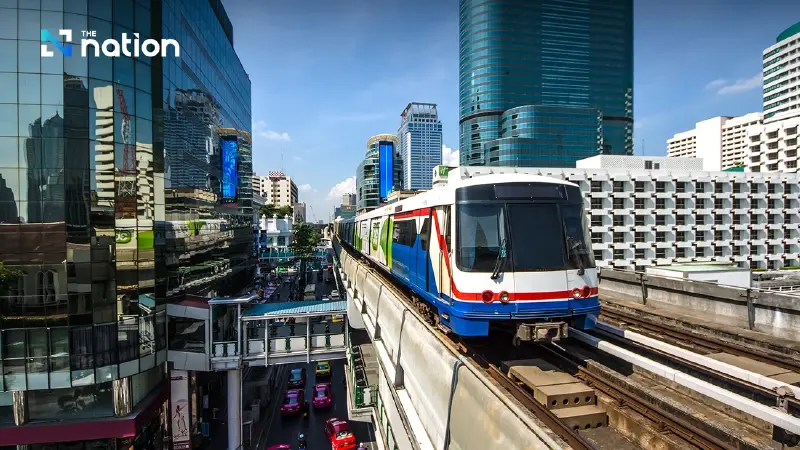


The ministry is weighing broader fare relief and targeted support for public and freight transport operators as rising oil prices drive up costs.
- The Ministry of Transport is introducing a fare reduction package for public transport, including electric rail, buses, and passenger boats, to ease travel costs amid the energy crisis.
- For the electric rail system, officials are considering a 40-baht all-day flat fare or a zoning system, with the 40-baht fare already being piloted on the Purple and Red lines.
- The long-term sustainability of the fare package is dependent on new legislation, the Rail Transport Act and the Joint Ticket Management Act, to create a common ticketing system.
- As an immediate measure, the ministry has frozen public transport fares for the Songkran holiday and is considering direct aid for operators affected by rising oil prices.

Phiphat Ratchakitprakarn, Minister of Transport, led three deputy transport ministers in paying respects to the ministry’s sacred shrines on April 7, 2026, before officially starting work on their first day.
Phiphat said the ministry was ready to move ahead with policies aimed at improving people’s quality of life and stimulating the national economy amid the energy crisis and the global economic crisis. After taking the oath, he said, the Prime Minister had instructed ministers from all ministries to begin work at the same time without waiting for an auspicious date or time, as the first day of work itself was the most suitable and auspicious moment to solve people’s problems.
The Ministry of Transport has a public transport fare reduction package covering electric rail services, buses and passenger boats to help ease people’s travel costs.
At present, the Mass Rapid Transit Authority of Thailand (MRTA) and the Department of Rail Transport (DRT) are considering either a 40-baht all-day fare or a zoning system.
The latest review is focusing on which model would offer the best value and greatest savings for passengers, with a view to expanding the policy to other rail lines.

At present, the 40-baht fare measure has already been introduced on a pilot basis on the Purple Line and the Red Line, where passenger numbers have risen to a satisfactory level.
However, the key flagship policy that would make the measure sustainable is the push for the Rail Transport Act 2025 and the Joint Ticket Management Act 2025. Both have already been approved by the Senate and are now awaiting subordinate legislation.
After that, the Ministry of Transport will prepare to submit them to the Cabinet for immediate promulgation.
These laws will help reduce costs across the entire mass transit system on land, water and rail.
On the proposed buyback of electric rail concessions, Phiphat said this would be necessary to manage the common ticketing policy and system.
Discussions are currently underway with private concessionaires, but as several private companies are involved, it will take time to reach a suitable joint conclusion.
Phiphat added that measures to help the public transport sector affected by the war in the Middle East, which has caused oil prices to rise continuously, were being considered from several angles in order to assist operators, whether in freight transport or mass transit.
Assistance would be considered according to the level of hardship faced by each sector, which is not the same, given the rapid rise in oil prices.
This includes reviewing whether the support criteria should be adjusted and what form of subsidy the government should provide.
During Songkran 2026, the Ministry of Transport has a clear policy that there will be no fare increases of any kind in order to reduce the burden on people travelling during the holiday.
The Department of Land Transport and Transport Co., Ltd. have been assigned to use funds to support and compensate for the difference, with the Ministry of Transport taking responsibility for overseeing this.
“Budget is now the most important factor.
We need to hold close discussions and work with the Ministry of Finance to conclude the budget that will be used for compensation or assistance in each area.
We expect to announce the various measures immediately after the government’s policy statement has been completed,” Phiphat said.
Phiphat added that budget cuts to respond to the current energy crisis could affect budget allocations for 2027, as funds are limited.
If the budget is insufficient, the ministry will initially have to find other channels or management methods to help ensure that its policies can continue to move forward as planned.
As for budget preparations, the Ministry of Transport will immediately propose the 2027 budget framework at the first Cabinet meeting, as it already has clear investment plans in place.
