
80 Years On: Ex-Japanese soldier considered himself expendable
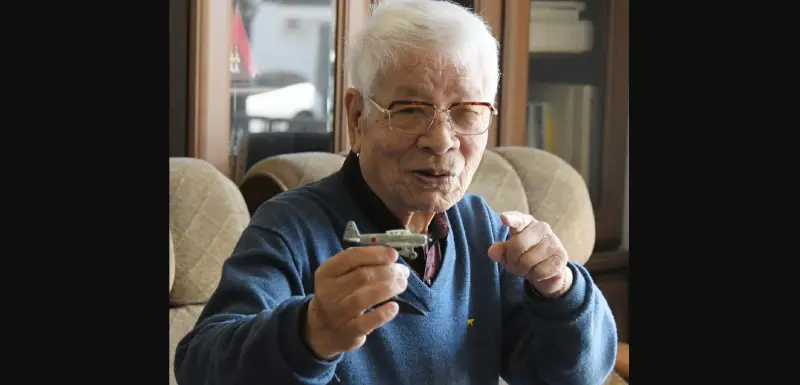


Yoshihiko Kagami, a 98-year-old former soldier of the now-defunct Imperial Japanese Army, recalls receiving a de facto kamikaze suicidal attack order on the eve of the country's defeat in the Pacific War, part of World War II, saying, "We were expendables."
The order was cancelled hours after the issuance, and Japan surrendered. Kagami, a resident of Tokai, Aichi Prefecture, central Japan, stresses that wars should never be waged.
Born in Gifu Prefecture, adjacent to Aichi, as the ninth son of a farming family, Kagami entered the Imperial Japanese Army's air communication school when he was 16 and was trained across various locations.
In the spring of 1945, he was informed in Fukuoka Prefecture, southwestern Japan, that he would be assigned to the 66th squadron.
He was initially directed to the Chiran airfield in Kagoshima Prefecture, south of Fukuoka, but upon arrival, he discovered that the squadron was based at the Bansei airfield in Kagoshima. From this confusion, Kagami learned that the situation facing the Imperial Japanese Army was deteriorating.
The 66th squadron's primary mission was to attack a US fleet off Kadena Bay, Okinawa Prefecture, southern Japan, and guide Japanese kamikaze suicide attack planes.
All Kagami heard from fellow air communication personnel, who used to sit in the backseat of Type 99 assault aircraft, was about the difference in firepower between Japan and its enemy.
Kagami and fellow soldiers decided to send a farewell signal over the radio when they would crash into an enemy ship. But a fellow soldier who made a sortie did not return with any such signal.
He still remembers an elderly woman kneeling on the roadside and saying that soldiers are gods who protect Japan. He received special treatment, such as being able to eat white rice, which made him believe that he had to do anything, no matter what order was given.
Later, the 66th squadron was transferred to the Tachiarai airfield in Fukuoka. But Japan's air supremacy had already been taken away.

Kagami was once machine-gunned by US aircraft and saw two Japanese planes shot down in an air battle. A few of the soldiers who had flown away returned.
On the evening of Aug. 14, 1945, Kagami was told to attack enemies the next morning. Although he was not a kamikaze pilot, his superior officer told him that it would be a suicidal attack.
He accepted the order and wrote a postcard to his parents with his hair and nails in an envelope on behalf of his remains.
"This will be my last letter," he wrote. "It seems that it will be difficult to come back alive this time."
"I'm sorry that I couldn't do anything good for you," he added.
After Kagami had a sleepless night, an order was given to stop the attack. He did not understand Emperor Hirohito's radio broadcast announcing Japan's surrender, aired at noon on Aug. 15, due to static. He learned a few hours later that the war was over.
He became emotional and brandished a Japanese sword in a bamboo grove while screaming.
"It was a pity," he recalls. The following day, he sank a communication device, which was removed from the aircraft upon instruction, into a pond, and burned the encryption table he used.
When he went back to his parents' home, he found his "will" postcard hanging on a Buddhist altar. His parents welcomed him with surprise and delight.
After that, he was invited to join the national police reserve, the predecessor of the Self-Defence Forces, but he refused as he did not want to go to war again. Kagami worked until retirement at a steel company.
"We were expendables," he said, stressing that kamikaze missions were a "really tragic operation."
"War must never happen again," he added.

[Copyright The Jiji Press, Ltd.]
