
US Supreme Court backs Trump on aggressive immigration raids
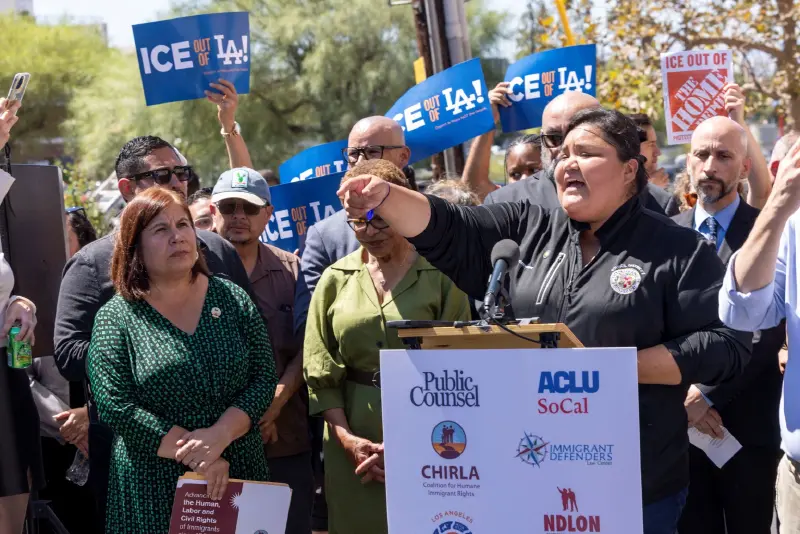


The US Supreme Court on Monday sided once more with President Donald Trump’s aggressive immigration stance, allowing federal agents to resume raids in Southern California that critics say openly target people based on race or language. Liberal justices warned the ruling effectively makes Latinos “fair game to be seized at any time.”
The court temporarily blocked a lower court order that had prohibited immigration officers from detaining individuals without reasonable suspicion of illegal presence, including cases where ethnicity, skin colour, or accented speech were the deciding factors.
California’s Democratic governor, Gavin Newsom, lambasted the ruling, accusing the court of legitimising racial persecution. “Trump’s hand-picked Supreme Court majority just became the grand marshal for a parade of racial terror in Los Angeles,” he said, noting the former president appointed three of the six conservative justices now on the bench.
The unsigned order provided no reasoning, but its effect is immediate: agents may resume sweeping raids while a lawsuit filed by Latino plaintiffs, some of them US citizens, remains unresolved. The administration vowed to continue “roving patrols.” Trump, who returned to power in January, had promised a crackdown on immigration, and heavily armed raids in Los Angeles earlier this year triggered street protests, prompting him to deploy military troops in June.
Justice Sonia Sotomayor, the court’s first Hispanic member, issued a fiery dissent joined by the other two liberal justices. She warned that the administration had effectively declared that “all Latinos, US citizens or not, who work low-wage jobs are fair game to be seized at any time.” She concluded: “Rather than stand idly by while our constitutional freedoms are lost, I dissent.”
US District Judge Maame Frimpong had ruled in July that the government’s practices likely violated the Fourth Amendment ban on unreasonable searches and seizures, halting raids based on race, language, or occupation. That injunction, which had applied to much of Southern California, was upheld by the 9th Circuit Court of Appeals in August before being overturned by the Supreme Court.
Newsom accused Trump’s team of waging an assault on California families and small businesses, claiming this was less about enforcing immigration law than about persecuting anyone who “doesn’t look or sound like Stephen Miller’s idea of an American.” Miller, Trump’s senior aide and the architect of the deportation surge, had earlier set a target of 3,000 arrests per day.
Trump’s attorney general, Pam Bondi, celebrated the ruling as a “massive victory,” writing online that immigration officers could now carry out patrols “without judicial micromanagement.”
The lawsuit, brought by several Latino residents, including citizens, describes people with brown skin being confronted by masked agents, forced to answer questions about their identity and origin under intimidation. Civil rights groups condemned the ruling as a major setback. Mohammad Tajsar of the ACLU of Southern California said communities had endured months of harassment “because of the colour of their skin, the jobs they hold, or the language they speak.”
Conservative Justice Brett Kavanaugh, concurring with the decision, argued that ethnicity alone should not suffice as suspicion but could still be considered alongside other factors. He stressed that citizens or legal residents stopped in such raids would be released once identified.
This case is part of a broader pattern in which the high court has allowed Trump’s contested immigration measures to go forward, including fast-track deportations and the removal of humanitarian protections for hundreds of thousands of migrants. His raids have already spurred widespread fear, lawsuits, and unprecedented military involvement in Los Angeles, which state and city officials decried as unlawful.

Workers say Korea Inc was warned about questionable US visas before Hyundai raid
Hundreds of South Korean specialists were swept up in a massive immigration raid in the United States last week, despite earlier warnings from colleagues and lawyers that their paperwork might not withstand Washington’s tougher stance under President Donald Trump.
For years, South Korean manufacturers have complained about the difficulty of securing short-term work visas for engineers needed to set up and maintain advanced production lines in the US. Many had grown accustomed to a more relaxed approach to visa enforcement under previous administrations. That changed early in Trump’s second term, when workers arriving under visas that did not permit employment began to face rejection at American airports.
The shift culminated on Thursday, when federal agents detained more than 300 South Koreans, out of 475 people, during a raid at Hyundai Motor’s new car battery facility near Savannah, Georgia. It was the largest single-site immigration enforcement action ever carried out by the Department of Homeland Security’s investigative arm.
Most of those held were subcontractor staff dispatched to install factory equipment. They had entered the country under the visa waiver scheme or B-1 business visitor visas, both of which generally prohibit hands-on work. “Getting H-1B visas for battery engineers is extremely difficult,” said Park Tae-sung, vice chairman of the Korea Battery Industry Association. “That’s why some end up travelling on B-1 visas or ESTA.”
A worker at the Georgia site told Reuters the practice had become routine. “It was a red flag everyone ignored. They get around the rules and keep working,” he said, requesting anonymity.
Warnings ignored
Technicians back in South Korea said they had pleaded with colleagues not to take the risk. “I told them they could ruin their lives if they were caught,” said one, who had himself once obtained a B-1 visa by claiming to be a supervisor instead of a technician. Another, contracted through LG Energy Solution (LGES), said his B-1 application was rejected earlier this year. When he tried to reach the US by flying to Mexico, he was denied boarding in Seoul. “We thought the US was our ally,” he said. “But they treat me like an illegal immigrant.”
LGES, Hyundai’s partner on the battery plant, acknowledged long-standing visa problems and said it had been working with law firms to brief staff and subcontractors to avoid violations. It confirmed that 47 of its workers were detained in the raid and subsequently advised others in the US either to return home or remain in hiding. Hyundai, for its part, stressed that it had “zero tolerance for those who don’t follow the law” and promised to investigate supplier practices. Neither company said any of Hyundai’s direct employees were detained.
Diplomatic fallout
The incident has rattled Seoul, which is one of Washington’s largest sources of foreign investment. South Korean officials said contractors had often resorted to the ESTA scheme to meet urgent deadlines, only to find themselves turned away at the border. Seoul has been lobbying for a dedicated US visa track for skilled industrial workers, similar to arrangements already in place for Australia and Singapore.
Foreign Minister Cho Tae-yul left for Washington on Monday with visa reform high on the agenda. The issue comes as Trump urges Asian companies to build more in America, while at the same time insisting they must hire and train US citizens. On Sunday, he suggested he might allow foreign specialists temporary entry to train American workers, but stopped short of promising broader visa changes.
‘Cutting corners’
US officials had already cautioned Korean firms against exploiting loopholes. “Please do not put your employees or the employees of your contractors at risk,” Andrew Gately of the Commerce Department told a seminar in Seoul last year.
The Georgia detainees are expected to be released and deported. But the scale of the raid has cast a long shadow over the future of South Korean investments in the US and highlighted the fragile balance between Washington’s drive for foreign capital and its increasingly uncompromising immigration regime.
Reuters
