
G20 split as South Africa pushes through declaration over US objections
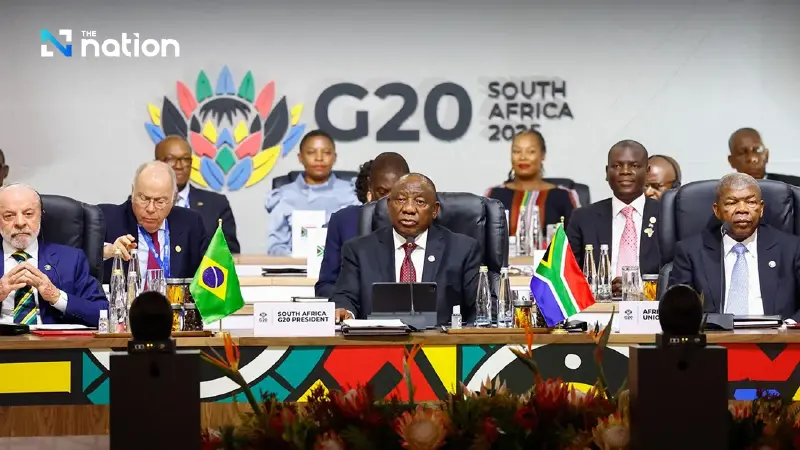


Global tensions flared at the G20 summit in Johannesburg on Saturday after member states endorsed a leaders’ declaration on climate action and global challenges, despite strong resistance from the United States, which accused South Africa of exploiting its role as this year’s chair.
- South Africa, as G20 host, finalized and adopted a summit declaration without US participation, announcing the text was non-negotiable despite American objections.
- The primary source of the dispute was the declaration's commitments to addressing climate change, supporting renewable energy, and providing debt relief, all of which the Trump administration opposed.
- The White House accused South Africa of breaking the G20's tradition of full consensus, claiming Pretoria had "weaponised" its presidency.
- The split was widened when Argentina, a US ally, also withdrew its support at the last minute over references to geopolitical issues.
South Africa announced that the text had been finalised without US participation and could not be reopened, highlighting deep strains between Pretoria and the administration of US President Donald Trump, which refused to attend the meeting. President Cyril Ramaphosa’s spokesperson, Vincent Magwenya, said negotiators had spent the year working toward the agreement and concluded an “intense” final week of talks.
The White House reacted sharply, claiming Ramaphosa had undermined G20 norms by refusing to oversee a standard handover process and by insisting on issuing a declaration Washington had repeatedly opposed. White House spokeswoman Anna Kelly said South Africa had “weaponised” its presidency, and that Trump intended to “restore legitimacy” to the group when the United States takes over the rotating presidency next year.
Ramaphosa insisted there had been “overwhelming consensus” to adopt the document. But South African officials revealed that Argentina, led by far-right president and Trump ally Javier Milei, abruptly withdrew from the final negotiations moments before adoption. Argentina’s Foreign Minister Pablo Quirno said Buenos Aires could not support the document’s references to geopolitical issues, particularly its brief mention of the Middle East conflict, which he argued failed to reflect its complexity.

Climate language at the heart of US resistance
The declaration, drafted on Friday without Washington’s input, contained commitments long opposed by the Trump administration: acknowledgement of the seriousness of climate change, support for renewable-energy expansion and concern over the crushing debt burdens of poorer nations. US officials had signalled they would block any mention of climate change, a stance consistent with Trump’s doubts over the scientific consensus on human-driven warming.
A senior US official criticised Pretoria for breaking with what Washington calls the G20’s tradition of issuing only fully consensual statements.
Ramaphosa, opening the summit, urged members not to diminish the significance of the first G20 hosted by an African nation. His assertive tone contrasted with his restrained demeanour during a visit to the White House earlier in the year, where Trump repeated a debunked claim about the “genocide” of white farmers in South Africa.

Broader geopolitical tensions
The summit took place against the backdrop of Russia’s war in Ukraine and discord in climate negotiations ahead of COP30 in Brazil. Japan’s cabinet public affairs secretary, Maki Kobayashi, noted that the G20’s diversity “underscores the importance of finding common ground.”
Despite Argentina’s last-minute withdrawal, Magwenya said the group achieved “sufficient consensus” to adopt the text.
South Africa’s agenda, focused on solidarity with developing countries, climate resilience, clean-energy transitions and lowering debt costs, was also dismissed by Trump, who argued the G20 should not centre on the host nation’s priorities.
South African Foreign Minister Ronald Lamola rejected that argument outright, saying, “This G20 is not about the US. We are equal members, and those present must make decisions about the direction of the world.”
Europe also expressed its own concerns. European Commission President Ursula von der Leyen warned about “the weaponisation of dependencies,” seen as an implicit reference to China’s restrictions on critical minerals needed for renewable energy and high-tech industries.
China’s Premier Li Qiang urged members to rebuild cooperation, saying fractured global coordination and diverging interests were major hurdles to unity.
Diplomatic spat over the G20 handover
Tensions escalated further when the US attempted to send its chargé d’affaires to accept the transfer of the G20 presidency, something Pretoria rejected as a breach of protocol. Magwenya said Ramaphosa would not hand over to a “junior embassy official.”
Lamola later clarified that South Africa would assign a diplomat of equivalent rank to complete the handover at the Foreign Affairs Department.
Reuters
