
South Africa’s G20 Summit 2025: The quest for a stable new world order amidst deepening global tensions
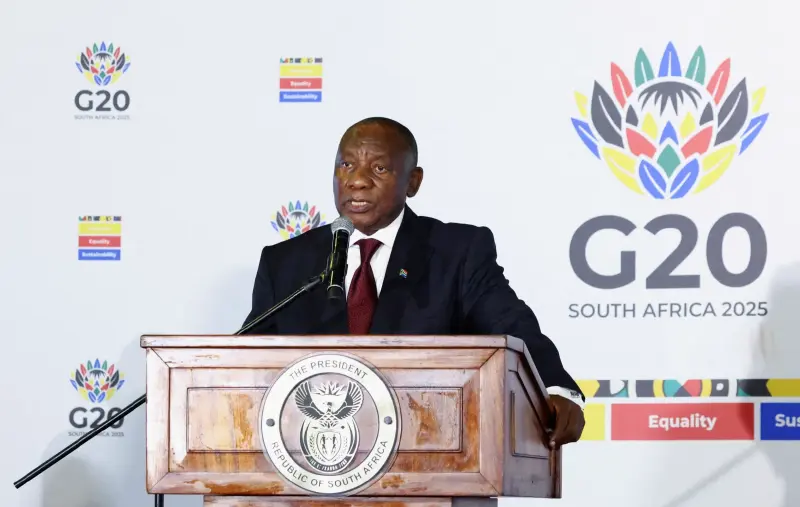


South Africa’s G20 Presidency takes place at a time when the world is facing a series of overlapping and mutually reinforcing crises.
The country assumed its Presidency after taking over from Brazil on the 1st of December 2024, the first African country to host this auspicious event and the 5th BRICS member to do so after Brazil, Russia, China and India have had their chances. South Africa took over the G20, when multilateralism is under tremendous pressure and a rules-based global order is under serious threat.
The central role of the United Nations (UN) in international affairs is being tested and, at worst, undermined by some amongst us, 80 years later. The United States' dominance is declining, and consequently, it is abandoning its global role, negatively impacting the global system it was central in creating.
But multilateralism is unlikely to collapse, despite the increasing global uncertainties.
The sheer heft of the G20, which represents approximately 85% of the world’s GDP, more than 75% of the world’s trade and around two-thirds of the world’s population, makes it a significant and influential bloc.
The African Union became a full member of the G20 in 2023, during India’s G20 Presidency, following South Africa’s lobbying and India’s support. South Africa’s Presidency is building on the successes of the three presidencies led by the Global South, Indonesia in 2022, India in 2023 and Brazil in 2024.
This is a unique opportunity for South Africa to champion the aspirations of emerging economies, including the African continent.
To tackle the global polycrisis, South Africa has embraced the theme ‘Solidarity, Equality, Sustainability for its G20 Presidency.
It is with the spirit of Ubuntu that South Africa approaches the G20. This African philosophy emphasises the interconnectedness of individuals within a broader society. It is becoming obvious that South Africa could be the last country to host an inclusive G20.
The prospect for a productive and inclusive G20 in the future is diminishing in the new low we are experiencing in international relations, and the space for debate, visionary leadership, and inclusivity is getting narrower.
South Africa has invited 13 countries, including Nigeria, Denmark, Egypt, Finland, Singapore, Algeria, the Netherlands and the United Arab Emirates.
The International Monetary Fund (IMF), the World Bank (WB), the United Nations and eight African regional organisations have also been invited.
This is a very positive response by South Africa and a demonstration of global leadership in a complex and rapidly changing world.
The geopolitical context in which South Africa is hosting the G20 is characterised by a subdued global economic growth, unsustainable levels of debt of many economies globally, conflicts and wars, rising nationalism, unilateralism, protectionism, and faltering and weak international cooperation.
The importance of the G20 Presidency for South Africa and Africa is to use the event to support emerging and developing economies to achieve inclusive and equitable sustainable development, to promote global stability and security.
It will also be used, amongst others, to mobilise predictable, sustainable and low-cost financing for sustainable development, contribute significantly to reinvigorating and strengthening multilateralism and creating consensus around issues that affect our collective future.
The inclusion of the African Union in the G20 is an opportunity to amplify Africa’s voice in global economic governance, whilst ensuring that the development priorities of the African continent and the Global South find expression firmly and permanently on the agenda of the G20.
The African Union’s six priorities for its participation in the G20 all find expression in South Africa’s theme, high deliverables and the priorities to be advanced in the various working groups under both the Sherpa and Finance Tracks.
Under its G20 Presidency theme, South Africa is advancing the following four overall priorities:
- Strengthening disaster resilience and response,
- Ensuring debt sustainability for low-income countries,
- Mobilising finance for a just energy transition,
- Harnessing critical minerals for inclusive growth and sustainable development
During its Presidency, South Africa will also review the work of the G20 called ‘The G20 at 20 years: A Reflection on Key Achievements and the Way Forward.
This will entail a high-level, qualitative assessment of progress against the G20’s key commitments and targets since 2008. The review will also look at ways to ensure that the G20 is fit for purpose and able to coordinate global response to crises. A review of the cost of capital will be undertaken.
The overarching goal of this initiative will be to investigate the issues that impair the ability of low- and middle-income countries to access sufficient, affordable and predictable flows of capital to finance their environmentally responsible and society-inclusive development plans.
Building on the German G20 Presidency’s Compact with Africa deliverable, South Africa is working with all G20 members to pursue a broadened and elevated G20 Compact with Africa.
The Compact will support Africa’s ambition to mobilise domestic and international savings through an improved investment framework. Germany and South Africa will co-host a high-level Compact with Africa event in Addis Ababa.
Egypt hosted the first-ever G20 Food Security Task Force meeting outside a member state in September 2025, focusing on global food system challenges like inflation, climate shock and geopolitical pressures under South Africa’s presidency.
The G20 members have reaffirmed efforts to support developing countries in responding to global crises and challenges and achieving the Sustainable Development Goals (SDGs).
South Africa’s G20 Presidency has also received a positive reception from the global community, business, academics and the public. The EU has also endorsed South Africa’s G20 Presidency and pledged its unwavering support.
Whilst South Africa is working very hard to engender consensus regarding the outcome of the Leaders Summit in November 2025, it is anticipated that issues such as Diversity, Equity and Inclusion (DEI), climate change, global health, wealth tax on the super-rich and trade will be contested.
South Africa, after its successful run of the 2025 G20 and aiming to contribute to a stable and fairer global order, will hand over to the United States of America to host the 2026 G20 Summit.
Darkey Africa
Ambassador of South Africa in Thailand
