
EU vows Arctic security work with US as Trump eyes Greenland
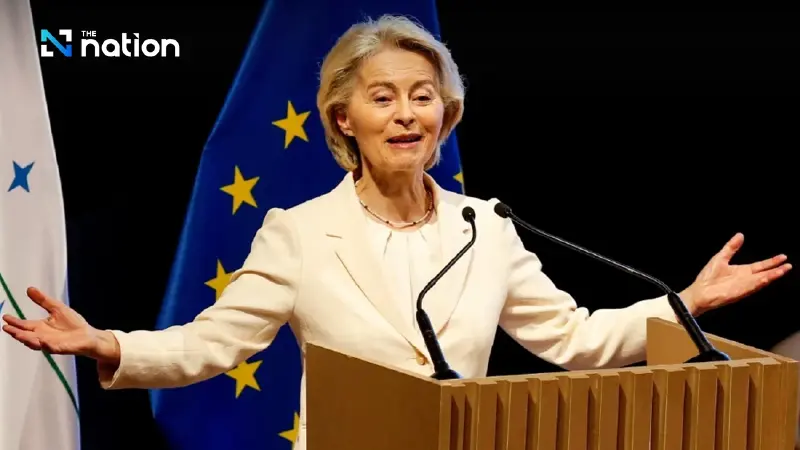


Von der Leyen said the EU would deepen support for Greenland while keeping Arctic security cooperation with Washington.
- The European Union has pledged to continue security cooperation with the United States in the Arctic, while also increasing its political and economic support for Greenland in response to President Trump's interest in the territory.
- Amid rising tensions, several European countries, including France and Germany, are sending a military reconnaissance mission to the Greenland area at Denmark's request.
- The European Commission has affirmed that Denmark could invoke the EU's mutual assistance clause, which would legally obligate other member states to provide aid and assistance if Greenland were subjected to an armed attack.
- Despite talks between US and Danish officials, a "fundamental disagreement" over Greenland remains, prompting the creation of a high-level working group to find a resolution.
European Commission President Ursula von der Leyen said the European Union will continue cooperating with the United States on Arctic security, even as US President Donald Trump repeats threats to take Greenland from Denmark.
Speaking during an official visit to Limassol, Cyprus, von der Leyen said the EU has built a strong standing in Greenland and wants to deepen cooperation there.
Standing alongside Cypriot President Nikos Christodoulides as Cyprus began its EU Council presidency, she said the bloc would increase investment and collaboration with Greenland, stressing that the territory can rely on EU political, economic and financial backing.
Trump has portrayed his push for control of Greenland as a national-security move.
He argued on Wednesday that NATO would be stronger if Greenland were under US control, and claimed Russia and China would otherwise gain in the strategically important region.
He posted the comments on Truth Social.
Denmark–US talks and a “working group”
Trump’s remarks came as Danish and Greenlandic officials held talks in Washington with US Secretary of State Marco Rubio and US Vice President JD Vance.
After the meeting, Danish Foreign Minister Lars Løkke Rasmussen described the discussions as direct and constructive, but said the two sides still had a “fundamental disagreement”.
He said Denmark had not shifted the US position, and added that Copenhagen and Washington agreed to form a high-level working group to seek a “common way forward” on Greenland.
Rasmussen also pushed back against Trump’s claim that Chinese warships had made gains around the island.
European reconnaissance mission
As tensions rose, several European countries publicly said they would send military officers for a reconnaissance mission linked to Greenland, at Copenhagen’s request.
Countries cited as joining include France, Germany, Sweden, Norway and the Netherlands.
Von der Leyen said Arctic security discussions are primarily a NATO matter, but emphasised that the Arctic is also a core EU concern.
EU mutual assistance clause and Greenland
Separately, the European Commission confirmed that Denmark could, in principle, rely on the EU’s mutual assistance clause if Greenland were subjected to an armed attack, even though Greenland is not part of the EU.
A Commission spokesperson told Euronews that Greenland forms part of the territory of the Kingdom of Denmark and is therefore, “in principle”, covered by Article 42.7 of the Treaty on European Union (TEU).
The spokesperson added that the issue is not currently triggered because Trump’s threats have not translated into action.
Article 42.7 TEU says that if an EU country is the victim of armed aggression on its territory, other member states must provide aid and assistance “by all the means in their power”, in line with the UN Charter’s right of collective self-defence.
The treaty text does not specify exactly what assistance must look like, and an explanatory Commission note says support could be diplomatic, technical, medical or civilian, while also allowing for military help.
The memo adds that activation requires an attack “from abroad”, and the decision to invoke the clause rests with the member state under assault; once invoked, the duty to assist becomes legally binding.
Since being introduced in 2007, Article 42.7 has been used only once, when France invoked it after the November 2015 terrorist attacks, requesting support for Opération Sentinelle.
Overlap, and uncertainty, with NATO Article 5
Article 42.7 is closely linked to NATO’s Article 5, the alliance’s collective-defence pledge.
Unlike the EU clause, NATO’s Article 5 explicitly refers to measures that can include the use of armed force.
However, because both the United States and Denmark are NATO members, there is no clear precedent for how Article 5 would apply if the US were to violate Danish sovereignty and seize Greenland by force.
A similar dilemma inside NATO was highlighted in 2020, when Turkey and Greece faced off over contested gas exploration, bringing two NATO allies close to confrontation.
Euronews
