
Trump threatens tariff hikes on eight European states in push for Greenland
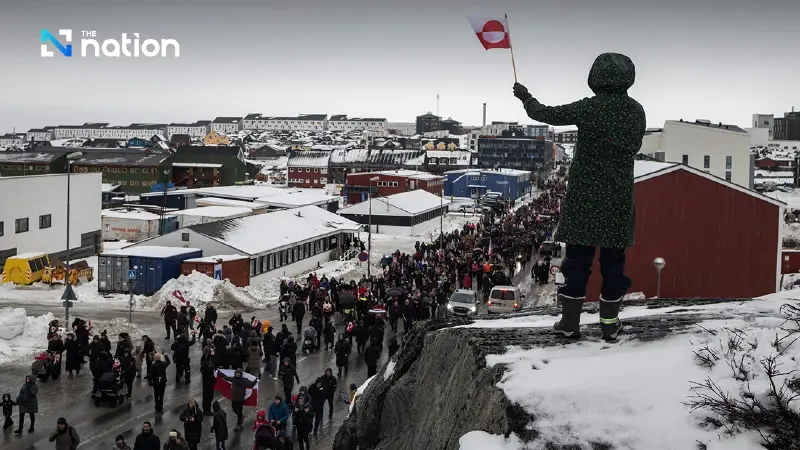


Trump has threatened escalating tariffs on eight European countries unless the US is allowed to buy Greenland, prompting Denmark and the EU to warn of damage to transatlantic ties and NATO unity.
- President Trump is threatening to impose escalating tariffs on eight European nations as leverage to pressure Denmark into selling Greenland to the US
- The proposed tariffs would start at an extra 10% on February 1 and increase to 25% on June 1, targeting Denmark, Norway, Sweden, France, Germany, the Netherlands, Finland, and Great Britain.
- Trump's push for Greenland is driven by its strategic location and mineral resources, which he deems critical to US national security.
- Leaders in Denmark and Greenland have rejected the sale, and European allies have condemned the tariff threat, warning it could damage the NATO alliance.
US President Donald Trump on Saturday (January 17) threatened a rising series of import tariffs on several European allies, saying the measures would stay in place until Washington is allowed to buy Greenland, a sharp escalation in a dispute over Denmark’s vast Arctic territory.
Writing on Truth Social, Trump said an extra 10% tariff would be imposed from February 1 on goods from Denmark, Norway, Sweden, France, Germany, the Netherlands, Finland and Great Britain. All are already subject to duties introduced by his administration, he said.
Trump added that the rate would climb to 25% from June 1 and remain there until an agreement is reached for the United States to purchase Greenland.
The US president has repeatedly insisted he wants ownership of Greenland, an autonomous territory within the Kingdom of Denmark. Leaders in both Denmark and Greenland have rejected the idea, saying the island is not for sale and does not want to become part of the United States.
A Reuters/Ipsos poll of US adults published this week found fewer than one in five respondents support the idea of acquiring Greenland.

Security and minerals
Trump has argued Greenland is critical to US security because of its strategic location, as well as its mineral resources. He has not ruled out using force to take the territory, and European countries this week dispatched military personnel to the island at Denmark’s request.
“These countries… have put a level of risk in play that is not tenable or sustainable,” Trump wrote.
In Denmark and Greenland, demonstrators rallied on Saturday against Trump’s demands, calling for the territory to decide its own future without outside pressure.
Countries named in Trump’s post reiterated support for Denmark, warning that any US move to seize territory from a NATO member would risk shattering the alliance led by Washington.
Denmark’s Foreign Minister Lars Løkke Rasmussen said in a statement that the announcement had come as a surprise.
British Prime Minister Keir Starmer, unusually forthright, condemned the threat on X and said London would raise the issue directly with Washington.
“Applying tariffs on allies for pursuing the collective security of NATO allies is completely wrong,” Starmer wrote.
European Commission President Ursula von der Leyen and European Council President António Costa posted separate but identical messages on X saying the European Union stood in “full solidarity” with Denmark and Greenland.
They warned tariffs would damage transatlantic ties and could trigger a dangerous spiral, adding that Europe would stay united and coordinated in defending its sovereignty.
Officials from Norway, Sweden, France and Germany also restated their backing for Denmark on Saturday and said tariffs should not be tied to talks on Greenland.
Cyprus, which currently holds the EU presidency, said it had called an emergency meeting of ambassadors from the bloc’s 27 member states for Sunday.
Trade arrangements at risk
Economists and trade analysts said the threat could disrupt tentative trade understandings Trump struck last year with the European Union and Great Britain, including baseline duties of 15% on European imports and 10% on most British goods.
William Reinsch, a trade expert at the Centre for Strategic and International Studies, said the most serious risk was Trump’s apparent readiness to treat some EU states differently from others, something that could harden opposition in the European Parliament to approving any US–EU agreement.
Trump first floated the idea of Greenland-linked tariffs on Friday, without setting out a legal basis. Tariffs have become one of his main tools for pressuring both adversaries and allies.
He also said this week he would impose 25% tariffs on any country trading with Iran, citing Tehran’s crackdown on anti-government protests. However, Reuters reported there has been no official White House documentation of that policy on its website, nor any explanation of the legal authority Trump would rely on.
The US Supreme Court has heard arguments over the legality of Trump’s broad tariff approach — a ruling that could carry significant implications for global markets and the reach of presidential powers.
Trump has said the growing presence of China and Russia makes Greenland strategically important. Danish and other European officials have countered that Greenland is already covered by NATO’s collective defence commitments.
The United States already operates the Pituffik Space Base in Greenland, with about 200 personnel, and a 1951 agreement allows Washington to deploy additional forces in the Danish territory.
Those arrangements have led many European officials, Reuters said, to conclude Trump’s push is driven more by a desire to expand US territory than by security concerns.
EU foreign policy chief Kaja Kallas said on X that China and Russia would benefit from divisions among allies.
In Washington, some senators also criticised the approach. Senators Jeanne Shaheen and Thom Tillis, the bipartisan co-chairs of the Senate NATO Observer Group, said in a statement that continuing down this path would be bad for the United States, American businesses and US allies.
Carsten Brzeski, global head of macro at ING Research, urged European leaders not to respond hastily, telling Reuters they should wait to see how the threat develops, while noting tariffs would still be a step down from earlier talk of military action.
Reuters
