
Indonesia eyes Italian aircraft carrier, but analysts wonder if it risks becoming a ‘port queen’
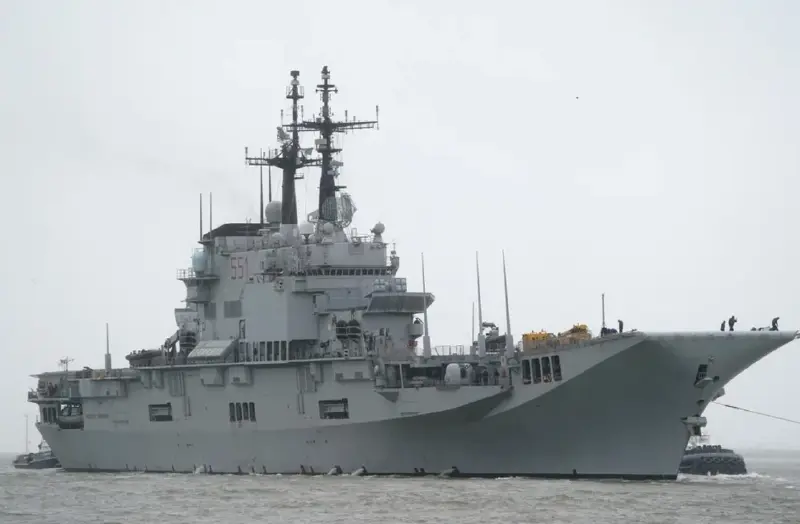


Indonesia’s plan to bring home its first aircraft carrier in 2026 has an undeniable cinematic quality – a 180m warship, long retired by a European navy, retrofitted and returning to life in South-east Asia as a floating runway and command post.
What many will be watching now is not just the ship’s arrival, but also how Indonesia intends to use it, including how often it will sail, what aircraft it will carry, and whether Jakarta can afford to keep such a complex platform operational over the long term.
With the Giuseppe Garibaldi, Indonesia will join just a handful of Asian countries, such as China, India and Thailand, that operate an aircraft carrier. But military experts and maritime defence analysts told The Straits Times that it remains unclear whether the ship will meaningfully shift the regional balance of power or risk becoming a “port queen”, which is navy slang for an impressive vessel that spends most of its time tied up at base.
National news agency Antara reported on Feb 13 that the carrier, which was commissioned in 1985 and was in service with the Italian Navy from 1985 to 2024, will be transferred to Indonesia by the Italian government as a grant.
Negotiations and administrative processes related to the vessel are ongoing between both governments, with the carrier expected to arrive before Oct 5, the anniversary of the Indonesian National Armed Forces.
Strategic value
Given how aircraft carriers are among the most complex and visible military platforms a country can operate, analysts expect Indonesia’s acquisition to be seen as a milestone moment for its navy, which is considered one of the strongest in the world.
According to the 2023 World Directory of Modern Military Warships report, Indonesia ranked fourth among 36 countries – after the United States, China and Russia – surpassing many established, larger nations. Its position was driven by a diverse inventory of more than 200 active, modern and locally supported vessels.
Thailand was the first country in Southeast Asia to operate an aircraft carrier, purchasing HTMS Chakri Naruebet from Spain in the 1990s. Commissioned in 1997, the ship has been deployed for disaster relief, including after the 2004 Indian Ocean tsunami and major floods.
Indonesian officials have emphasised that the ship would be used primarily for what is known as military operations other than war. This means that it will not be used for violence, but instead for non-combat missions, including humanitarian assistance and disaster relief. But independent defence analyst Muhammad Fauzan Malufti noted that this emphasis is unusual.
Aircraft carriers are usually bought to carry and deploy combat aircraft at sea, with disaster relief treated as an added benefit. Mr Fauzan said that presenting it mainly as a humanitarian tool raises questions about whether Jakarta plans to develop the aircraft and support systems needed to make the ship truly useful strategically.
“At the end of the day, it is a naval platform. Therefore, its main value should be in generating aviation-based combat power. Humanitarian assistance and disaster relief are important, of course, but usually, that is seen as a secondary benefit of buying an aircraft carrier, not the main reason to buy one,” he added.
Analysts say the move is widely seen as part of Indonesia’s broader effort to strengthen and modernise its navy.
Dr Collin Koh, a senior fellow at the S. Rajaratnam School of International Studies (RSIS), said: “The acquisition of the carrier, prima facie, is aimed at bolstering Indonesia’s naval capability.”
But he noted that there is debate in Indonesia over whether the carrier truly serves the country’s strategic objectives, as much depends on what missions it is actually meant to perform and whether those missions can be met more cheaply and reliably with other naval assets.
Dr Koh noted that an aircraft carrier could, “in theory”, alter Indonesia’s overall defence posture.
“The reason why I deliberately said that it would shift the posture in theory is (that) given the platform is a force projection asset, it may convey the impression that the Indonesian defence posture has turned from defensive to offensive,” he said.
In practice, however, Indonesia’s military structure and doctrine still prioritise defending the archipelago rather than projecting power beyond it, added Dr Koh, who is from RSIS’ Institute of Defence and Strategic Studies. “The carrier, given Indonesia’s longstanding foreign policy and security doctrine, would not practically alter the country’s overall defence posture.”
Limited use
A big question on analysts’ minds is what aviation capability the ship would field, given how Indonesia’s naval air arm remains relatively limited. Mr Pieter Pandie, a researcher at Indonesian think-tank Centre for Strategic and International Studies, said aircraft carriers only strengthen defence posture if deploying them translates into actual capabilities and strategic objectives.
“Carriers are incredibly complex and expensive to operate, even for major powers such as the United States, creating significant consequences as well for Indonesia’s defence budget and operational capabilities,” he said.
The 180.2m-long ship can travel at speeds of up to 56kmh and is powered by four gas turbines.
It was designed to operate both short take-off and vertical landing aircraft, as well as helicopters, and is equipped with radar jammers and weapons such as anti-aircraft missiles, surface-to-surface missiles and torpedoes.
During its service with the Italian Navy, the Giuseppe Garibaldi was reportedly operated by a crew of about 800 personnel. Mr Pieter said maintaining an aircraft carrier carries high costs as it requires specialised trained personnel.
“The resources that may go into acquiring and operating the carrier could have gone into other assets such as patrol boats or frigates, of which several are needed to improve maritime domain awareness throughout Indonesia’s vast archipelago,” he added.
Some say the vessel might not even be seen as a full-fledged carrier if it does not carry combat aircraft, especially given the emphasis on non-war roles. Mr Fauzan, the defence analyst, told ST: “Owning a carrier hull does not automatically give Indonesia credible carrier-based combat power.”
Even for humanitarian missions, the Giuseppe Garibaldi is limited in what it can do, with Mr Fauzan pointing out that the ship does not have a well deck – an internal space in a ship used to launch small boats and landing craft. This means the vessel cannot deploy landing craft to move vehicles or heavy equipment ashore.
Beyond capability, a bigger question is whether Indonesia can keep the carrier running without stretching the rest of its navy. Dr Koh said the Indonesian Navy is still struggling to meet the country’s defence needs across its vast archipelago, with limited resources and an under-strength fleet.
He brought up how Indonesia’s Minimum Essential Force modernisation targets – a long-running plan to build up the military’s baseline capabilities and equipment – expired in 2024, and much of the navy’s fleet is still ageing.
While Jakarta is acquiring new frigates and multipurpose combat ships that could one day support a carrier, these vessels are also needed for everyday tasks such as patrols and maritime security.
Indonesia’s navy operates more than 200 vessels overall, including submarines, amphibious ships and patrol craft, many of which are already stretched across routine missions.
“One should legitimately question whether Indonesia is capable of sustaining the carrier without it being at the expense of other aspects of fleet readiness,” Dr Koh said.
“If funding is not forthcoming for the peacetime operations... for the carrier, there is always the risk of consigning the ship to ‘port queen’ status – that is, mostly tied up in its base, barely underway for operations.”
