
China urges immediate ceasefire after US-Israel strikes on Iran
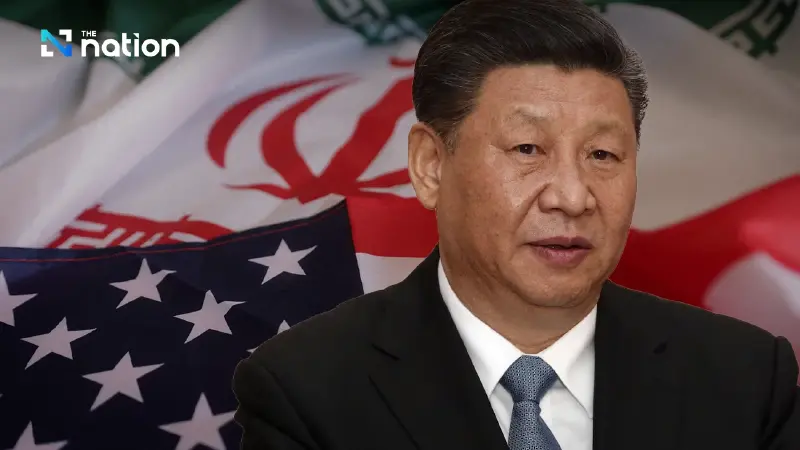


China urged an immediate ceasefire after the US and Israel launched strikes on Iran, as President Xi Jinping’s government considers how to respond to the escalating Middle East crisis.
In a statement issued on Saturday (February 28), a Chinese Foreign Ministry spokesperson said Beijing was “highly concerned” about the attacks, calling for an “immediate cessation of military operations” to prevent tensions from worsening.
China also urged a return to dialogue and negotiations, saying this was necessary to protect peace and stability in the region.
The US and Israel began hitting targets across Iran on Saturday, while US President Donald Trump called on Iranians to overthrow their government, raising fears the conflict could spread across the oil-rich Middle East.
China’s relationship with Iran is economically uneven.
Beijing makes up roughly a third of Iran’s trade, while Iran accounts for less than 1% of global commerce for the world’s second-largest economy, according to the Centre for Strategic and International Studies.
China is also estimated to buy about 90% of Iran’s oil exports despite US sanctions, yet Iran remains an energy supplier that China could, in theory, replace.
Still, China faces exposure through regional shipping routes.
Around a third of China’s crude oil supply is carried by vessels passing through the Strait of Hormuz, the narrow channel beside Iran that links the Persian Gulf to open seas.
After Saturday’s bombing, some oil tankers reportedly avoided the strait as shipowners took a more cautious stance.
Diplomatically, Beijing has deepened engagement with Tehran in recent years, though it has no formal alliance with Iran.
Xi backed Iran’s entry into the Shanghai Cooperation Organisation in 2023 and supported its accession to the BRICS bloc, two groupings China has promoted as part of a broader effort to counter US influence.
A separate 25-year strategic cooperation agreement signed in 2021, reportedly including $400 billion in Chinese investment pledges, has seen limited follow-through, while China’s economic stakes across the wider Gulf have grown to far exceed its interests in Iran.
Beijing has also been wary of supplying weapons to Iran, citing concerns over potential US sanctions.
During the previous surge in regional tensions, China swiftly denounced attacks and floated a four-point blueprint related to the Israel-Iran war, but avoided offering material support.
Separately, Chinese state media condemned the strikes.
In an editorial published on Saturday, China Daily said the US and Israel’s actions “breed chaos” and risk triggering a retaliatory cycle that could swallow the entire region, arguing that preventing a wider war must come first.
China Daily is the Communist Party’s English-language propaganda outlet.
Bloomberg
