
Lee tops 60% approval after Middle East response
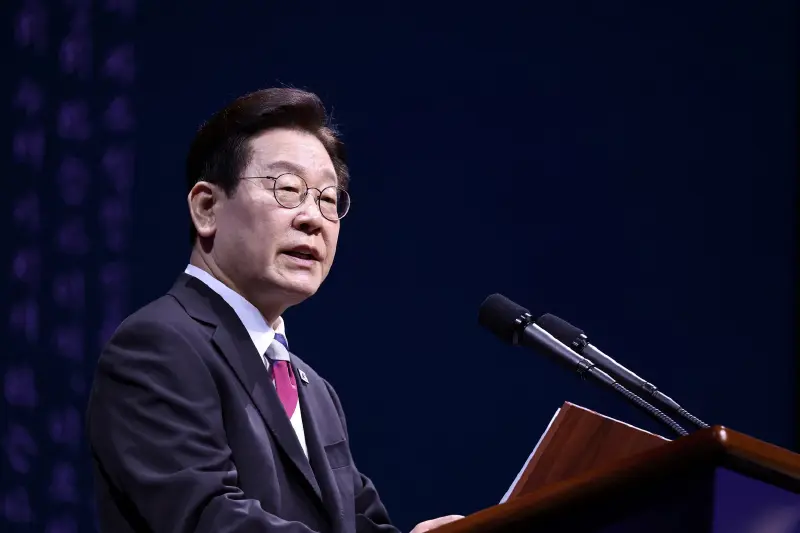


President Lee Jae Myung’s approval rating rose above 60 per cent for the first time in about seven months, according to a poll released Monday, extending a recent rise in public support.
In the survey conducted by Realmeter, Lee’s approval rating stood at 60.3 per cent, up 2.1 percentage points from the previous week and marking a second consecutive weekly increase.
Negative evaluations fell by 2.1 percentage points to 35.0 per cent, while 4.7 per cent of respondents said they were unsure, unchanged from a week earlier.
The poll was conducted from March 9-13 among 2,513 voters aged 18 and older nationwide. It marked the first time Lee’s approval rating in a Realmeter survey had surpassed 60 per cent since the fifth week of July last year, when it reached 63.3 per cent.
“Amid a situation in which international oil prices have surged, and inflation concerns have grown due to the worsening Middle East crisis, the government’s swift rollout of preemptive economic and livelihood measures — including an oil price cap and an early supplementary budget — appears to have helped boost the president’s approval rating,” Realmeter said.
In particular, the sharp rebound in the daily approval rating — from 56.6 per cent on March 6 to 62.3 per cent on March 10 — appears to reflect the “immediate effect of policy announcements,” including the formalisation of a supplementary budget.
Lee ordered "extraordinary measures" to shore up energy supplies and rein in surging oil prices at an emergency economic response meeting held on March 9. After the meeting, Kim Yong-beom, the presidential chief of staff for policy, announced plans to cap fuel prices later that week. The government needed to move preemptively to draw up a supplementary budget if the conflict in the Middle East dragged on, he added.
The uptick in approval was largely driven by a shift among centrist voters, while conservatives showed modest improvement, and progressive support remained largely unchanged.
Approval among centrists rose 4.6 percentage points to 63.5 per cent, while support among conservatives edged up 3.1 percentage points to 33.9 per cent. Among progressives, positive evaluations fell by 2.5 percentage points to 85.6 per cent.
Across regions, positive evaluations of Lee’s job performance rose everywhere except in Gwangju and the Jeolla provinces, a typically progressive stronghold, as well as in Daegu and North Gyeongsang Province, a longstanding conservative base.
In a separate Realmeter survey on party approval, the ruling Democratic Party of Korea garnered 50.5 per cent support, while the main opposition People Power Party recorded 31.9 per cent. The nationwide survey was conducted from March 12-13 among 1,005 voters aged 18 and older.
Support for the Democratic Party rose 2.4 percentage points from the previous week, while the conservative People Power Party fell 0.5 percentage points.
The Democratic Party’s support increased for a second straight week, topping 50 per cent for the first time in about seven months, since the second week of July. The gap between the two major parties widened to 18.6 percentage points from 15.7 percentage points a week earlier, marking the seventh consecutive week that the difference remained outside the margin of error.
“The rise in support for the Democratic Party appears to reflect the effect of the government’s livelihood-focused policies translating into support for the ruling party," Realmeter analysed. "Internal turmoil within the People Power Party also produced a backlash effect."
The sharp rise in Seoul, where support for the Democratic Party jumped 10.9 percentage points, also appears to reflect growing consolidation among ruling party supporters after Chong Won-o announced his bid for Seoul mayor, according to the pollster.
The decision by incumbent Mayor Oh Se-hoon not to seek the People Power Party nomination also seems to have nudged some conservative voters toward the Democratic Party, it added.
The Korea Herald
