
US-Iran talks open with Hormuz, frozen funds and ceasefire at stake
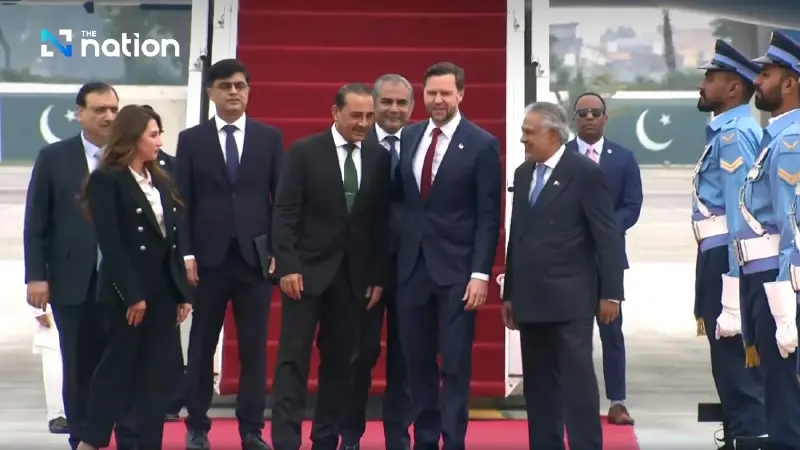


Washington and Tehran began their first direct meeting in more than a decade, with Hormuz, disputed frozen assets and wider ceasefire terms dominating talks.
- U.S. and Iranian officials are holding their highest-level direct talks in decades in Pakistan, focusing on a wider ceasefire and resolving key disputes.
- A central point of negotiation is the release of $6 billion in frozen Iranian funds; an Iranian source claimed the U.S. agreed to release the money in exchange for safe passage in the Strait of Hormuz, a claim U.S. officials deny.
- Control of the Strait of Hormuz, a critical global oil route blocked by Iran, is a major point of "serious disagreement," with the U.S. demanding free passage while Iran seeks control and transit fees.
- The talks are being held under a temporary two-week ceasefire, but Iran's demands include a broader regional ceasefire that would also apply to conflicts involving its allies in areas like Lebanon.
US and Iranian negotiators held their most senior talks in nearly half a century in Pakistan on Saturday (April 11), with the first direct meeting between the two sides in more than a decade quickly turning on the Strait of Hormuz, frozen Iranian assets and competing demands for a wider ceasefire after six weeks of war.
The talks in Islamabad were the highest-level discussions between Washington and Tehran since Iran’s 1979 Islamic Revolution and were held under a two-week ceasefire agreed last week.
According to a Pakistani mediation source, US Vice President JD Vance, special envoy Steve Witkoff and President Donald Trump’s son-in-law Jared Kushner met Iranian Parliamentary Speaker Mohammad Baqer Qalibaf and Foreign Minister Abbas Araqchi for two hours before breaking off.
Another Pakistani source said: “There were mood swings from the two sides and the temperature went up and down during the meeting.” Iran’s state-affiliated Nournews said the talks would resume later on Saturday night or on Sunday.
Before the meeting, a senior Iranian source told Reuters that the United States had agreed to release Iranian frozen assets held in Qatar and other foreign banks.
The source said Tehran viewed the purported move as a sign of “seriousness” in reaching a deal with Washington.

The same source, who declined to be named because of the sensitivity of the matter, said it was one of Iran’s demands “in messages conveyed to the US side” and that Tehran had received a US agreement to release the assets.
The source added that unfreezing the money was “directly linked to ensuring safe passage through the Strait of Hormuz”, which is expected to remain one of the key issues in the negotiations.
The senior source did not disclose the value of the assets in question.
A second Iranian source said the United States had agreed to release $6 billion of frozen Iranian funds held by Qatar.
A US official swiftly denied the assertion, while Qatar’s Foreign Ministry did not immediately respond to a request for comment.
The $6 billion was originally frozen in 2018.
It had been due for release in 2023 under a US-Iranian prisoner swap, but was frozen again by the administration of President Joe Biden after the October 7, 2023, attacks on Israel by Hamas, an ally of Iran.
US officials said at the time that Iran would not be able to access the money for the foreseeable future and stressed that Washington retained the right to freeze the account completely.
The funds came from Iranian oil sales to South Korea and had originally been blocked in South Korean banks after Trump, during his first term in the White House, reimposed sanctions on Tehran in 2018 and scrapped the deal between Iran and world powers over its nuclear programme.

Under the September 2023 prisoner swap mediated by Doha, the money was transferred to bank accounts in Qatar.
The exchange involved the release of five US citizens detained in Iran and five Iranians held in the United States.
US officials said at the time that the funds were restricted to humanitarian use only and could be disbursed only to approved vendors for food, medicine, medical equipment and agricultural goods shipped into Iran under US Treasury oversight.
Hormuz remained central to the negotiations.
The strait, a major transit point for global energy supplies and a chokepoint for about 20% of global oil and liquefied natural gas shipments, has effectively been blocked by Iran, while Trump has vowed to reopen it.
Iran’s semi-official Tasnim news agency said the waterway remained one of the main points of “serious disagreement” between the Iranian and US delegations.
Trump said the United States had already begun the process of reopening the route. “We’re now starting the process of clearing out the Strait of Hormuz as a favour to Countries all over the World,” he posted on social media.
The US military said two of its warships had passed through the strait and that conditions were being set to clear mines.
Iran’s state media denied that any US ships had transited the waterway.
Iranian state television and officials said Tehran’s demands go beyond the release of assets abroad.
They include control of the Strait of Hormuz, payment of war reparations and a ceasefire across the region, including in Lebanon.
Tehran’s agenda also includes seeking to collect transit fees in the strait.
Trump’s stated goals have varied, but at a minimum, he wants free passage for global shipping through Hormuz and the crippling of Iran’s nuclear enrichment programme to ensure it cannot produce an atomic bomb.
Mutual distrust remained high. “We will negotiate with our finger on the trigger,” Iranian government spokesperson Fatemeh Mohajerani said on state television. “While we are open to talks, we are also fully aware of the lack of trust; therefore, Iran’s diplomatic team is entering this process with maximum caution.”
The Iranian delegation arrived on Friday dressed in black in mourning for former Supreme Leader Ayatollah Ali Khamenei and others killed in the war.
The Iranian government said they also carried shoes and bags belonging to some students killed during the US bombing of a school next to a military compound.
The war has sent global oil prices soaring, killed thousands of people and led to strikes on Gulf Arab states.
The biggest-ever disruption in the Strait of Hormuz has fed inflation and slowed the global economy, with the impact expected to last for months even if negotiators succeed in reopening the waterway.
Even so, shipping data showed that three Liberian- and Chinese-flagged supertankers passed through the strait on Saturday, appearing to be the first vessels to exit the Gulf since the ceasefire.
Israel, a US ally that joined the February 28 attacks on Iran that launched the war, has also continued bombing Tehran-backed Hezbollah militants in Lebanon and says that the conflict does not form part of the Iran-US ceasefire.
More than 90 people were killed in Israeli air strikes across Lebanon on Saturday, the Lebanese health ministry said, bringing the death toll there to 2,020, including 165 children, nearly 250 women and 85 medics.
Hezbollah said it had conducted several military operations against Israeli positions on Saturday, both within Lebanese territory and in northern Israel.
Israeli and Lebanese officials are due to hold talks in the United States on Tuesday.
Islamabad, a city of more than 2 million people, was locked down for the US-Iran talks, with thousands of paramilitary personnel and army troops deployed on the streets.
Pakistan’s mediating role marks a remarkable transformation for a country that was a diplomatic outcast a year ago.
“This was a world war that Pakistan stopped. It played a big role, and we should appreciate it,” Nasir Khan Abbasi, a dry cleaner in an Islamabad market, said. “I really like this, and I feel great that Pakistan’s name is shining in the world.”
In an impassioned appeal on Saturday, Pope Leo urged world leaders to end what he called the “madness of war.”

