
India’s sugar export ban expected to benefit Thai sugar suppliers
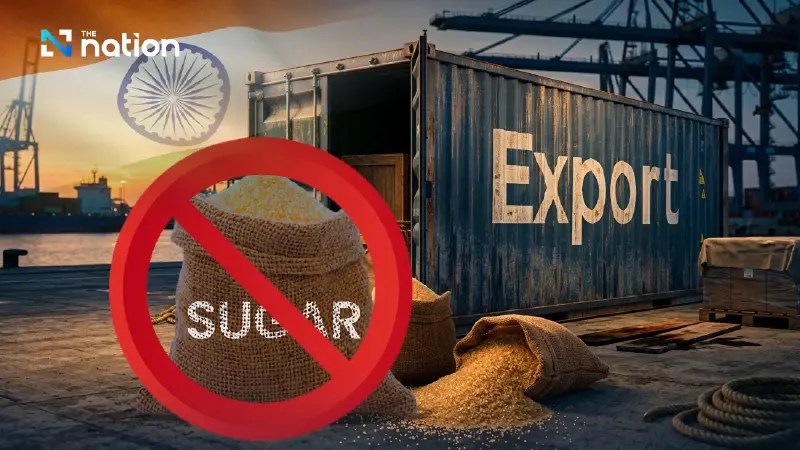


India has temporarily banned all sugar exports until September 30, 2026, in a move expected to support global prices and open space for Thai exporters.
- India has temporarily banned all sugar exports until at least September 30 to ensure domestic supply and control inflation, citing concerns over future output due to El Niño.
- The export ban is expected to cause a rise in global sugar prices, with markets in London and New York showing an immediate increase following the announcement.
- Major sugar-exporting competitors, particularly Thailand and Brazil, are likely to benefit by gaining market share in countries that previously relied on Indian sugar.
The website of the Department of International Trade Promotion, Ministry of Commerce, citing its Office of Commercial Affairs in New Delhi, India, reported that the Indian government has temporarily banned the export of all types of sugar from May 13 until September 30, or until further orders are issued.
The move is aimed at maintaining sugar supplies for domestic consumption, controlling food inflation and stabilising consumer goods prices, amid concerns over the impact of El Niño on sugarcane output in the next season.
The measure was announced by India’s Directorate General of Foreign Trade (DGFT), under the Ministry of Commerce and Industry, through Notification No. 16/2026-27 dated May 13.
It changes the export policy status for sugar under ITC (HS) Codes 1701 14 90 and 1701 99 90, covering raw sugar, white sugar and refined sugar.
The policy status has been changed from “Restricted”, under which exports were allowed subject to government quotas and conditions, to “Prohibited”, meaning exports are banned outright.
However, the Indian government continues to allow exemptions in some cases, including exports to the European Union (EU) and the United States under special CXL and Tariff Rate Quota (TRQ) arrangements, exports under the Advance Authorisation Scheme (AAS), government-to-government exports for food security purposes, and goods already in the export process before the notification took effect.
Although India still has sufficient domestic sugar supplies, with production in the 2025/26 season expected at about 27.9 million tonnes and opening stocks of more than 5 million tonnes, bringing total sugar availability to around 32.9 million tonnes, above domestic consumption demand of about 28 million tonnes, the Indian government has still decided to impose the strict measure due to concerns over future supply risks.
These risks include the El Niño phenomenon, which could lead to below-average rainfall and affect sugarcane output in the next production season.
There are also concerns over fertiliser costs and supply linked to the crisis in the Middle East, as well as the government’s uncertainty over the actual sugar stock levels reported by some sugar mills.
India is also pushing a policy to use sugarcane for ethanol production for fuel blending, reducing surplus sugar available for export.
At the same time, the Indian government wants to guard against inflation risks in food, fuel and fertiliser prices before the monsoon season, prompting it to prioritise export restrictions to preserve domestic stability.
On the impact on global trade and the sugar market, analysts expect the measure to support world sugar prices, particularly raw sugar and white sugar prices in the London and New York markets, which rose immediately.
The increase followed India’s announcement of the measure.
Meanwhile, other major exporters, such as Brazil and Thailand, are likely to benefit from opportunities to increase their market share in Asia and Africa in place of India.
India is the world’s second-largest sugar producer after Brazil and is one of the world’s key exporters.
In fiscal 2025, India’s sugar exports were valued at about US$1.9 billion, with major export markets including Sri Lanka, Bangladesh, Libya and Sudan.
The Office of Commercial Affairs in New Delhi said India’s temporary sugar export ban could allow Thai sugar exporters to expand their market share in importing countries that previously relied on Indian sugar, particularly in South Asia, Africa and the Middle East.
As India is one of the world’s major sugar exporters, the export halt could force importers to seek alternative sources, while Thailand, as a major global sugar exporter, may benefit from rising world sugar prices and have opportunities to increase export volumes in some markets.
Although India has suspended sugar exports, it is unlikely to need to import sugar from abroad in the short term, as it remains a major sugar producer with enough output for domestic consumption.
India also maintains relatively strict sugar import controls, including import licensing, quotas and import duties of more than 100%, which remain major obstacles to Thai exporters seeking access to the Indian market.
