
Myanmar’s Junta Chief Turned President Heads to India, With an Eye on China
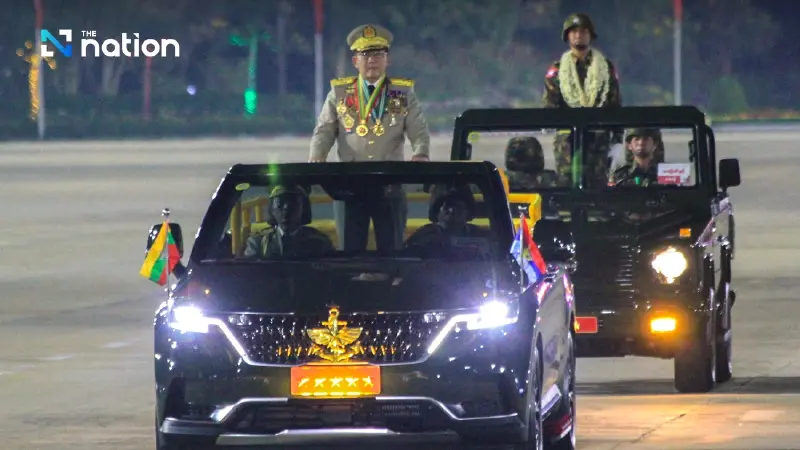


Min Aung Hlaing’s five-day trip to India marks his first overseas visit as civilian president, signalling a strategic push for regional legitimacy
- Myanmar's leader, Min Aung Hlaing, is making his first overseas trip as president to India, a move aimed at gaining regional legitimacy and re-engaging diplomatically after years of isolation following the 2021 coup.
- The visit is a strategic effort by Myanmar to counterbalance the significant and long-standing influence of its key ally, China.
- For India, the visit is an opportunity to dilute China's regional influence, secure access to Myanmar's valuable rare earth deposits, and bolster security along their shared border.
Min Aung Hlaing’s five-day trip to India marks his first overseas visit as civilian president, signalling a strategic push for regional legitimacy.
Less than two months after completing a carefully engineered transition from junta chief to president, Min Aung Hlaing will fly to India on an official visit on Saturday, marking his first overseas trip since assuming the civilian role.
The five-day trip, during which the former general will hold talks with Indian Prime Minister Narendra Modi, underscores the gradual return of regional re-engagement for Myanmar, five years after many of its neighbours shunned the Southeast Asian nation’s military leadership following a coup.
For India, the visit presents an opportunity to dilute China's outsized influence on Myanmar whilst working to secure access to the country’s deposits of critical rare earths and bolster security along its northeastern borders, analysts said.
Search for Improved Regional Relations
"After changing into civilian clothes as president, Min Aung Hlaing is looking to boost diplomatic engagement across the region," said Richard Horsey, senior Myanmar adviser at Crisis Group.
"He expects more normal ties with ASEAN," Horsey added, referring to the grouping of Southeast Asian countries, "with support from Thailand and some other member states. He is also likely to visit Beijing soon to meet Xi Jinping. India is Myanmar's other key neighbour."
An official from Myanmar’s presidential office, reached via phone, declined to comment on the visit.
Indian foreign ministry spokesman Randhir Jaiswal told reporters on Friday: "All issues that form part of the gamut of relations between Myanmar and India will come up for discussion."
From Isolation to Re-engagement
In a dawn takeover on 1 February 2021, Min Aung Hlaing ousted the elected civilian government led by Nobel Peace Prize winner Aung San Suu Kyi, sparking a protest movement that transformed into a nationwide armed uprising against the military.
The coup drew widespread condemnation, including from the ASEAN bloc which barred Myanmar's generals from its summits, leaving the new military-led administration increasingly isolated.
However, a devastating earthquake last year provided a diplomatic opening for Min Aung Hlaing, who made a rare visit to a regional summit in Bangkok. He is now seeking to build on that momentum following a widely criticised election that paved the way for his presidency.
"He is seeking more and more regional and international respectability post-election," said Gautam Mukhopadhaya, a former Indian ambassador to Myanmar.
Frontier Area Offensives
Although long backed by Beijing, which holds a vast range of investments in the country, Min Aung Hlaing’s decision to travel to India for his first overseas visit is seen in part as a calculated move to counter China's deep influence, analysts noted.
"This has been part of Myanmar's way of dealing with India and China, capitulating more to China and trying to sort of balance it with India," said Mukhopadhaya.
The visit coincides with renewed military offensives launched by Myanmar's armed forces in frontier areas where rare-earth deposits are located, as well as along vital trade routes into India and Thailand.
"Min Aung Hlaing will almost certainly seek India's help in countering the Arakan Army and Chin armed groups," Horsey said, referring to rebels fighting the military in Myanmar's Chin state, which borders India, and nearby Rakhine state.
India, on its part, has been keenly interested in securing access to Myanmar's resources. Reuters has previously reported that New Delhi has been working to obtain mineral samples with the assistance of a powerful rebel group.
"The bottom line behind this visit from the Indian side is what they can get out of it in terms of raw materials, rare earths [and] business propositions," Mukhopadhaya said. "And that's exactly what the Myanmar military wants, because it wants its military enterprises strengthened."
