
Myanmar junta pushes to retake rare-earth belt near China border
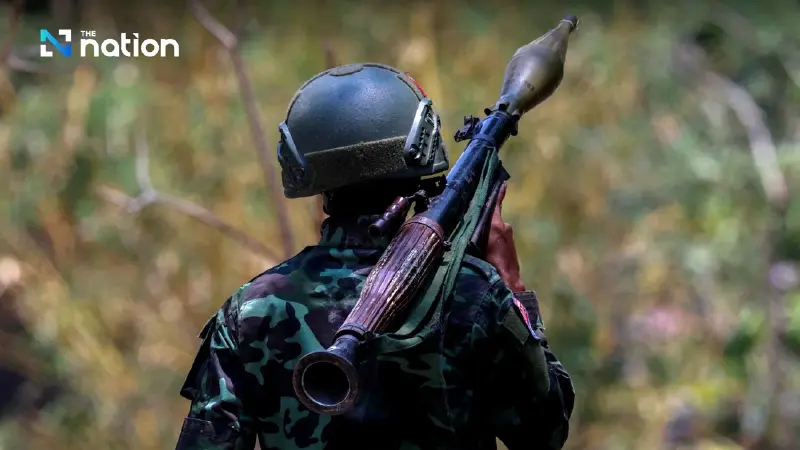


Myanmar’s military has launched renewed offensives in Kachin, Chin and Karen states, targeting rare-earth mining areas near China and key border trade routes near India and Thailand.
Myanmar’s military has stepped up offensives across key border regions as it seeks to retake a rare-earth mining belt in northern Kachin State that is crucial to global supply chains for electric vehicles and wind turbines, according to a Reuters report.
The campaign marks a major push by the junta to reclaim strategic territory from ethnic armed groups that have expanded their control since Myanmar’s 2021 coup. Reuters reported that the military’s latest operations are focused on Kachin State, along the Chinese border, as well as Chin State near India and Karen State near Thailand.
Junta targets rare-earth stronghold
The most strategically sensitive front is in northern Kachin, where mining belts near the Chinese border produce roughly half of the world’s heavy rare-earth elements, according to Reuters. These minerals are vital for clean-energy technologies including electric vehicles and wind turbines.
The area includes the Chipwi and Pangwa townships, which were taken by the Kachin Independence Army in October 2024. The KIA has since fortified its positions as junta forces attempt to drive deeper into the region.
KIA spokesperson Naw Bu told Reuters the group was prepared to defend the territory, saying: “We will welcome them with the barrels of our guns.”
Military claims gains on key route
The military-run Global New Light of Myanmar reported that new military chief Ye Win Oo told soldiers last week that junta forces had secured an arterial route between Mandalay and Myitkyina, the capital of Kachin State. The same report said the military had also secured Falam town in Chin State.
Reuters said it could not independently verify the details of the military’s offensives or their immediate battlefield gains, noting that media access remains heavily restricted in Myanmar.
Broader fight for border corridors
The Kachin offensive is part of a wider military strategy to regain control of communication and trade routes across Myanmar’s borderlands.
In Chin State, near the Indian border, the military has intensified operations as it tries to recover lost ground. Salai Van, a spokesperson for the Chin National Front, told Reuters that resistance fighters had made strategic retreats from Falam and Tonzong as the military used heavy aerial bombardment.
In Karen State, near Thailand, the military is also fighting to control the Myawaddy-Kawkareik highway, a vital trade route that has seen repeated clashes since the Karen National Union pushed into Myawaddy in 2024.
Air power remains central to junta strategy
Reuters reported that the junta’s bombing campaign has previously relied on illicit deliveries of jet fuel, including from Iran. The news agency said earlier reporting found that Myanmar military airstrikes had hit more than 1,000 civilian locations over a 15-month period.
The latest offensives come after former junta chief Min Aung Hlaing, now president, called on rebel groups to enter peace talks within 100 days. However, several ethnic armed groups have rejected the offer, citing deep distrust of the military.
Rare earths raise global stakes
The battle for Kachin is not only a domestic military contest. Control of the rare-earth belt could affect China’s supply of heavy rare-earth elements and, by extension, global production of high-tech and clean-energy products.
Myanmar’s conflict has increasingly become a struggle over border gateways, trade highways and natural resources. As the junta tries to reverse battlefield losses, ethnic armed groups are seeking to hold territory that gives them both military leverage and economic bargaining power.
With independent access to the war zones restricted, the full scale of casualties and territorial changes remains unclear. But the renewed push into Kachin shows that Myanmar’s civil war is now closely tied to one of the world’s most sensitive supply chains.
