
Behind dinosaur discovery: challenges facing Thai pure scientists
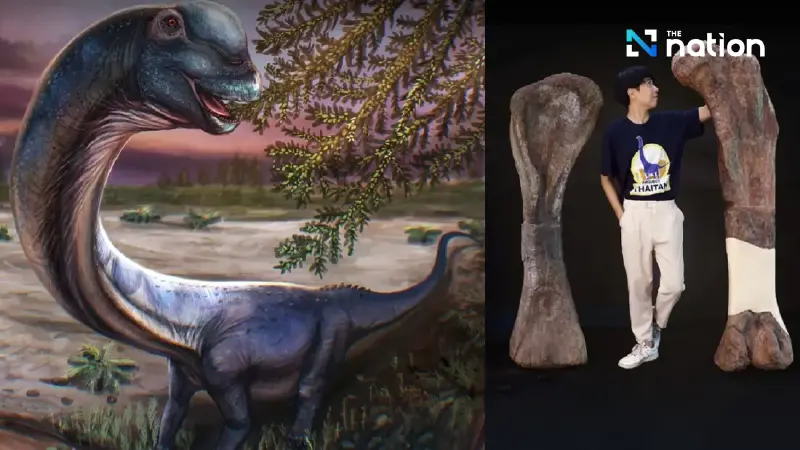


A Thai palaeontological researcher suggested stronger government support, while a giant dinosaur from north-eastern Thailand, has drawn global attention.
The discovery began by coincidence when a villager went fishing and found fossils of “Nagatitan chaiyaphumensis”, one of the largest plant-eating dinosaurs ever discovered in Southeast Asia
Dr. Sita Manitkoon, a Dinosaur researcher at Mahasarakham University and National Geographic Explorer, said the discovery reflects broader funding challenges in Thailand’s scientific community.

The discovery marks a major achievement for Thai palaeontology
He was one of the Thai lead researchers behind the recent discovery of “Nagatitan chaiyaphumensis”, officially recognised as Thailand’s 14th dinosaur species and one of the largest plant-eating dinosaurs ever discovered in Southeast Asia.
The herbivorous long-necked sauropod lived during the Early Cretaceous period around 100–115 million years ago. Researchers estimate it measured nearly 30 metres long and weighed more than 26 tonnes.
The study was published in the international scientific journal Scientific Reports.
Despite the significance of the discovery, the research did not continue smoothly.
It all started in Chaiyaphum, Thailand’s northeastern province 10 years ago when a villager named Thanom found unusual rocks near a pond when he went fishing. Those rocks later turned out to be fossils of Nagatitan.

Dr. Sita shared that researchers from the Department of Mineral Resources studied the fossils for two years before the specimens were transferred to the Sirindhorn Museum in northeastern Thailand.
But after that, Dr. Sita said the project was paused.
“However, they also faced budget and staffing constraints. As a result, research and follow-up work on the collected samples, including fieldwork at the excavation sites, could not continue,” he noted.
He explained that Nagatitan Chaiyaphumensis had the potential for further scientific study and could qualify for one of the highly competitive grants from the National Geographic Society, which supports researchers, educators, storytellers, and conservationists working on projects that benefit the planet.
A Dinosaur discovery with global and local impact
With support from grants of the National Geographic Society, Dr. Sita became one of fewer than 10 Thai National Geographic Explorers and the first Thai palaeontologist to receive recognition for research related to the identification of Nagatitan Chaiyaphumensis under Project Titan, a collaboration between Thai and UK researchers.
He said the reason the team received the highly competitive international grant was because Nagatitan represents more than just a dinosaur discovery, it is also about the story surrounding the find and its connection to local communities.
“We’re fortunate that the Nagatitan research site is located within a geopark, one of UNESCO’s recognised conservation and education models.
What makes the geopark in Chaiyaphum stand out are its fossils, scenic rock formations, and the relationship between the geopark and local communities, including their ways of life, culture, and diverse ethnic groups,” he said.
Dr. Sita and his team later expanded the National Geographic-supported project through outreach programmes such as the “Paleo Roadshow”, “Paleo Camp”, and “Paleo Youth Conference”, which were designed to engage schoolchildren in the fossil discovery area as well as young people across Thailand.
The activities aim to raise awareness about local ways of life, the geopark, and the importance of palaeontological studies in Thailand.

The finding of Nagatitan reflects potential Thai scientists.
Beyond its scientific significance, the discovery has also showcased the potential of Thai researchers and Mahasarakham University on the international stage.
Although Thailand continues to invest in research through national funding programmes, Dr. Sita said fundamental sciences still receive less attention.
Dr. Sita pointed out that despite the government’s funding in science research, ‘pure’ or ‘basic’ science research is still in need of stronger support from domestic organizations, adding that the government or domestic support is often directed toward research that creates innovation, generates income, or contributes to economic and technological development.
“Fundamental research like ours is also important. It encourages people to become interested in science and helps raise awareness about our country’s natural resources.
“When there is limited research funding available domestically, international grants like those from the National Geographic Society become an answer because they do not impose those kinds of conditions. They see this kind of work as something necessary for the world,’’ he opined.
For Dr. Sita, the discovery of Nagatitan Chaiyaphumensis is not only about uncovering prehistoric life, but also about proving that fundamental science in Thailand deserves greater recognition and support.
