
Unlocking Thailand’s THB221bn Myanmar Demographic: Study Warns Firms are Missing a New Purchasing Powerhouse
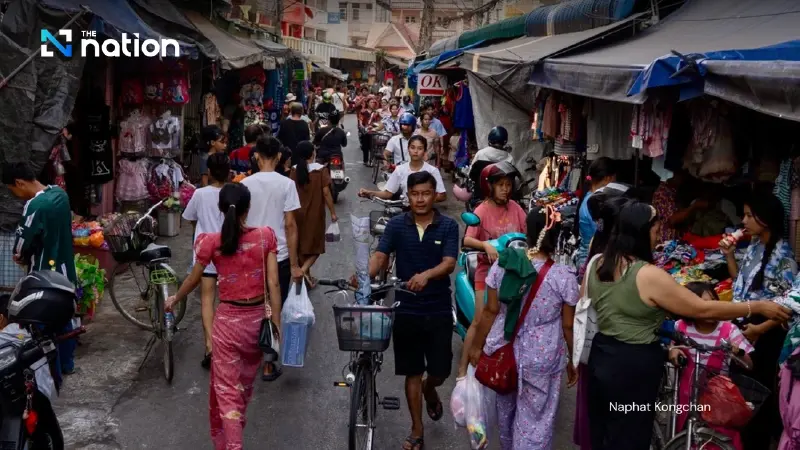


A landmark study by Happio reveals Thailand's four million Myanmar residents inject 221bn baht annually into the economy, altering the retail landscape
- A study reveals Thailand's four million Myanmar residents represent a 221 billion baht annual consumer market that is largely overlooked by domestic firms.
- Many Thai companies are missing this opportunity due to outdated stereotypes, failing to recognize the demographic's evolution from manual laborers to aspirational consumers with significant purchasing power.
- This group's spending is concentrated in key sectors such as food and beverages, accommodation, and transport, making them a vital engine for domestic retail.
- To succeed, businesses must move beyond simple price competition and translated ads, instead focusing on strategies rooted in cultural understanding and building community trust.
A landmark study by Happio reveals Thailand's four million Myanmar residents inject 221 billion baht annually into the economy, altering the retail landscape.
The Myanmar consumer segment in Thailand is rapidly emerging as a lucrative new "Blue Ocean" retail market that domestic brands are largely overlooking, despite accelerating saturation across the country’s traditional consumer base.
According to a comprehensive new market intelligence report titled "The Myanmar Market in Thailand 2026: Surpassing 221 Billion Baht" published by consultancy firm Happio, Thailand is currently home to more than four million Myanmar nationals. Crucially, their financial circulation within the formal Thai economy has reached an unprecedented ฿221 billion annually.
This aggregate expenditure represents approximately 65 per cent of the total collective income earned by the diaspora inside the country.
The data underscores an historic macroeconomic transition. Once viewed by corporate strategy departments purely as a source of low-cost manual labour, the demographic has evolved into a sophisticated consumer segment with genuine disposable income, distinct lifestyle preferences, and formidable purchasing power across multiple retail sectors.
Natee Jarayabhand, chief executive officer of Happio Co., Ltd., noted that corporate complacency has left a massive capital pool untapped.
"Today, the Myanmar consumer market in Thailand is no longer a niche, fringe sector; it is a vital engine of domestic purchasing power," Natee said. "Far too many Thai brands remain shackled to legacy stereotypes, viewing this demographic solely through the lens of industrial labour. In reality, we are witnessing the rise of a highly aspirational generation of entrepreneurs, skilled workers, and upwardly mobile families spending heavily to elevate their living standards. The commercial spoils will go to first-movers who decode this audience."
The research identifies food and beverages as the largest single beneficiary, capturing 17.4 per cent of total consumer spend, followed by accommodation at 13.8 per cent, transport at 8 per cent, and personal care at 4.4 per cent. Collectively, these everyday outlays comprise over 40 per cent of their total income, positioning the demographic as a primary driver for brick-and-mortar retail, convenience store networks, and essential service providers.
|
Sector |
Market Value (THB) |
Market Share % of Top Spending |
|
Food & Beverages |
฿59.2 billion |
17.4% |
|
Housing & Accommodation |
฿46.8 billion |
13.8% |
|
Digital & Financial Services |
฿24.7 billion |
7.0%–8.0% range |
|
Healthcare & Medical |
฿19.7 billion |
~5.0% |
Orawee Tangmeesang, a prominent cross-border market specialist and founder of the Natty Loves Myanmar platform, emphasized that marketing strategies must shift away from pure price-point competition.
"Modern Myanmar consumers in Thailand are no longer making procurement decisions based strictly on cost," Orawee observed. "They are driven by brand equity, communal trust, and cultural recognition. Because a vast majority of this population utilizes social media for daily information and commerce—and frequently resides in tight-knit communal hubs—word-of-mouth endorsement carries unparalleled weight. Cultivating brand loyalty at the localized, community level allows for exponential consumer acquisition."
Geographically, the report locates the highest concentrations of this purchasing power within central industrial hubs and border economic zones, with 31.8 per cent residing in Bangkok and its immediate suburbs, and 39.2 per cent across the Central Plains.
Industrial areas such as Samut Sakhon, alongside border trading posts like Tak and Ranong, are highlighted as prime regions for targeted offline activations.
The report concludes that companies must move beyond lazy marketing methods, noting that simply translating advertising copy into the Burmese language is no longer sufficient.
To capture long-term market share before the space devolves into a hyper-competitive "Red Ocean," firms must employ a robust first-mover strategy rooted in an authentic cultural context and a deep understanding of the diaspora's unique financial pain points.
