
Aliansi Kolibri & Civil Society Unite for Climate Innovation in Indonesia


Climate change is an escalating global threat, and Thailand is no exception. According to the Copernicus Climate Change Service, January 2024 was the warmest January ever recorded globally, with an average surface air temperature of 13.14°C, 0.70°C above the 1991–2020 average and 1.66°C above pre-industrial levels.
In Thailand, agriculture is a cornerstone of the economy, but is increasingly threatened by climate change. Rising temperatures, erratic rainfall, and extreme weather events like droughts and floods have significantly impacted crop yields, particularly rice, which is Thailand's most important food crop.
For instance, during the 2015–2016 drought, rice production declined by 16%, dropping from 19.8 million tons to 16.5 million tons, leading to substantial economic losses.
These climate-induced disruptions not only threaten local food production but also affect global supply chains, as Thailand is a major exporter of rice and other agricultural products.
Addressing these challenges requires the adoption of climate-resilient farming practices, investment in sustainable technologies, and supportive policies.
In Indonesia, smallholder farmers, supported by alliances and civil society organisations, are working to restore degraded land and implement agroecological methods to adapt to climate impacts. Their efforts provide a valuable model for strengthening agricultural resilience across Southeast Asia, including Thailand.

Collaborating to Tackle Climate Change
One such collaboration is the one done by Aliansi Kolibri in partnership with Yayasan Citra Mandiri Mentawai (YCMM), an organisation established in 1995, to confront the growing challenges of climate change in the Mentawai Islands, on the western coast of Sumatra Island.
To date, YCMM has helped safeguard approximately 237,701.17 hectares of forest from exploitation.
This collaboration focuses on community-based solutions that empower indigenous and local communities. A key part of their work involves introducing adaptive, environmentally friendly farming techniques such as agroforestry and the cultivation of climate-resilient crops.
One of the key members of the community is Yohanes (44), a farmer from Madobak Village in the Mentawai Islands, West Sumatra. On his one-hectare plot, Yohanes cultivates Songer bananas (Musa acuminata × balbisiana), a local variety of banana, along with areca nuts and other crops.
During harvest, he can collect up to 10 bunches of bananas, which sell for around 15 cents US$ per kilogram or are consumed by his family.

As the son of a traditional elder of the Samalelet Tribe, Yohanes sees maintaining economic stability and sustainability in Madobak Village as a top priority.
For him, customary forests are not only a source of livelihood but also a cultural heritage that must be protected from outside exploitation. Committed to defending indigenous rights, Yohanes continues to adapt and innovate in the face of environmental challenges.
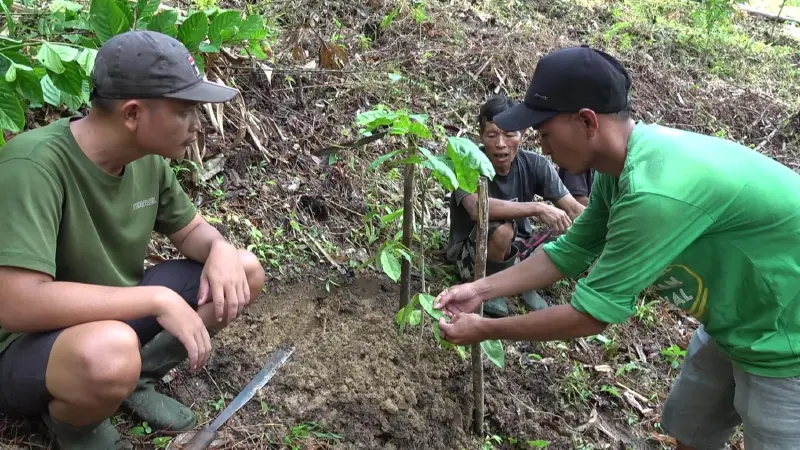
Yohanes is not alone in his efforts. He often encourages fellow residents of Madobak Village to take part in protecting the natural landscape around them. Through the local tradition of goro, Yohanes and his neighbours collectively plant trees to enrich forest biodiversity and organise group harvests.
“Goro” is a long-standing tradition in which community members routinely come together for shared activities. Each evening, the tribal leader invites members to sit together and exchange stories, strengthening social bonds.
These gatherings also serve as a platform to discuss environmental protection initiatives, such as planning restoration work, selecting seedlings, and setting planting days.
For Yohanes, this sense of togetherness fosters solidarity and strengthens the community’s ability to face everyday challenges.
Through Goro, we plant trees together and protect our village ecosystem. This collective spirit gives us the strength to face everyday challenges,” Yohanes shared.
YCMM believes that the sustainability of forests and the recognition of indigenous rights are key to successful environmental protection. With its achievements and strong commitment, YCMM remains at the forefront of preserving the Mentawai ecosystem and improving the livelihoods of indigenous and local communities.
