
What is a cloudburst, the trigger behind deadly floods in India and Pakistan?
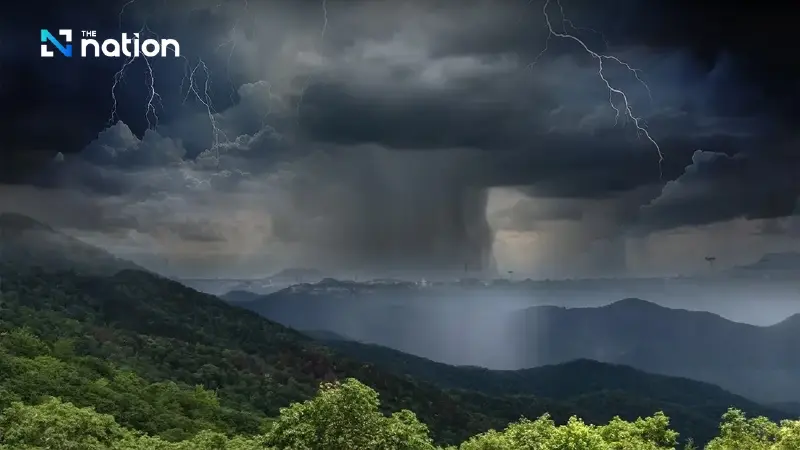


Hundreds have died in India and Pakistan in recent floods blamed on cloudbursts, sudden, violent downpours that experts say remain almost impossible to predict.
- A cloudburst is a violent weather event involving an intense downpour, often exceeding 100mm of rain in one hour, concentrated over a small area.
- They are caused when warm, moisture-laden air is forced upwards by mountainous terrain, forming dense clouds that become trapped and release an explosive burst of rain.
- India and Pakistan are particularly vulnerable due to their mountainous geography and monsoon climate, with climate change increasing the frequency of these events as warmer air holds more moisture.
- Due to their small scale, short duration, and sudden onset, cloudbursts are extremely difficult to forecast, making it challenging to issue timely warnings to prevent casualties.
The impact of climate change on Asia’s monsoon season is becoming increasingly evident, with the phenomenon known as a cloudburst unleashing devastation across India and Pakistan.
The sudden, violent downpours have triggered flash floods and landslides, killing hundreds of people in recent weeks.
In northwest Pakistan’s Buner district, more than 300 people were reported dead after severe thunderstorms caused flash floods, mudslides, and rockfalls, which swept through communities and crushed homes.
Earlier this month, India’s northern state of Uttarakhand was battered by torrential rainfall, with television footage showing floodwaters surging down Himalayan slopes and sweeping into mountain villages.
What is a cloudburst?
A cloudburst is a violent weather event where storm clouds release an exceptionally intense downpour over a small area in a very short time, often exceeding 100 millimetres of rain in just one hour, across an area of about 30 square kilometres.
The effect is comparable to a “rain bomb,” unleashing a wall of water that can cause severe flooding and destruction.
Cloudbursts occur suddenly and with extreme intensity, often causing severe impacts and widespread destruction. Several factors contribute to these events, including the uplift of warm, moist air, high humidity levels, low atmospheric pressure, instability in the atmosphere, and the formation of convective clouds.
Cloudbursts occur when warm, moisture-laden air is forced upwards, often by mountains or hilly terrain. As the air cools and condenses, dense storm clouds form and become trapped by topographical barriers, preventing the moisture from dispersing. Strong updrafts keep the moisture suspended until the clouds can no longer hold it, releasing an explosive burst of rain in a short period.
India and Pakistan are particularly vulnerable to cloudbursts because of a combination of geography, climate, and seasonal weather patterns. The three factors, high humidity, the monsoon cycle, and mountainous terrain, interact to force moisture-laden air upwards, causing condensation and sudden, torrential downpours.
In recent years, cloudbursts in the two countries have become more frequent as the atmosphere warms. Warmer air holds more moisture, creating conditions for more intense and abrupt rainfall events.
South Asia experiences two monsoon periods each year. The main season runs from June to September, when rains sweep from the southwest towards the northeast. A second monsoon occurs between October and December, moving in the opposite direction.
However, rising greenhouse gas emissions have altered these monsoon patterns. Warmer air absorbs more moisture from the Arabian Sea and Indian Ocean, releasing it in concentrated bursts. This leads to alternating extremes of devastating floods and prolonged dry spells, rather than steady rainfall across the season.
This is not the first time India has faced catastrophic cloudburst-related flooding. In June 2013, the town of Kedarnath in Uttarakhand suffered one of the country’s worst disasters, when flash floods and landslides killed more than 6,000 people, according to UN reports.
Forecasting cloudbursts remains extremely difficult due to their small scale, short duration, sudden onset, and complex atmospheric mechanisms.
Asfandyar Khan Khattak, an official from Pakistan’s northwestern Khyber Pakhtunkhwa province, stressed that no weather system in the world can pinpoint the exact time and location of a cloudburst.
The Pakistani government acknowledged that although an early warning system was in place in Buner district, the rainfall was so sudden and intense that alerts could not be issued in time, leading to hundreds of deaths.
The community organisation SOST said while cloudbursts cannot be forecast precisely, their dangers can be mitigated. It urged residents to avoid building homes near rivers and valleys, postpone travel to mountainous areas when heavy rain is expected, keep emergency kits prepared, and avoid mountain roads during downpours or at night.
SOST also recommended broader prevention measures, including reforestation to reduce surface runoff and increase water absorption, as well as the regular expansion and maintenance of riverbanks and drainage channels.
