
Is the “Republic of Kawthoolei” real or a breakaway claim?
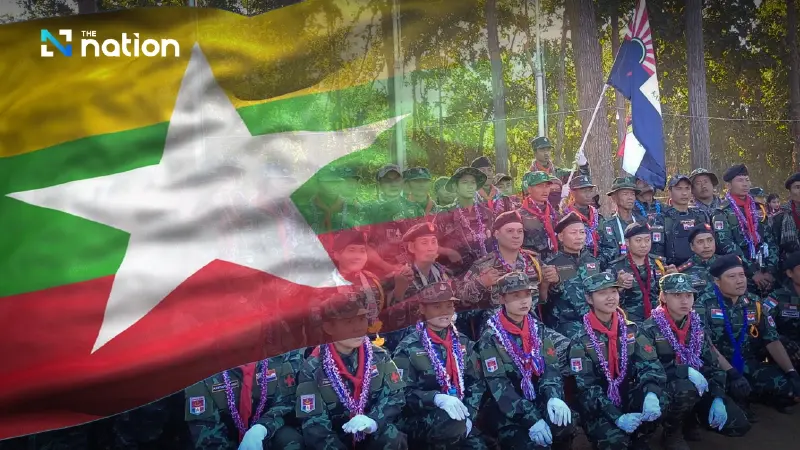


A new “Republic of Kawthoolei” declaration raises questions over KTLA’s break from the Karen movement—and whether independence is feasible.
A new development on January 7, 2026 has reignited debate over Karen politics and the feasibility of declaring an independent state.
The Government of Kawthoolei (G.O.K.) issued a statement declaring formal independence from Myanmar and proclaiming a new sovereign state, the “Republic of Kawthoolei”. It described the move as a legitimate right of the Karen people under international law and universal human rights principles. The declaration was issued from a stronghold on the Thai-Myanmar border, opposite Nong Luang subdistrict in Umphang district, Tak province.
The statement, released in the name of the Government of the Republic of Kawthoolei, cited international human rights principles and conventions, including the Universal Declaration of Human Rights, the International Covenant on Civil and Political Rights (ICCPR) and the International Covenant on Economic, Social and Cultural Rights (ICESCR). It claimed that Karen people in Kawthoolei have faced longstanding oppression, persecution and discrimination across all aspects of life.
KTLA’s emergence and the Karen movement’s long history of splits
Thitiwut Boonyawongwiwat, from the Faculty of Political Science and Public Administration at Chiang Mai University, said the KTLA (Kawthoolei Army) was formally established on July 17, 2022 by General Nerdah Bo Mya, a former commander of the Karen National Defence Organisation (KNDO).
He argued that KTLA’s stance should be analysed within the broader historical evolution of the Karen nationalist movement, rather than treated as an isolated, immediate event. KTLA’s emergence is directly linked to a break from the long-established structure of the Karen National Union (KNU), founded in 1947 and regarded for decades as the core organisation of Karen nationalism.
Structurally, the KNU developed its armed wing, the Karen National Liberation Army (KNLA), in the late 1940s. However, decades of experience show the Karen struggle has not unfolded under sustained organisational unity, but through repeated branching, fragmentation, breakaways and shifting alignments.
This has been reflected in the rise of multiple Karen armed groups, including the Democratic Karen Buddhist Army (DKBA), which split from the KNU in the mid-1990s—an important turning point in the balance of power along the Thai-Myanmar border. Another example is the Karen National Liberation Army-Peace Council (KNLA-PC), which broke away after reaching a ceasefire agreement with the Myanmar government in the late 2000s, adopting a more accommodationist political approach and prioritising territorial control and local interests over ideological agendas.
Some Karen forces have also moved directly under Myanmar’s security structure as Border Guard Forces (BGF), a semi-military, semi-local mechanism used by the state to absorb certain ethnic armed groups into its authority framework.
Against this backdrop, Thitiwut said KTLA’s declaration—especially the idea of establishing an independent state—should be understood as the position of one Karen armed group, not as a consensus across the entire Karen movement. At present, other Karen factions, including the traditional KNU/KNLA, the KNLA-PC, and Karen forces within BGF structures, have not formally signalled support for or participation in the project. Their clearer positions, he said, still need to be seen, even if there are some positive signs.
Political positioning in a prolonged war
A second point he highlighted is the structural context of Myanmar’s conflict as it moves deeper into a long war. This comes as Myanmar’s authorities push an election process that is widely viewed as incapable of ending a civil war that has continued for years.
Under these conditions, armed groups are increasingly defining clearer strategies and political positions—covering political goals, models of governance, and the future shape of power. In KTLA’s case, Thitiwut suggested that declaring an independent state can be interpreted as setting a high political “ceiling” for future negotiations and bargaining, rather than representing a final conclusion of the political process at this stage.
