
MAMA sales fall as profit drops 17.27% on economic impact
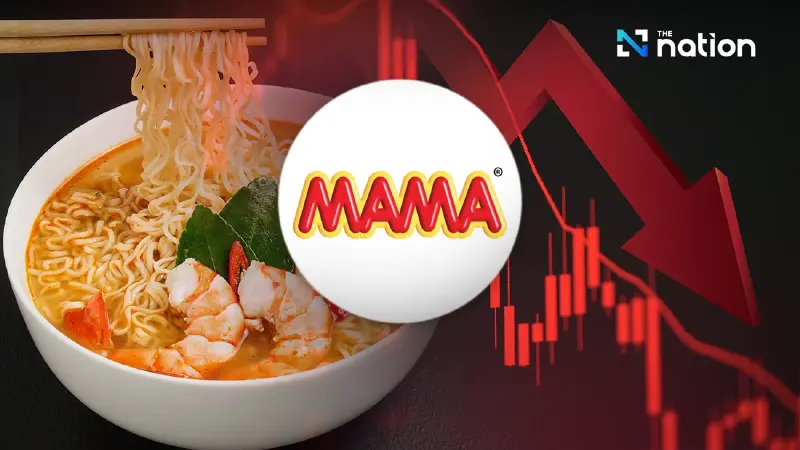


TFMAMA reported weaker revenue and a sharp profit decline, pressured by softer overseas demand, higher raw material costs, and intense price competition, while “MAMA” maintained its market-leading position.
- TFMAMA's total sales revenue fell by 6.61% to THB 27.64 billion, resulting in a net profit drop of 17.27% to THB 3.7 billion.
- The financial decline was attributed to slower overseas sales (down 17.49%), higher raw material costs, and intense market competition.
- Despite the downturn, the "MAMA" brand maintained its leadership in the Thai instant noodle market with a 50% share.
Thai President Foods Public Company Limited, or TFMAMA, the producer of “MAMA” instant noodles, reported its operating results for 2568, with total sales revenue of THB27.64 billion, down by THB1.95 billion or 6.61% from the previous year.
Sales from the TFMAMA business alone fell 5.56%, due to pressure from the competitive landscape and market conditions both domestically and internationally.
Net profit attributable to the company’s shareholders stood at THB3.7 billion, down by THB774.19 million or 17.27% from the previous year.
Net profit for the TFMAMA business on a standalone basis was THB3 billion, down 15.84%.
The 2568 performance reflected pressure from slower overseas sales, higher raw material costs, and competition in certain product groups, although the company continued to maintain the strength of its core domestic business and its market leadership across several product categories.
For Thailand’s instant noodle industry in 2568, the total market value was about THB23.12 billion, up 1.5% from the previous year.
This reflected a gradual recovery in purchasing power amid economic uncertainty.
While overall market growth remained limited, competition intensified, particularly through pricing strategies and promotional campaigns to defend market share.
As a result, overall revenue expansion relied on both volume management and shifting the product mix towards higher value-added segments.
“MAMA” nevertheless maintained its market leadership with a 50% market share.
The core domestic market continued to be driven by instant noodles and semi-instant foods.
Instant noodles accounted for 53.06% of total domestic sales, growing 2.3% from the previous year.
Packet noodles represented 38.98% of domestic sales, up 2.53%, while cup noodles accounted for 14.07%, up 1.67%.
This growth was supported by new product development, particularly premium products under the “OK Series”, which helped lift the share of value-added products and strengthened the overall portfolio.
The semi-instant rice vermicelli, noodle, and glass noodle product group accounted for 3.96% of domestic sales and was a standout growth segment, with sales rising 10.04%, in line with overall market growth of as much as 21.9%. The company also maintained its No. 1 market share at 51.3%, supported by new product launches, broader distribution, and ongoing promotional activities, which significantly improved both value and volume sales.
Semi-instant porridge products accounted for 0.73% of domestic sales, falling 7.46% due to intense competition and changing consumer behaviour.
Semi-instant rice soup products accounted for 0.59%, growing 3.74%, reflecting demand for convenient ready-to-eat foods.
Overseas revenue, which accounted for 20.51% of total revenue, fell 17.49% from the previous year.
Performance was pressured by slower order volumes across several regions amid geopolitical factors, volatility in the global economic environment, and international trade conditions.
The company, therefore, focused on cost management, raw material management, improving production efficiency, and controlling expenses to maintain profitability and strengthen long-term financial flexibility.
By overseas revenue mix, the main market was Asia at 43.4%, followed by Europe at 30%, the United States at 17.1%, Australia at 4.8%, Canada at 4.2%, and Africa at 0.6%.
For 2569, the company expects the instant noodle market to grow by around 2.3–3.3%, supported by fast-paced lifestyles that keep consumers reliant on semi-instant foods, affordable pricing suited to current economic conditions, and the expansion of convenience store channels reaching consumers nationwide.
However, business risks remain, particularly uncertainty in raw material prices.
For example, wheat prices face risks from drought and global warming in key producing countries such as Australia and Canada.
The company has set comprehensive risk management guidelines, prioritising the search for new alternative raw material sources and R&D to develop production formulas that can effectively use substitutes.
It will also adjust its strategy in line with economic conditions and international trade developments to maintain competitiveness and deliver sustainable long-term growth in both domestic and overseas markets.
In addition, the company is enhancing sustainability management by linking it to business strategy and risk management, covering economic, social, and environmental dimensions across the supply chain.
This approach aims to support cost stability, security of raw material sourcing, and stakeholder confidence, while supporting long-term growth.
The company will continue to drive innovative product development, adjust business strategy in line with changing consumer behaviour, and develop personnel capabilities to strengthen sustainable competitiveness.
