
Thai Army rebuts Prak Sokhonn over ‘650,000 displaced’ claim
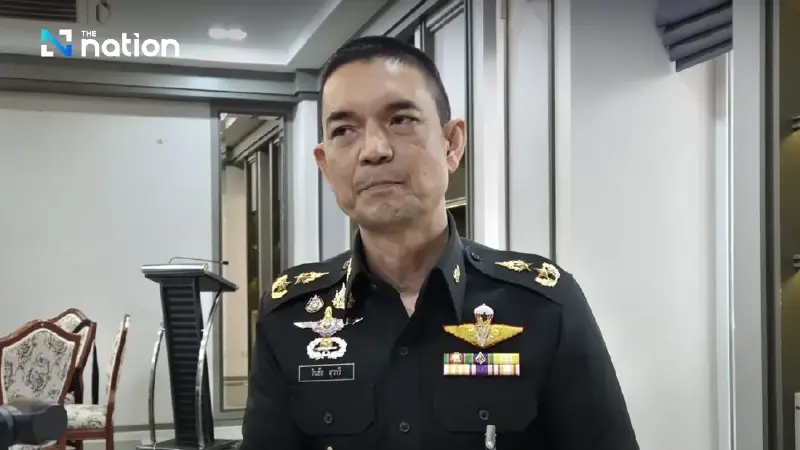


Thai Army rejects Cambodia’s Prak Sokhonn’s UN claims of 650,000 displaced, saying figures are exaggerated and ceasefire terms remain in force
On February 26, 2025, Maj Gen Winthai Suvaree, spokesperson for the Royal Thai Army, responded to remarks by Prak Sokhonn, Cambodia’s Deputy Prime Minister and Minister of Foreign Affairs and International Cooperation, delivered at the 61st session of the United Nations Human Rights Council (UNHRC) in Geneva, Switzerland, on February 24, 2026, concerning the Thailand–Cambodia border situation.
Winthai said the statement contained points relating to the Thai Army that were not factual and were inconsistent with the ceasefire terms set out in the joint statement signed on December 27, 2025, as follows:
1) Claim that the “second ceasefire” is fragile and Thailand must strictly comply
Prak was quoted as saying the second ceasefire reached at the end of 2025 was “fragile” and calling on Thailand to respect and strictly comply with all ceasefire agreements.
Winthai said the ceasefire under the joint statement is not fragile as claimed, but rather a strong, jointly agreed framework that can lead to peaceful solutions—provided all sides sincerely adhere to it. Thailand and Cambodia agreed to and signed the joint statement on December 27, 2025.
He added that throughout the period, the Thai Army has prioritised strict compliance. He alleged, however, that Cambodia has repeatedly acted inconsistently with the agreement, including presenting distorted information to international forums, engaging in provocative conduct by frontline personnel, and failing to demonstrate sincere intent to cooperate on clearing landmines along the border.
He said the Cambodian deputy prime minister’s remarks reflected a lack of importance attached to the jointly agreed framework and did not support a genuine peaceful-resolution process.
2) Claim that Thai troops expanded operations, displacing 650,000 civilians
Prak was quoted as saying Thai military operations expanded into several border areas, displacing more than 650,000 civilians, with more than 80,000 unable to return home; homes were destroyed; military infrastructure was established; and access was blocked with barbed wire.
Winthai said several locations are within Thai sovereignty, but Cambodia has encroached for a long time—something Thailand has consistently rejected and does not accept.
He said that in some areas during past fighting, the locations were used as sites from which Cambodia attacked and harmed Thai soldiers and civilians. Thailand therefore deemed them operationally important and high-risk for the safety of Thai personnel and the public, making it necessary to control and monitor those areas to prevent them being used for attacks against Thailand.
After the ceasefire agreement on December 27, 2025, he said forces were maintained in some of those areas for monitoring purposes, in line with Joint Statement Clause 2, which states: “Each side shall maintain its deployment in the same areas after the ceasefire.”
As for obstacles placed using shipping containers and barbed-wire fencing, he said these were temporary security measures to prevent confrontation that could lead to clashes in the area.
Regarding the claim of 650,000 displaced Cambodian civilians, Winthai said the figure appeared far beyond reality. He said that when both sides conducted military operations in response to each other, Thailand tried to limit the use of weapons strictly to military targets posing threats to Thailand, primarily within the border-line area, so as not to affect Cambodian people in other areas—consistent with international humanitarian principles.
He also rejected as false the claim that as many as 80,000 Cambodians could not return home. He said Cambodia was attempting to distort the facts, and that in reality, in three main villages in Sa Kaeo province, there were no more than 1,000 households—or only several thousand individuals.
He said this group consisted of Cambodian people who had encroached and settled within Thai sovereign territory, stemming from Thailand’s past assistance to Cambodian refugees during Cambodia’s internal conflict. Over the years the community expanded continuously, despite Thailand repeatedly raising objections and urging Cambodia to address the issue, which he said Cambodia ignored and did not cooperate on. He argued that this group should not be classified as displaced persons, but rather as trespassers or encroachers on Thai sovereignty.
Therefore, instead of criticising Thailand in international forums on this matter, he said Cambodia should manage and care for its own citizens in a way more consistent with international humanitarian principles, similar to how Thailand cared for Cambodian migrants in the past.
“From this incident and previous ones, it can be seen that although Cambodia knows the facts well, it continues to present distorted information to international forums in an attempt to reduce Thailand’s credibility, or to use the information to obtain humanitarian support from foreign countries. This is inappropriate and contrary to the ceasefire agreement. We therefore call on Cambodia to stop repeating the same information that is inconsistent with the facts, which may further intensify tensions between the two countries. Cambodia should instead work seriously and sincerely with Thailand to resolve issues constructively under bilateral mechanisms,” Winthai said.
