
Sihasak denies Cambodia’s territorial claims, urges peace
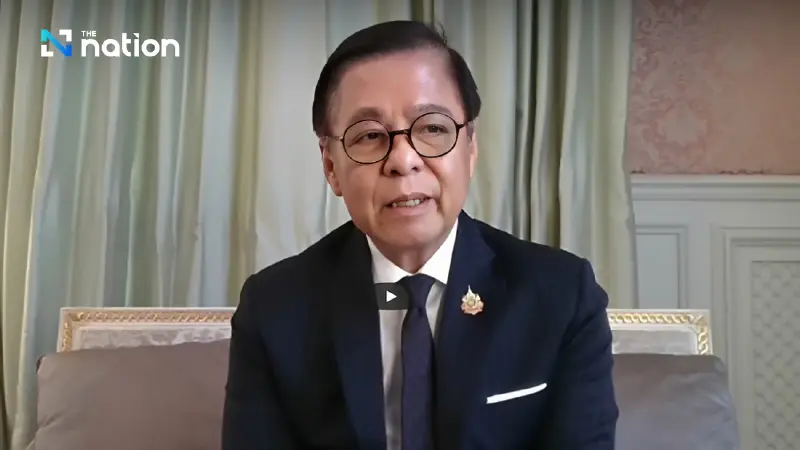


Foreign Minister Sihasak rejects Cambodia’s territorial claims, stresses peaceful diplomacy and urges both sides to avoid provocation and misinformation
On February 23, 2026, Thai Foreign Minister Sihasak Phuangketkeow spoke to France 24, denying accusations that Thailand has occupied Cambodian territory. He responded to comments made by Cambodian Prime Minister Hun Manet in the United States, which claimed that Thailand is occupying not only the border area but also parts of Cambodia.
Sihasak reiterated that Thailand and Cambodia have reached a ceasefire agreement, although he acknowledged that it remains fragile. He explained that both sides must continue building confidence and that military forces from both countries should remain at their positions. He added that negotiations for a future border agreement should move forward, pointing out that Cambodia had encroached on Thai land before the conflict started.
“We need to work to avoid escalating the situation, avoid provocation, and avoid misinformation and distortion of facts. We need to maintain peace so we can move forward with our relations. Thailand believes that in the end, we must live peacefully with all our neighbouring countries and live together in prosperity. This is our goal, and I want to confirm this,” Sihasak stated.
Regarding the accusation of territorial occupation, Sihasak emphasized that the ceasefire agreement requires both sides’ troops to remain in their current positions, while future discussions will address border issues. He also pointed out that before the conflict, Cambodia had encroached on Thai territory, urging both sides to consider the facts and avoid escalating the situation with provocation or incorrect information.
Response on container and barbed wire issue: confirmed within Thai territory
When asked about accusations that Thai soldiers had placed containers and barbed wire in areas Thailand had previously accepted as Cambodian territory, Sihasak disagreed with the accusation. He confirmed that the area where the barriers were installed was within Thai territory, and that the encroachments had been ongoing for some time. He recalled the past conflict when Thailand accepted around 400,000 Cambodian refugees, but after the conflict ended and peace was restored, many Cambodian villagers refused to return to their land.
Sihasak denied the claim that Thailand had encroached beyond its territory, stating that it was entirely incorrect.
On Thai Prime Minister's stance: Defend sovereignty, no compromise
The host asked about Thailand’s Prime Minister’s tough stance, refusing to back down or dismantle border barriers, including the idea of building a border wall. Sihasak explained that Thailand had to take necessary measures to protect its sovereignty and territorial integrity, possibly including defensive measures in some areas to prevent encroachments. He said that the future direction depends on Cambodia’s stance: whether they want to pursue peace or continue down the path of conflict. This, he noted, is Cambodia’s decision.
He reiterated that Cambodia has made this a matter between nations and continues to make false claims even after the ceasefire. Sihasak urged that both sides need to act with restraint, avoid provocation, and move towards better relations. He expressed concern that Cambodia’s actions were more about moving backwards than advancing the relationship.
On communication with Cambodia’s Foreign Minister
The host then asked whether Sihasak had communicated with Cambodia’s Foreign Minister or if there had been direct talks between the two leaders. Sihasak confirmed that he had communicated with Cambodia’s Foreign Minister via WhatsApp to prevent misunderstandings and reduce the risk of the situation escalating into a conflict. He also noted that Thailand had recently undergone elections and was in the process of forming a new government. Some issues may need to wait for the new government to take office. During this transition, he urged both sides to maintain calm and avoid situations that could lead to further conflict, as this would result in even greater losses, which he believed would not benefit either country.
On Cambodia’s claims of intercepting Cambodian citizens in Thai waters
Sihasak addressed Cambodia’s claims that Thailand had intercepted three Cambodian citizens in what Cambodia considered its waters. He affirmed that Thailand was operating within its own waters and, if any incursions were made into Thai territory, Thailand would have to act according to its duties. He further mentioned that Cambodia often employs pressure tactics and attempts to portray Thailand as the aggressor, which he rejected.
On Myanmar: Thailand’s position and peace-building efforts
The host also asked Sihasak about Thailand’s position on Myanmar following his meeting with Myanmar’s Foreign Minister, as well as efforts to bring Myanmar back into the ASEAN framework nearly five years after the military coup. Sihasak clarified that Thailand did not recognise or support the election results in Myanmar but acknowledged that it was a reality. He stressed that Myanmar needed to move towards dialogue, reconciliation, and a peace process, which is Thailand’s message.
Sihasak explained that Thailand’s approach was to call on Myanmar to show sincerity and effort in the peace process. He reiterated that Thailand, as a neighbouring country, had a direct interest in Myanmar’s stability and lasting peace. He confirmed that Thailand is actively working to promote peace, not just hoping it will happen by itself.
