
Makha Bucha night to bring a rare total lunar eclipse over Thailand on March 3
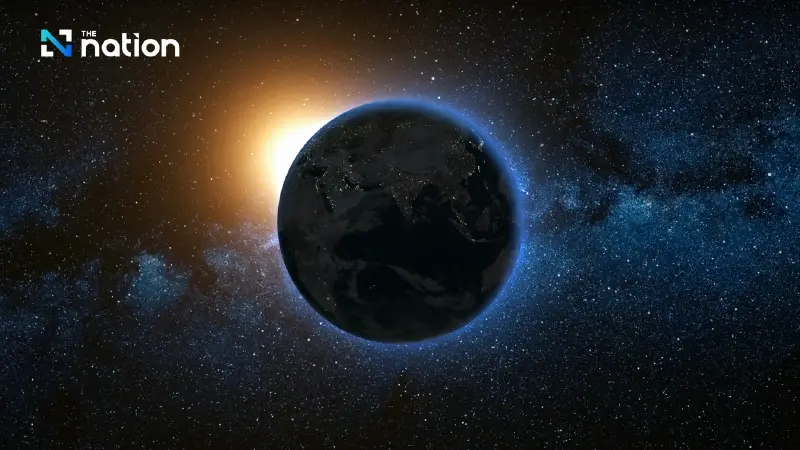


The full Moon is set to glow brick-red (“Blood Moon”) during a total lunar eclipse on 3 March 2026, with the most striking phase lasting about 39 minutes after moonrise in Thailand.
- A rare total lunar eclipse will be visible over Thailand on the night of March 3, which is also Makha Bucha Day.
- The Moon will appear brick-red, or a "Blood Moon," and can be seen with the naked eye from moonrise at approximately 6:23 PM.
- The total eclipse phase, where the Moon is fully red, will last for 39 minutes.
- This event is considered rare, as the next total lunar eclipse visible from Thailand will not occur until the end of 2028.
A rare astronomical event, a total lunar eclipse, will take place on March 3, which also falls on Makha Bucha Day.
The National Astronomical Research Institute of Thailand (Public Organisation) (NARIT) says the Moon will appear brick-red across the entire disk.
If you miss this viewing, the next one will not happen again until the New Year period, from the night of December 31 2028, into January 1 2029.
On Makha Bucha night, the eclipse will occur from 3.44pm–9.23pm (Thailand time, Bangkok).
In Thailand, it can be seen with the naked eye from the moment the Moon rises above the eastern horizon at around 6.23pm onwards.
The full Moon will appear brick-red, often called a Blood Moon, until about 7.02pm, lasting 39 minutes.
After that, the eclipse can still be followed until the event ends.
A lunar eclipse happens when the Sun, Earth, and Moon align in the same plane, with Earth between the Sun and the Moon.
It occurs only at full Moon (around the waxing 14th–15th lunar nights).
As the Moon moves through Earth’s shadow, people on Earth see the Moon gradually “bite” away until it is fully in Earth’s dark shadow, then appear “bitten” again as it exits.
In ancient Thai tradition, this was called “Rahu swallowing the Moon.”
Although the Moon orbits Earth every month, a lunar eclipse does not happen at every full Moon because the Moon’s orbital plane is tilted by about 5 degrees relative to Earth’s orbital plane, so the Moon often passes above or below Earth’s shadow.
On average, lunar eclipses occur at least twice a year, but visibility depends on geographic location.
Dates, times, and viewing areas can be calculated accurately in advance.
For the best viewing, choose an open area with a clear view of the eastern horizon, without buildings or trees blocking the view, such as a high rooftop, viewpoint, or seaside location.
If the weather is unfavourable (heavy cloud or rain), visibility may be poor.
NARIT has announced five main observation points:
- Princess Sirindhorn AstroPark, Mae Rim District, Chiang Mai
- Regional Observatory for the Public, Nakhon Ratchasima
- Regional Observatory for the Public, Chachoengsao
- Regional Observatory for the Public, Songkhla
- Regional Observatory for the Public, Khon Kaen
On the night of March 3, from 6pm–10pm, the public can join to watch the total lunar eclipse on Makha Bucha Day and observe other interesting celestial objects.
Entry is free, or viewers can watch a live broadcast on NARIT’s Facebook and YouTube channels.
