
Total lunar eclipse on March 3; brick-red Moon visible nationwide in Thailand
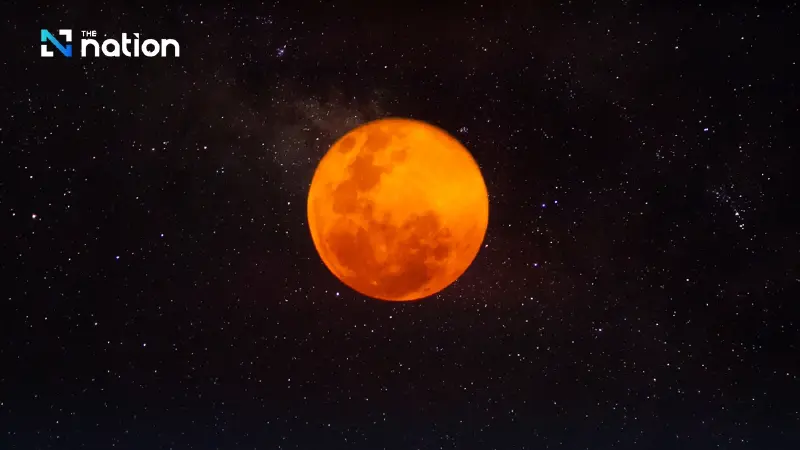


The eclipse coincides with Makha Bucha Day, with totality expected around moonrise and free public viewing events planned at NARIT sites across the country.
- A total lunar eclipse will be visible nationwide in Thailand on the evening of March 3, 2026.
- The Moon will appear brick-red and will be visible to the naked eye as it rises above the eastern horizon.
- For viewers in Thailand, the Moon will rise around 6:23 p.m. while already in the total eclipse phase, which will be observable for approximately 39 minutes.
- The National Astronomical Research Institute of Thailand (NARIT) will host free public viewings at five locations and provide a live stream of the event.
Get ready for a major astronomical event to close out the first quarter of the year, as a total lunar eclipse will take place on the night of Makha Bucha Day, March 3. This one is special: the Moon is expected to appear brick-red from the moment it rises above the eastern horizon, allowing people in Thailand to enjoy the spectacle with the naked eye nationwide.
The National Astronomical Research Institute of Thailand (Public Organisation), or NARIT, reported that a lunar eclipse will occur on March 3, coinciding with Makha Bucha Day.
The event is expected to run from around 3.44pm–9.23pm (Thailand time, Bangkok).
The Moon will enter Earth’s penumbra at 3.44 pm, then move into Earth’s umbra, creating a partial lunar eclipse at 4.50 pm, before reaching the total lunar eclipse phase from 6.04 pm–7.02 pm.
After that, the Moon will again appear partially “bitten” as it gradually exits Earth’s umbra.
The partial lunar eclipse will end at 8.17pm, and the Moon will fully leave the penumbra, bringing the event to an end at 9.23pm.
For Thailand, the Moon is expected to rise above the eastern horizon at around 6.23 pm, which falls during the total-eclipse period.

Viewers will see a full Moon in a brick-red shade rising from the horizon, visible with the naked eye across Thailand (times may vary by location) until about 7.02pm, a total observable totality of 39 minutes.
After that, the eclipse will proceed through partial and penumbral phases before ending, in that order.
Beyond Thailand, the eclipse can be observed in many parts of the world, including Asia, Australia, North America, South America, the Pacific Ocean, the Atlantic Ocean, the Indian Ocean, and parts of the Arctic and Antarctica.
A lunar eclipse occurs when the Sun, Earth, and Moon align in the same plane, with Earth positioned between the Sun and the Moon.
It happens only at the full Moon phase (around the 14th–15th night of the waxing Moon).
As the Moon moves into Earth’s shadow cast into space, observers on Earth see the Moon gradually darken until it is fully within Earth’s umbra, then see the “bite” appear again as the Moon moves out of the umbra. In ancient Thai tradition, this phenomenon was called Rahu swallowing the Moon.
However, a lunar eclipse is a natural phenomenon caused by the Moon’s orbit around Earth.
Because the Moon’s orbital plane is tilted by about 5 degrees relative to Earth’s orbital plane, the Moon does not pass through Earth’s shadow every month, instead moving “above” or “below” it.
Lunar eclipses occur on average at least twice a year, but visibility depends on geographic location, and the date, time, and visibility region can be calculated accurately in advance.
Check five observation points nationwide, by NARIT
The National Astronomical Research Institute of Thailand (NARIT) is inviting the public to join free telescope viewing from 6pm–10pm at five main locations:
- Princess Sirindhorn AstroPark, Mae Rim District, Chiang Mai
- Regional Observatory for the Public, Nakhon Ratchasima
- Regional Observatory for the Public, Khon Kaen
- Regional Observatory for the Public, Chachoengsao
- Regional Observatory for the Public, Songkhla
For those unable to travel, the event can be followed via live streams on NARIT’s Facebook and YouTube channels.

