
TCC to open beverage plants in Vietnam


Charoen Sirivadhanabhakdi, chairman of TCC Holding, which has many diversified subsidiaries, plans to set up plants in Vietnam for the production of its major beverages, notably beer and non-alcoholic drinks.
Among TCC Holding’s major units are Thai Beverage, the maker of Chang beer, Oishi Group, the leading producer of ready-to-drink green tea, and Berli Jucker, which already has extensive business interests in Vietnam.
Charoen is also chairman of Berli Jucker.
He said investment in beverage facilities in Vietnam would, however, not occur before 2015, when the Asean Economic Community (AEC) is fully implemented and by which time the company has established a firm distribution network and support manufacturing facilities, such as glass containers and aluminium cans, in the country.
“We need to develop strong business fundamentals in Vietnam, in the areas of human resources, logistics and distribution, and support facilities such as product containers and packaging, before setting up our beverage plants there,” he said yesterday.
He said the establishment of bottling plants for its major alcohol and non-alcohol beverages in Vietnam was not a difficult task and could be implemented quickly when the timing comes.
Charoen added that TCC Holding was currently conducting a feasibility study and business planning for the investment in its first beverage facility in Vietnam.
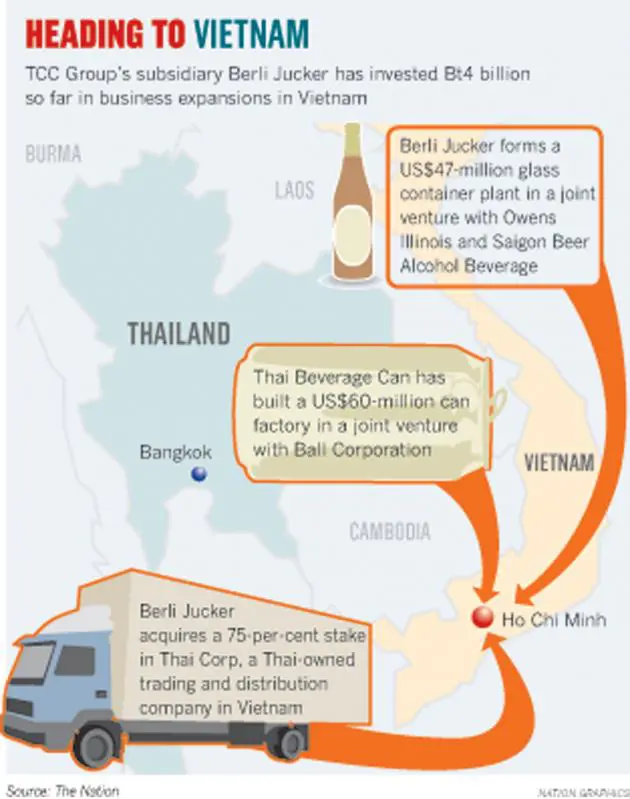
Berli Jucker early this week officially opened its glass-container factory in Vietnam in partnership with US-based Owens-Illinois and the country’s Saigon Beer Alcohol Beverage Company.
Located some 60 kilometres southeast of Ho Chi Minh City, the US$47-million (Bt1.44 billion) factory will initially produce about 75,000 tonnes annually of mainly returnable premium glass containers for Vietnam’s beer, wine, spirits, soft drink, food and pharmaceutical |markets.
The new plant has the capacity to adapt to market trends, being extendable to four lines with a production capacity of 84,000 tonnes of glass annually.
“Thai beer is now achieving international standards in taste and quality. We have the same production know-how as other international breweries,” said Charoen.
“We have recently launched our export beer, Chang Export, in the Thai market to reflect the brand’s international standard and to complement our existing Chang Classic, which has been developed to suit the taste of Thai drinkers, who prefer stronger beer,” he added.
Charoen said the establishment of beverage plants in Vietnam would allow the company to reduce costs, especially for transportation, and enable its logistics and distribution subsidiary Thai Corp International to work more efficiently.
Thai Corp International currently distributes Thai products in Vietnam, covering more than 50,000 wholesale and retail outlets.
The company achieved Bt1.8 billion in overall sales last year, up 24.1 per cent over 2010. Sales are expected to increase to Bt3 billion within the next three years, and to Bt10 billion within 10 years.
Meanwhile, Berli Jucker president Aswin Techajareonvikul said the Berli Jucker Group posted sales growth of 20 per cent last year.
“We will invest about Bt4 billion this year in maintaining and upgrading existing factories, including for tissue papers and glass containers. The budget, however, does not include mergers and acquisitions to be made during the year,” he said.
The company is looking to acquire distribution and logistics companies in Thailand, Vietnam and Burma, he added.
“We have invested Bt4 billion in Vietnam over the past 10 years. Our businesses in Vietnam generate more than Bt4 billion in combined sales annually, which accounts for about 10 per cent of Berli Jucker Group’s business,” said Aswin.
Berli Jucker Group achieved Bt30 billion in sales last year, up from the Bt25 billion posted in 2010.
“About 90 per cent of our group’s business is generated in Thailand. However, by 2015, when the Asean Economic Community is fully implemented, we expect the business contribution from Vietnam will rise to 15 per cent,” said Aswin.
