
PTG Energy expects ranking boost after fund-raising
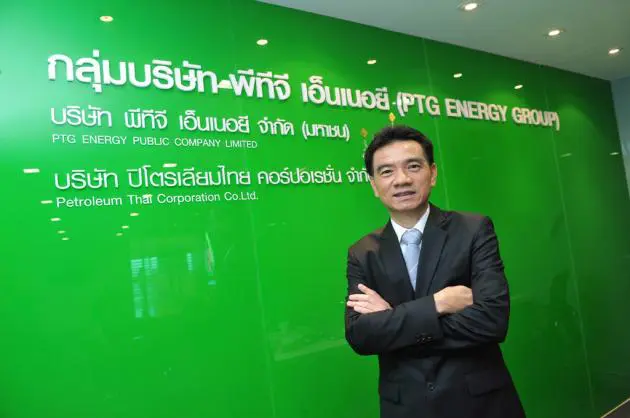


PTG Energy, the country's sixth-largest oil retailer in terms of the number of fuel stations, aims to become the third-biggest by the end of next year, largely on anticipated strong support via a public fund-raising on the stock exchange.
The company plans to expand its number of tank farms and fuel stations, the size of its truck fleet and rebrand its PT operations to achieve the target, chief executive officer Pitak Ratchakitprakarn told The Nation in an interview last week.
PTG Energy started business as Paktai Chueplerng in 1988 with two tank farms in Samut Sakhon and Chumphon and distributed gas for local communities, the fishing industry and factories in the South before expanding its fuel depots to six locations across the country.
Overall, there about 18,000 fuel stations in the Kingdom, of which 5,000 are branded. PTT ranks as the top oil retailer in terms of the number of stations, followed by Bangchak, Shell, Caltex and Esso. PTG Energy ranks sixth.
The key to success is economy of scale, Pitak said, explaining that the company had been able to reduce its per-unit costs as a result of the use of larger trucks capable of carrying as much as 45,000 litres, against 30,000 litres previously. It also has 10-wheeled trucks that can carry 20,000 litres.
Expanding the number of fuel stations is also helping leverage rapid sales growth, he added.
“Owning a fleet of trucks is the heart of logistics cost management for oil retailers,” said the CEO.
The best net margin the company can operate at is 1 per cent, meaning that the lower its costs are, the more it can save and the higher its profits will be, he said.
PTG Energy has about 500 fuel stations around the country, of which 330 are owned and operated by company and the rest are owned and operated by dealers. This translated into sales of 660 million litres valued at about Bt20 billion in the first half of the year.
Last year, the company had 440 petrol stations and posted sales of 950 million litres for Bt27.8 billion, generating a net profit of Bt200 |million.
In 2010, it had 360 fuel stations, sold 550 million litres for Bt17 billion and made a net profit of Bt80 |million.
“We been opening an average of 10 new stations a month,” Pitak said.
About 70 per cent of revenue is from retail operations, with the remainder being wholesale business.
The company offers its dealers a guaranteed minimum marketing margin of 70 satang per litre, which could be raised to 90 satang as one of its marketing strategies, he said.
However, its bargaining power on the supply side is relatively low, Pitak added, as almost of its oil is supplied by Thai Oil.
Nonetheless, Pitak said the company believed that a strong point of its fuel stations was that most of the oil it sells is diesel, which means it can attract more agricultural truckers than other operators.
PTG Energy has six tank farms covering every region of the country. Besides those in Samut Sakhon and Chumphon, the facilities are in Lampang, Khon Kaen, Saraburi and Nakhon Srithamarat.
It will open a seventh depot, in Nakhon Ratchasima, in October.
In its initial public offering, the company plans to sell 420 million shares, accounting for 25 per cent of its paid-up capital.
It expects to submit its filing to the Securities and Exchange Commis-sion this quarter.
After being publicly floated on the stock exchange, the major stakes in PTG Energy held by the Ratchakit-prakarn, Witjitthanarak and Vachi-rasakpanich families, which own 40 per cent, 20 per cent and 10 per cent respectively, will be diluted.
