
Thai pavilion proves a hit at Moscow tourism trade fair
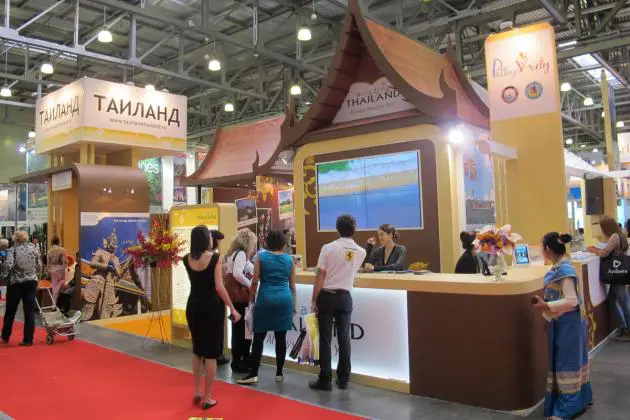


The Tourism Authority of Thailand's pavilion was a standout at the Moscow Autumn Travel Industry Week, or MATIW-Leisure 2012, one of the world's biggest leisure trade fairs. The TAT pavilion occupied 274 square metres, at a cost of Bt10 million plus decor
The highlights of the event were spa/massage and medical services. The exhibitors in traditional Thai dress were busy welcoming guests for a trial massage. Umbrella painting was also on show to add colour to the Thai atmosphere.
Throughout the day, Thai-boxing shows were held to demonstrate Thai martial arts as a magnet for visitors. Without a doubt, the Thai pavilion was of the most interesting ones at the mart, proved by the long line of people wanting tourism information and to try out the spa and massage service.
“Look at the event: Our nation differentiates itself from other nations selling cultural and natural products. We have spa and medical services as today’s popular trend,” said Tanes Petsuwan, TAT’s director for Europe, Africa and the Middle East.
This was the scene at MATIW, held from September 19-22. Interestingly, the Thai pavilion was surrounded by those of Asean rivals such as the Philippines, Malaysia and Indonesia. Participation in their events made it clear that the Russian market is very promising, with more and more travellers, paving the way for business opportunities as Asean countries strive to get a slice of this lucrative cake.
The first two days of the four-day event were only for trade visitors, and the rest for the public. There were 37 participants including hotels, travel agencies and other tourism-related business, while 31 buyers from Belarus, Kazakhstan and Ukraine were invited to meet 17 Thai operators. The TAT charged Thai operators Bt50,000 each to join the event.
Last year, Russia’s population was 142 million. In 2010, the Russian Federal Agency for Tourism recorded 13 million travelling outside the nation.
Thailand is one of the key tourism destinations for Russians. According to the TAT, about 1.05 million Russian travellers visited Thailand last year, an increase of 63.45 per cent from 2010. Also during the period, there were 101,425 travellers from nations in the Commonwealth of Independent States, the former Soviet republics including Kazakhstan, Ukraine, Uzbekistan, Belarus and Turkmenistan.
This year, it is expected that the number of Russian and CIS travellers coming to Thailand will total 1.27 million, an increase of 10 per cent from 2011. In the first half of this year alone, the number of Russian visitors to Thailand was recorded at 671,122, an increase of 18.72 per cent year on year.
TAT adviser Auggaphol Brickshawana said Russia was a key market for Thai tourism in the European region. In 2004, fewer than 100,000 Russians travelled to Thailand, but now it has become the first European nation to break the 1 million mark for travellers to the Kingdom.
Last year, Malaysians were the No 1 visitors, numbering about 2.4 million, followed by 1.7 million Chinese, 1.1 million Japanese, and then Russians. Since achieving political stability, Russia has shown big potential because of growing economic prosperity, which drives the number of charter flights to Thailand.
Tanes said keeping the focus on the Russian market was a clear trend towards serving the government’s policy to achieve Bt2 trillion in annual tourism revenue by 2015. Tourism from Russia will also help offset the declining market in other European nations that are facing financial problems.
Sunny beaches and a tropical climate have lured Russians’ hearts. Sixty per cent of the travellers from Russia and the CIS nations have gone to Pattaya. The sprawling beaches in the Southern region from Samui, Phang Nga and Krabi to Satun are being promoted as new destinations. Typically, Russian visitors like to drink and have fun, while some prefer to go on shopping sprees.
According to a TAT release, travellers from Russia and CIS nations spend Bt4,297 per day per head, with an average stay of 13.29 days at present.
However, medical treatment and wedding organising are also becoming popular draws for Russians. In the former category, they like to undergo beauty surgery and herbal treatments, beyond treatment for medical ailments.
“Medical and beauty treatment will be the focus of the TAT, which wants to attract quality tourists with high spending,” Tanes said. Currently, the high number of Russians coming to Thailand is important, with quality niche travel for this market to come later.
Neil Maniquiz, head of the international marketing for international marketing department of Bangkok Hospital Pattaya, welcomed the move and saying that after attending the leisure market in Moscow for three years, the number of Russians started to increase about 80 per cent in the second year.
