
Chevron to invest in new stations, offer more secondary products


Play
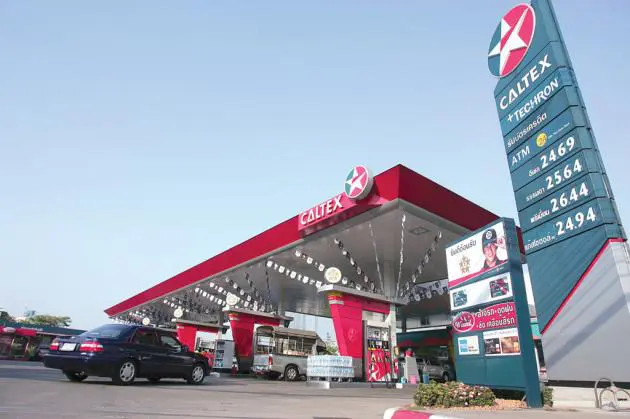
Chevron yesterday announced a significant retail investment plan that included opening new outlets, refurbishing petrol stations, and offering non-oil-related products at its Caltex stations.
Salman Saadat, country chairman and general manager for products at Chevron (Thailand), said that besides opening new stations, it would work with the operators of existing Caltex stations to provide new products, including food and beverage outlets, convenience stores, lubrication bays and car workshops.
Chevron currently has four “ancillary profit centre” (APC) partners, namely FamilyMart, Caffe D’Oro, Black Canyon and B-Quik.
“We will work with our retailers to add new offerings, such as with our APC partners,” he said.
About 90 per cent of Caltex stations are so-called ro-ro outlets – that is, retailer-owned and retailer-operated.
After a consolidation that saw the closure of many unprofitable outlets over the past four or five years, oil companies have resumed their retail expansions. Shell, Thailand’s fourth-largest fuel retailer, announced early this month that it would open 30 new sites in each of the next three years, after halting such expansion for nearly 10 years.
Chevron, which has built close to 60 new retail outlets during the past three years, has committed to its plan announced late last year to add close to 100 stations within the next three to four years.
“The challenge is to find the right sites,” Saadat said.
To make its retail outlets more competitive, Chevron aims to increase the number of Caltex stations that have APC or other secondary offerings by 20 this year, and another 20 in 2015. At present, 60 Caltex stations already have at least one APC outlet.
“The Thai market is highly competitive. A silver lining is that consumption is growing, in the automotive, logistics and commercial sectors.
“But consumers are more demanding. They are looking for additional products and services,” he said.
Chevron plans to introduce a loyalty programme by the end of this year and is also looking to launch an online campaign to enhance consumers’ experiences.
Saadat said Chevron was committed to refurbishing “20-plus” retail outlets every year, after converting one-third of its network to the new look since kicking off the programme three years ago. The refurbishment varies from just a signage change to putting in new fuel tanks that require substantial investments.
Chevron has become the last of the major oil companies to enter the premium diesel segment, introducing Caltex Power Diesel with Techron D at the end of July. It plans to double the number of its retail stations that offer Power Diesel, aiming to tap the niche segment of luxury diesel vehicle owners, to 50 by year-end.
At present, Caltex, Shell and Bangchak price their premium diesel products Bt3.43 a litre higher than for normal diesel, while PTT and Esso set the price gap at Bt3 a litre.
Saadat said Chevron’s financial performance during the first half of this year was in line with its targets, despite the difficult economic situation.
Chevron opened 22 new retail stations last year, compared with Shell’s 12 new openings.
He said Chevron was waiting to hear the government’s energy policy and it hoped there would be a “more balanced approach” in terms of pricing, tax, and the Oil Fund’s structure, as well as less subsidisation of diesel fuel.
“We’re one of the markets that have very a low [fuel sales] margin,” he said, adding that Singapore and Malaysia were offering fairly high sales margins for fuel retailers.
At the press conference yesterday, Chevron said it currently had “close to 400” service stations in Thailand. According to the official figures from the Ministry of Energy’s Energy Business Department, as of March 31, there were a total of 23,081 fuel retail stations in Thailand. PTT Group led the pack with 1,621 stations, followed by Bangchak with 1,065 outlets, PTG (772), Shell (517), Esso (516), Caltex (364), and Siam Gas (428). Within Bangkok and surrounding provinces, the official figures showed Caltex had 91 retail outlets, the fewest among the top five brands. PTT group had 290 stations, Esso 182, Bangchak 170 and Shell 156.
