
Bayer CropScience focuses on R&D to ensure food security


Play
Aims for higher crop productivity to meet rising demand in future
To achieve higher crop productivity and secure future food security, Bayer CropScience is increasing its investment in research and development while focusing on food safety and human health through its works and products, CEO Liam Condon told an annual meeting held recently in Monheim.
“It is a great challenge for food producers to feed more than 9 billion people in the world in 2050, and Bayer realises the importance of sustainable education on agriculture, along with development of seeding and crop grains in the years to come,” he told nearly 100 reporters from 28 countries that attended the session and visited Bayer’s 100-hectare Hofchen research centre in Burscheid.
Condon reiterated Bayer’s philosophy on safety for food producers, consumers and the environment through crop-protection products safe to the three stakeholders, products which he said must be the “safest, effective and environment-friendly”.
“Business profits in agriculture must co-exist with environmental conservation and social responsibility,” he added.
At the event, Bayer CropScience introduced a new device that sprays insecticide from its base on the ground up – instead of in the other direction – to more easily minimise the fumes from spreading. This will be used with a new tool to mix insecticide in a close-system to ensure safety for farmers.
The other new device is to drop seeds through a clean channel, which increases productivity.
As these devices are expensive, they are more inclined to be used in Europe and the US, where farmers are richer.
In South Asia, where soil is generally saltier, local Bayer offices are developing rice seeds that would better withstand twofold saltiness. They will be grown in India in 2016, and later in Bangladesh and Vietnam.
For Thailand, Sinchai Sawasdichai, head of Bayer CropScience in Thailand and Myanmar, said four new products had been launched and more would come, as the Kingdom, which Bayer has regarded as an important market for the past 52 years, had the potential to maintain its leading role in producing rice, sugar, rubber and fruit.
Bayer CropScience is an affiliate of Bayer AG and takes care of the German giant’s agriculture-related business, employing 22,400 people in 120 countries. Its sales income last year came in at 8.819 billion euro (Bt361 billion).
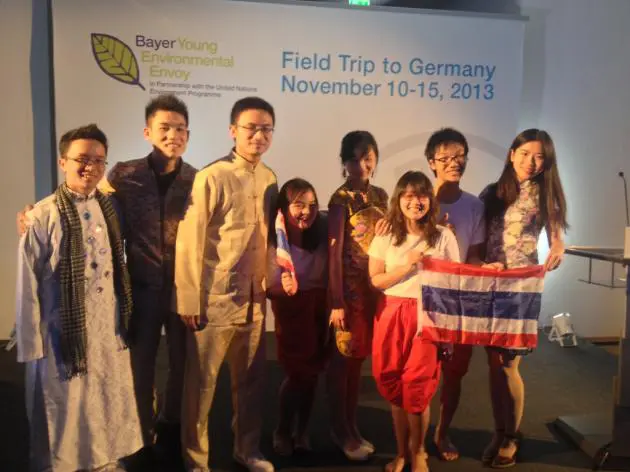
The firm also offers scholarship opportunities designed to support students with pioneering ideas in agriculture, and organises international exchange formats for young leaders interested in sharing ideas and having an open dialogue about agriculture.
For more information, visit www.ag-education.bayer.com.
Bayer CropScience is investing more than 2.4 billion euro in R&D over a three-year period, starting last year.
This will prepare the company to secure a large share of an overall crop market valued at 100 billion euro in 2020, double the value in 2008.
