
Giant UTC consolidates brands


Play
All products to come under new local unit
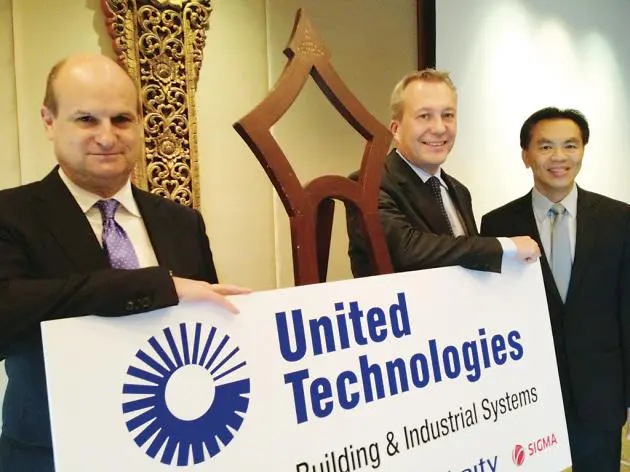
Wall Street-listed United Technologies (UTC), the world’s leading provider of aerospace and building solutions, yesterday officially launched a business operation in Thailand as part of the company’s major consolidation of brands and organisations under one company.
UTC is the manufacturer and owner of well-known brands for building components, including Carrier heating, air-conditioning and refrigeration systems; Otis elevators and escalators; Sigma elevators; and Chubb and Onity for fire and security solutions.
The company’s top executives – Philippe Delpech, chief operating office for intercontinental operations, and Patrick Blethon, president for South Asia Pacific – were in Bangkok yesterday to preside over the opening ceremony of UTC Building & Industrial Systems, its Thai operation, based at TCIF Tower on Bang Na-Trat Road. The new company will consolidate all brands and organisations that had previously operated as separate entities.
“We put all these brands under one company to better serve our customers and the market,” said Delpech, adding that the decision to consolidate was made at its headquarters in October last year.
Ardi Rammanee, managing director of UTC Building & Industrial Systems, said that under the consolidation, all sales, management and back-office departments had been merged. This strategic move gives the company more power to provide a total building solution to project customers building high-rise buildings, hospitals and hotels under a one-contact-point basis.
With headquarters in the US state of Connecticut, UTC expects to post US$30 billion (Bt985 billion) in sales this year, including all activities of building and industrial systems. It is nearly half of the company’s overall turnover targeted at $65 billion this year. The rest will be shared by aerospace and defence systems. The company employs 120,000 people all over the world.
Delpech said UTC expected its annual sales of building and industrial systems to reach $50 billion globally by 2020, including future acquisitions, and aimed to achieve average growth of about 5.4 per cent per annum.
“About 40 per cent of the world’s pollution has been generated by buildings, which released more carbon dioxide into the environment than transportation and industry,” he said. “The worldwide population has increased significantly from 3 billion to 7 billion over the past 50 years, and nine years from now the population will reach 10 billion.”
He added that 3.5 billion people were now living in cities, and 65 million moved from farms and rural areas to cities every year. They need more buildings and consume more energy. These have created a trend of intelligent buildings in which the release of pollution and energy consumption would be less.
Blethon also said that in Thailand, the level of urbanisation had increased significantly from 31 per cent in 2000 to 48 per cent in 2013. In Germany, the level of urbanisation is now reaching maturity at 80 per cent. In India the urbanisation rate is now at 42 per cent and in China, 50 per cent.
He added that Asean in particular currently had a population of more than 600 million, and a $2.3-trillion total gross domestic product. The company has seen a lot of opportunities in this Asean Community. UTC has factories for building components in Thailand, Singapore, Malaysia and the Philippines.
Blethon said the company was also looking and evaluating the market to set up a business operation in Myanmar in the near future.
Delpech said: “We are actively present in Thailand. Besides Singapore, we consider Thailand the company’s largest market in Southeast Asia.”
He said the Thai operation, including local joint ventures, currently employed 3,000 people. It expected to earn Bt16 billion in sales this year with double-digit growth compared with last year.
Despite a mature market for building components in Bangkok, the company sees growth potential and a lot of opportunity in Thailand.
Delpech said worldwide sales of UTC for building systems were now equally generated by the United States, Europe and Asia, about one-third each. However, he anticipated that in the next 10 to 15 years, 40 per cent of total sales would come from Asia.
