
Artificial intelligence rules on agenda for G-7 tech ministers


Play
TOKYO - The government will propose the establishment of common international rules on research and development of Artificial Intelligence (AI) at the Group of Seven information and communication technology ministers’ meeting to be held in Takamatsu city
Some experts in the field predict that AI will have higher-level capabilities than human brains by 2045. An increasing number of people say it is necessary to establish systems to prevent AI programmes from running out of control and harming humans, and to prevent AI programmes from leaking personal information.
The government wishes to establish international rules with which AI developers will have to comply, and to encourage AI development while also securing safety for humans.
At the G-7 ministers’ meeting, Internal Affairs and Communications Minister Sanae Takaichi will present Japan’s draft of guidelines for the development of AI, and then call for cooperation from other countries in making the rules.
The participants in the meeting are planning to share information about the possible effects of AI on societies and economies. The Japanese government expects ministers at the meeting will confirm their position that as many countries as possible should continue to discuss the issue at international conferences.
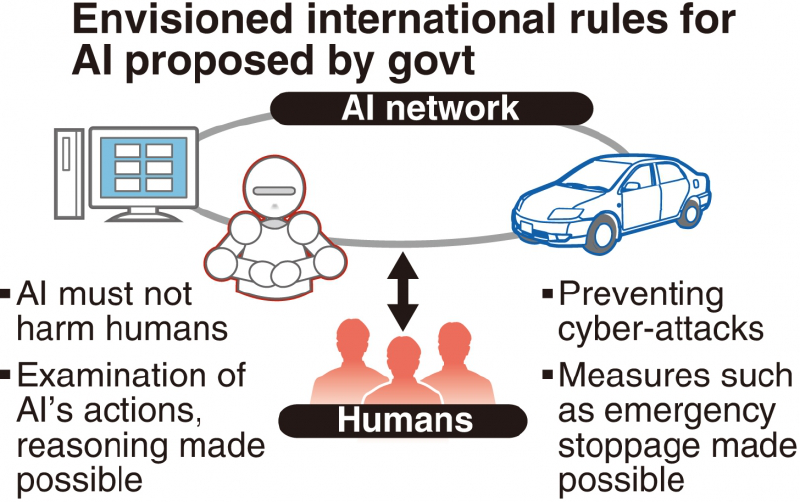
The government will propose about eight principles as guidelines for national governments and private companies to follow when they develop AI programmes.
Practically, the guidelines will likely include the following points:
■ AI programmes should be designed to not pose dangers to human lives and physical safety;■ When AI programmes get out of control, it must be possible to make emergency stops and correct wrong trains of thought;■ AI programmes should be able to protect themselves from cyber-attacks so that people with malicious intentions cannot take control.
The information-processing capabilities of AI programmes have been rapidly rising, as was seen in one AI programme’s victory over the world’s top Go player recently.
AI programmes are expected to play active roles in the future in various fields, such as industrial and medical work.
The Internal Affairs and Communications Ministry’s expert panel estimated that economic effects from AI in Japan will be worth 121 trillion yen around 2045.
Many countries, including Japan, the United States, European nations and China, are fiercely competing in AI development. But as yet there are no international rules to help humans and AI programmes coexist safely.
(US$1 = 109 yen)
