
Local banks told to cash in on GMS
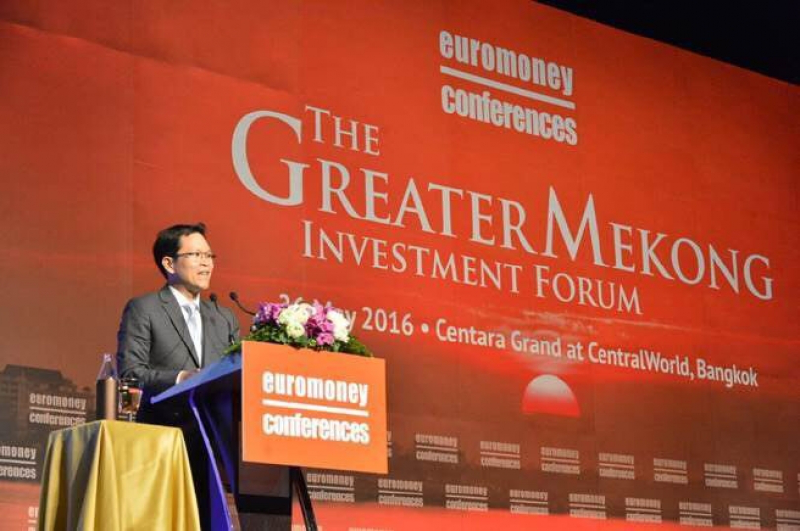


THAI BANKS have been encouraged to expand their presence in the Greater Mekong Subregion (GMS) to cash in on an expected influx of investments over the next few years.
In his keynote address to the “Euromoney Greater Mekong Investment Forum” yesterday, Bank of Thailand Governor Veerathai Santiprabhob mentioned plans to liberalise banking activities further by broadening cross-border banking networks.
“We encourage Thai commercial banks to expand their regional presence further to support businesses operating in the GMS. In addition, we fully support foreign banks using Thailand as a springboard to expand their businesses into the subregion,” he said.
The Thai central bank has in recent years relaxed regulations to accommodate investment in the region. Businesses in the region can obtain unlimited loans from Thai banks. The BOT has also lifted the cap on carrying baht across borders from Bt500,000 to Bt2 million to support border transactions.
He added that the BOT would continue to work with regional regulators to improve payment-system connectivity to support trade, labour movement and tourism. As Thailand is building a new electronic-payment infrastructure under the National e-Payment Plan, GMS countries can leverage on this infrastructure to improve system capability and connectivity, he said.
For Veerathai, the second area to promote subregional connectivity is to foster the growth of regional capital markets, to nurture sustainable development of financial interconnections.
“In this light, Thailand is playing a proactive role to enhance our capital-market capacity, aiming to link up GMS capital markets with global investors. Firms from the GMS can raise funds in the Thai capital market to facilitate their businesses, while global investors can invest in products with GMS exposure,” he said.
On the panel on “Banking Sector Development in the GMS”, Ratchada Anantavrasilpa, senior financial-sector specialist at the World Bank, acknowledged the uniqueness of the banking regulatory framework in each country. In this regard, banking systems in the GMS countries will have to adjust to the local context. But knowledge transfer should be in place to enhance access to finance.
Tim Amstutz, chairman of Kredit Microfinance, a leading microfinance company in Cambodia, noted that countries with a mature banking industry could provide knowledge and resources to help banking industries in other countries.
In his speech, Veerathai added that the BOT was committed to promoting financial-system connectivity to facilitate closer economic integration, and was ready to move forward with partners in Thailand and elsewhere in the GMS.
Connectivity has profoundly influenced countries in the region, including physical infrastructure, people-to-people, and financial inclusion, he said.
The GMS will continue to be an ideal choice for regional and global investors, and Thailand stands ready to connect businesses wishing to benefit from this vibrant subregion, he said.
Countries in the subregion are expecting massive inflows. In Myanmar, while foreign direct investment is expected to hit US$8 billion (Bt280 billion) this year, the Asian Development Bank expects another $2 billion to $3 billion from donor countries, including investment in infrastructure projects.
Cambodia is also open for foreign investment in its 18 special economic zones, particularly to Sihanoukville, a province in the southwest, to help develop a Port Hub of the Greater Mekong Region.
Tekreth Kamrang, secretary of state to Cambodia’s Commerce Ministry, said Thai investors could tap the potential by investing in infrastructure development in Cambodia. To cooperate in promoting the GMS economy, Cambodia and Thailand could forge closer cooperation between the government and private sectors in many areas, including trading, investing, financing, and business matching.
She said GMS would create greater benefit for Cambodia and other countries in Asia by the connectivity of the region. To ensure greater benefit from regional integration, harmonising rules of laws and standards should be a priority for GMS, she said.
