
Thara Tharasak squeezes money from stone
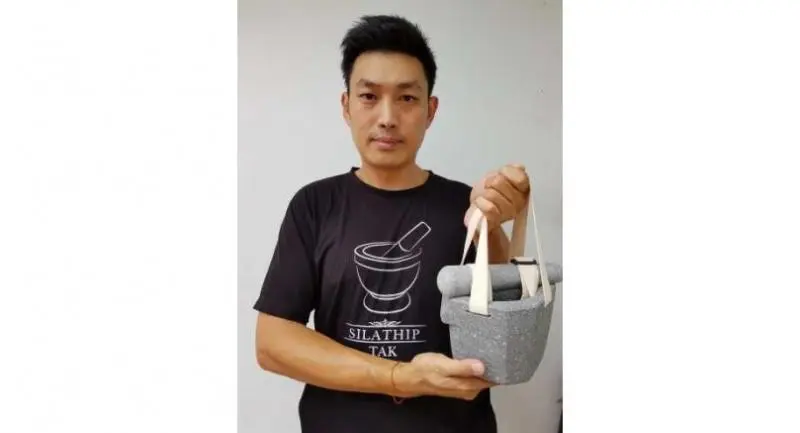


THARA THARASAK redesigns the traditional stone mortar to appeal to the tastes and lifestyles of a younger generation of customers. The result was a surge in the company’s sales in both domestic and overseas markets to more than Bt5 million a year.
And he’s doing it from Tak province, where he in 2009 moved his production plant from Chonburi province. The move was to cut costs for transporting stone from Tak, where it is quarried, to Chonburi.
But the move has “also created jobs for the community around our Granite Quarry in Tak,” he says.
Thara, age 39, is the third generation of the Tharasak family involved in the mortar business, originally in Ang Sila municipality in Chonburi.
After moving production to Tak, Thara turned his attention to researching how the traditional mortar stone could be updated to attract a new generation of users.
The simple practicality of the traditional design has survived centuries of use. In Thailand’s version of the mortar set, food ingredients have been smashed between a wooden pestle and a stone bowl, ideal for preparing Thai food.
Today’s customers have an additional requirement: being able to pick up and move the set when they move or take it on vacation.
Thara decided to create a channel in the stone bowl that could hold the pestle in place. And his big innovation was to add an attractive carrying handle.
The channel came first. “I took over than a year to design the product and launched it in the market last year. It still didn’t have the carrying handle, but had the holder for the wood food-smasher. It got positive feedback from the market with a sale price of Bt600 per set. This price is higher than for the traditional mortar, which offers a price of only Bt300 per set,” he said.
Then this year Thara added increased functionality with a carrying handle and created the Silathip brand. It also got positive feedback, including from overseas customers who saw the product at an OTOP expo, he said.
His company makes other stone products, too, including custom orders for people who want a unique looking garden. They create decorative stones, wall decorations made from granite, flowerpots, and even candlesticks.
After redesigning the mortar set, he changed the company’s production process include machines as well as hand-crafting. The result has been to reduce production waste, while also introducing more products to serve market demand.
For example, using only human hands, a 30x30x30-centimetre stone can produce a single mortar that sells for Bt200 per set. But using a combination of machine and craftsmen, the same sized stone can produce six products under the process by machine and workers – a mortar, flowerpot, two candlesticks, and wall decoration products. Together, they could sell for Bt1,000.
“We developed our production process and could also create more products to serve our customers’ demands,” said Thara. “This is also generates more income for our staff in the community, who have their own business as farmers and get additional income when they produce stone products.”
Both the new design and traditional products have enjoyed success through overseas exports to Hong Kong and Myanmar that combined amount to some Bt400,000 a year. Thara was also planning to export to neighbouring Asean countries, particularly Laos, Vietnam, and Cambodia this year.
“We believe that our design under the brand, Silathip, can meet the challenge of finding both domestic and overseas customers, including customers in Europe, where people saw our products in an OTOP expo and wanted to buy them to decorate their home, too.”
“The challenge for me is to research and develop our products to match with customers’ future demands. When we do business we have to create a function for our products that will drive our business growth and differentiate us from our competitors in the market,” he said.
