
Thai businesses eye opportunities in Russia despite sanctions challenges and balance with the West
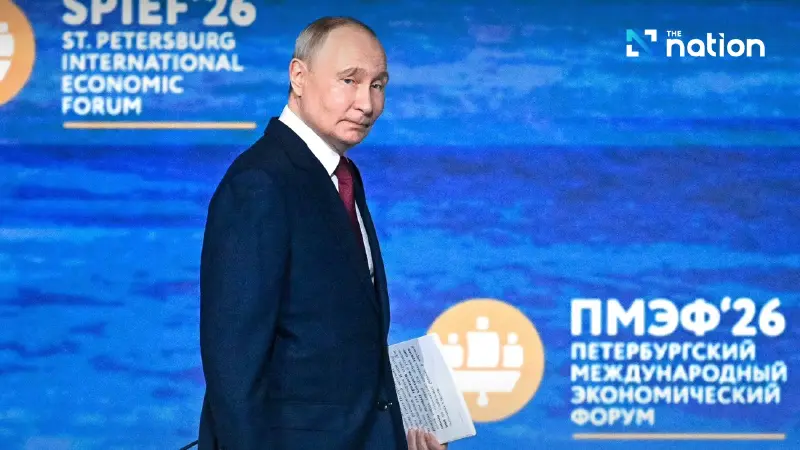


St. Petersburg, Russia - Thai businesses are increasingly exploring opportunities in Russia despite concerns over sanctions, payment restrictions and potential repercussions for companies with links to Western markets, as Thai delegates attended the St. Petersburg International Economic (SPIEF).
St. Petersburg, Russia - Thai businesses are increasingly exploring opportunities in Russia despite concerns over sanctions, payment restrictions and potential repercussions for companies with links to Western markets, as Thai delegates attended the St. Petersburg International Economic (SPIEF).
While Russia's economy remains under extensive Western sanctions following the Ukraine conflict, some Thai executives view the departure of many Western firms as creating openings for new opportunities. However, uncertainty surrounding financial transactions and so-called "secondary sanctions" continues to weigh on investment decisions.
"Most Thai businessmen have been impacted because of the financial banking system," said Wisan Wanasakissakul, Head of the Thailand-Russia Business Council Committee and Chief Executive Officer of sportswear manufacturer Warrix.
"The biggest obstacle is the payment system. If businesses are seen as conducting transactions with Russia, there are concerns that it could affect their access to international financial networks and their core businesses elsewhere,” he noted.
According to Wisan, many Thai companies with customers or operations in Europe, the United States and Japan remain cautious about publicly engaging with Russian partners.
"Some businessmen prefer not to announce meetings or business plans involving Russia because they are concerned about the impact on their relationships with Western markets," he said.
Despite those concerns, Wisan believes opportunities remain significant, particularly as competition has decreased following the withdrawal of many international brands from Russia.
"Many sanctioned-country businesses walked out, but we walk in because there are fewer competitors," he opined.
He highlighted Thailand's potential role as a regional gateway connecting Russia to broader Asian markets. Beyond tourism, which remains the most familiar aspect of Thailand for many Russians, the country could serve as a logistics, trade and investment hub linking Russia with Southeast Asia.
Thailand already exports a range of agricultural and food products to Russia, including fruit and processed food. Major Thai companies such as CPF have established operations in the Russian market, while Russia exports construction materials and industrial products to Thailand.
Wisan also sees potential in sectors such as infrastructure, health and wellness, technology and sports.
As CEO of Warrix, he revealed that the company is in discussions with leading Russian football clubs, including opportunities involving youth development, sports academies and apparel partnerships.
"We are looking for distributors and business partners in Russia. There is strong potential for growth because Russia has a large market and strong sporting culture,” he added.
To address payment difficulties, Wisan underscored that businesses from both countries have explored settlement mechanisms using trade balances and local currencies. However, he acknowledged that a more sustainable long-term financial framework would be needed to unlock larger investment flows.
Beyond traditional trade, digital cooperation is emerging as another area of interest between Thailand and Russia.
M.L. Luesak Chakrabandhu, Director of the Digital Council of Thailand, said Thailand's open approach to technology adoption positions the country well to work with Russian innovators.
"Thailand is a heavy user of technology and we are open to international platforms. This creates opportunities for Russian technology companies to work with Thai private-sector partners,” said.
Luesak identified artificial intelligence, digital workforce development and digital platforms as three areas with strong potential for bilateral cooperation.
He noted that Russian firms are developing AI technologies through approaches that differ from mainstream Western models, creating opportunities for Thai businesses seeking diverse technology sources.
"Thai ecosystems are quite open and we adopt technologies from many origins. That means we are likely to be able to integrate new technologies coming from Russia,” he noted.
In workforce development, he pointed to Russia's strengths in cybersecurity, telecommunications and advanced engineering, while Thailand could contribute expertise in services and digital adoption.
The Digital Council of Thailand signed a cooperation agreement with Russian counterparts last year aimed at expanding digital innovation ties, but Luesak stressed that meaningful progress will require sustained engagement between businesses and institutions from both countries.
As geopolitical tensions continue to reshape global trade patterns, Luesak argued that Thailand's long-standing policy of maintaining neutrality with major powers could help create opportunities across competing economic blocs.
"Thai people are naturally neutral and open. The most important thing is to integrate different technologies, cultures and ideas, and find ways to work together,” he underscored.
