
KBank Doubles Green Finance Target to Bt500bn as Climate Pressures Mount
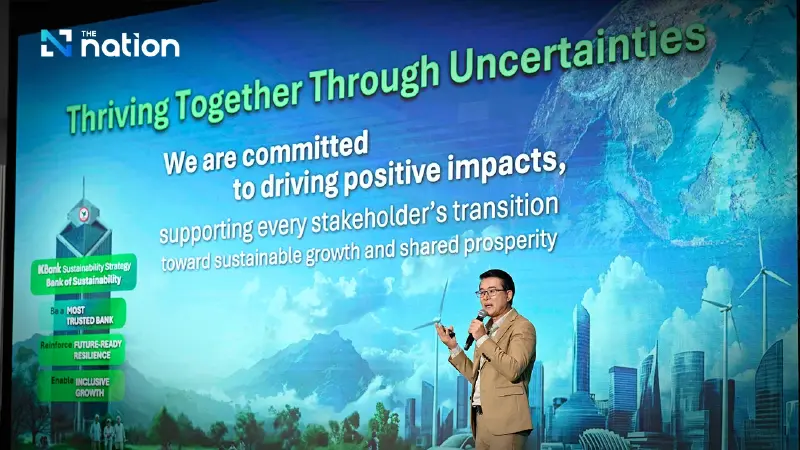


Thai lender shifts to issue-based sustainability strategy whilst positioning itself as comprehensive climate solutions provider
- KASIKORNBANK (KBank) has doubled its sustainable finance and investment target to between 400 and 500 billion baht by 2030.
- This increase is a direct response to mounting climate pressures and international carbon regulations, such as the EU's Carbon Border Adjustment Mechanism, which will affect Thai exports.
- The bank is shifting its strategy to become a "Comprehensive Climate Solution Provider," offering advisory and technological tools in addition to traditional financing for clients transitioning to low-carbon operations.
- To date, KBank has already provided over 173 billion baht in sustainable finance and investment, which has helped reduce greenhouse gas emissions by over 2.74 million tonnes of CO2 equivalent.
KASIKORNBANK has doubled its sustainable finance and investment target to between 400 billion baht and 500 billion baht by 2030, as Thailand's largest banks respond to mounting pressure from climate change and international carbon regulations.
The Thai lender announced on Wednesday a significant shift in its sustainability approach on Wednesday, moving away from traditional ESG frameworks towards what it calls an "issue-based strategy" that integrates environmental, social and governance considerations more holistically across its operations.

The recalibration comes as Thai exporters face growing scrutiny from trading partners. The European Union's Carbon Border Adjustment Mechanism, set to begin collecting carbon taxes in 2026, is projected to affect Thai exports worth 11 billion baht initially, expanding to approximately 28 billion baht by 2030.
"Businesses that adapt early will gain a competitive advantage," said Chongrak Rattanapian, KBank's president, noting that Thailand faces multiple structural challenges including high public and household debt alongside geopolitical tensions and trade conflicts.

Beyond banking
KBank has positioned itself to become "The Most Comprehensive Climate Solution Provider", extending beyond traditional financial services to offer advisory support and technological tools for clients transitioning to low-carbon operations.
The bank has already delivered more than 173 billion baht in sustainable finance and investment, helping reduce greenhouse gas emissions by over 2.74 million tonnes of carbon dioxide equivalent.
This includes electric vehicle loans for more than 39,000 vehicles, green building loans covering over one million square metres, and loans for more than 500 sustainability projects.
The lender's new three-pillar strategy centres on becoming "a most trusted bank", reinforcing "future-ready resilience", and enabling "inclusive growth". This replaces its previous ESG-based framework.

Climate transition accelerates
In line with its Net Zero Commitment declared in 2021, KBank has reduced operational greenhouse gas emissions by 17.02 per cent in 2024 compared to its 2020 baseline.
The bank has installed solar photovoltaic systems across all main buildings and 161 branches, deployed more than 354 electric vehicles, and maintained carbon neutrality certification for eight consecutive years.
The bank is also managing decarbonisation strategies across six industrial sectors: power plants, upstream oil and natural gas, thermal coal mining, cement, aluminium and automotive.
Its power plant portfolio has reduced greenhouse gas emission intensity per gigawatt hour by 26 per cent compared to 2020 levels.
Beyond lending, KBank has developed tools including KClimate1.5 for greenhouse gas inventory preparation, established the Creative Climate Research Center, and launched platforms such as Watt's Up for electric bikes and Green Pass for Renewable Energy Certificate requests.

Collaborative approach
The bank has partnered with private, government, financial and academic sectors to establish the Thailand Climate Business Network, which comprises more than 34 member organisations.
The network has produced an "E-Handbook for Greener SMEs" and a white paper on climate ecosystem collaboration submitted to government.
KBank's asset management arm, KAsset, holds the number one market position in Thailand for ESG and SRI funds, with assets under management of 38.9 billion baht and 37.9 billion baht respectively.

The bank has also expanded financial literacy programmes, with its SATI campaign on online fraud awareness reaching over 16.4 million people, whilst KResearch's economic and ESG insights have engaged over 6.58 million readers.
"Every mission of the bank requires collaboration from all interconnected sectors within the ecosystem to build a resilient, strong and quality foundation for stakeholders," Chongrak said, emphasising that the approach aims to help "every life and business move forward, overcome all challenges together, and continue to grow with stability and sustainability."

