
BOT and US Treasury issue joint statement to dispel currency manipulation concerns
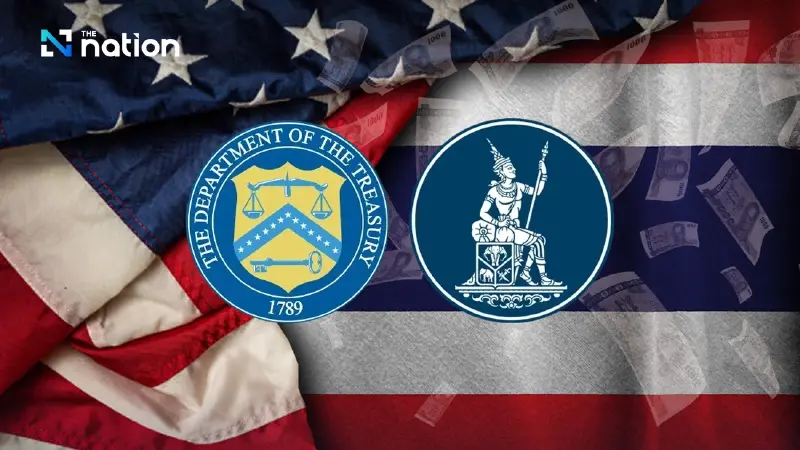


US and BOT reaffirm commitment to exchange rate stability, dismiss claims of currency manipulation, amid concerns over Thailand’s trade surplus.
Amid global currency fluctuations, international financial stability cooperation is gaining attention. The latest joint statement from the U.S. Department of the Treasury and the Bank of Thailand (BOT) reaffirms their continued collaboration on macroeconomic and exchange rate policies, emphasising their commitment to not manipulating currencies to gain a competitive edge in global markets.
Chayawadee Chai-anant, Assistant Governor of the BOT's Corporate Relations Group, stated that the U.S. has been closely monitoring exchange rate policies of trading partners, evaluating conditions such as balance of payments and trade balances with the U.S. Thailand was previously placed on the monitoring list in 2020-2021. As part of ongoing trade negotiations, both countries have committed to publicly confirming that exchange rates will not be manipulated for competitive advantage, following similar statements from Japan, Switzerland, and South Korea. The BOT maintains the right to intervene in exchange rate policy to ensure stability.
Kanchana Chokpaisansilp, Research Executive at Kasikorn Research Center, highlighted that the U.S. Treasury's upcoming "Macro and Foreign Exchange Policy" report will monitor key trading partners' foreign exchange practices and assess whether countries are manipulating currencies for trade advantage. The U.S. evaluates three key criteria, and Thailand does not currently meet the threshold for currency manipulation.
These criteria include:
- FX Intervention – Continuous net foreign exchange purchases for 8 out of the last 12 months. Only Singapore and Switzerland met this condition as of June.
- Current Account Surplus – A surplus exceeding 3% of GDP, which Thailand does not currently have, as its current account balance is more balanced.
- Trade Surplus with the U.S. – A surplus exceeding $15 billion. Thailand meets this criterion, having had a trade surplus with the U.S. of approximately $45 billion in the last four quarters.
However, in the past, Thailand was included in the Monitoring List, which is a list of countries closely monitored by the United States. Currently, Thailand is no longer on that list and has never been identified as a country that manipulates its currency, as it does not meet all three criteria.
Moreover, according to the U.S. report from June, no country has been identified as "manipulating its currency." Only two countries—Singapore and Switzerland—are under close scrutiny. Thailand meets just one of the criteria: the trade and services surplus with the U.S.
Additionally, Thailand’s exclusion from the list and the absence of allegations of currency manipulation reflect the transparency of Thailand’s exchange rate policies, which align with international standards. This is in line with the role of the BOT, which has consistently managed the stability of the baht.
The BOT intervenes in the foreign exchange market only when there is high volatility to maintain market order, not to gain a trade advantage. Therefore, interventions at certain times are in accordance with the principles of central banks worldwide.
Regarding the recent appreciation of the baht over the past 1-2 days, the main factors are not due to Thailand's policies but are driven by external pressures, particularly movements in the U.S. dollar and regional currencies. These pressures arise from three factors:
1. Expectations of U.S. Federal Reserve interest rate cuts: Global investors are anticipating rate cuts by the Fed in the near future, leading to widespread selling of the U.S. dollar, which has weakened the dollar and strengthened emerging market currencies, including the baht.
2. Positive news on global trade: There have been positive signals regarding trade negotiations between the U.S. and China, as well as between the U.S. and Japan, creating a positive atmosphere for currencies in the Asia region.
3. Influence of the Chinese yuan: When the Chinese yuan appreciates, it often results in movements of other currencies in the Asia region, including the baht, in the same direction. Therefore, the recent strengthening of the baht is the result of multiple combined factors and is not related to currency manipulation.
Thailand's Foreign Reserves Hit New High
Regarding Thailand's foreign reserves, the current reserves are at an all-time high. As of October 17, the latest data shows that Net International Reserves stood at US$298.455 billion, or approximately 298.5 billion dollars. This marks a continued increase compared to the past and over the last five years.
Looking back over the past five years (from 2020 to 2024), Thailand's reserves have increased by an average of around US$3 billion per year. While the increase hasn’t been uniform each year, the overall trend has been upward, reflecting the financial stability of the country.
This increase in reserves is not solely attributed to currency interventions, but also involves factors such as asset valuation adjustments, such as the rise in gold prices or changes in exchange rates of major currencies. When these adjustments are converted back to U.S. dollars, the total value of the reserves increases.
Another point raised by Kanchana is the increasing proportion of gold in the reserves over the past four years. The proportion of gold in the reserves was 5.1% in 2021, 5.8% in 2022, 6.4% in 2023, 7.5% in 2024, and most recently, 10.7% in 2025.
These figures indicate that gold is playing an increasingly significant role in Thailand’s foreign reserve portfolio. This helps diversify risks and preserve value during times of financial market volatility. However, the growth in reserves does not come only from foreign currency trading but also from effective asset management, such as increasing gold holdings.
That said, the composition of the reserves includes foreign assets such as government bonds from major countries and in key reserve currencies like the U.S. dollar, euro, yen, and pound, as well as gold.
BOT urged to Improve Public Communication
Sanguan Jungsakul, Senior Director for Money and Capital Markets at Krungthai Bank, stated that the agreement in question is a bilateral agreement, and its fundamental principles are in line with the existing guidelines of the IMF. The focus is on ensuring that currency interventions are not made to support unfair trade practices, and if interventions do occur, they should be limited to addressing currency volatility, without encouraging unfair competition.
The most significant concern surrounding this issue is the communication from the Bank of Thailand (BOT). Since this agreement is bilateral, and the BOT is one of the signatories, it may need to provide additional information to the public to help the market understand the meaning of the agreement. This would confirm that the agreement does not differ from the three existing criteria set by the United States.
"Clear communication will help the financial markets feel at ease and gain confidence, as there have been concerns, especially since Thailand has had the largest increase in foreign reserves in the region over the past year, rising by 12% year-on-year," he said.
Therefore, the interpretation of the increase in reserves is complex and raises concerns about being under scrutiny. Currently, reserves have grown substantially, and the main factor driving changes in reserves—whether they increase or decrease—is valuation, which results from adjustments in the portfolio of assets within the reserves. Actual intervention may only constitute a small part of the increase.
"The 12% increase in Thailand’s reserves may be due to the internal performance of our reserves, meaning the value of assets in the portfolio, such as gold (which rose by 10%) or other currencies that appreciated against the dollar, causing the overall value of reserves to rise."
Regarding the short-term exchange rate outlook, the expected range for the exchange rate is 32-33.00 baht per U.S. dollar, with the baht having appreciated by around 5% since the beginning of the year.
