
TrueMoney's Tap-to-Pay Push Targets Thailand's Card-less Majority
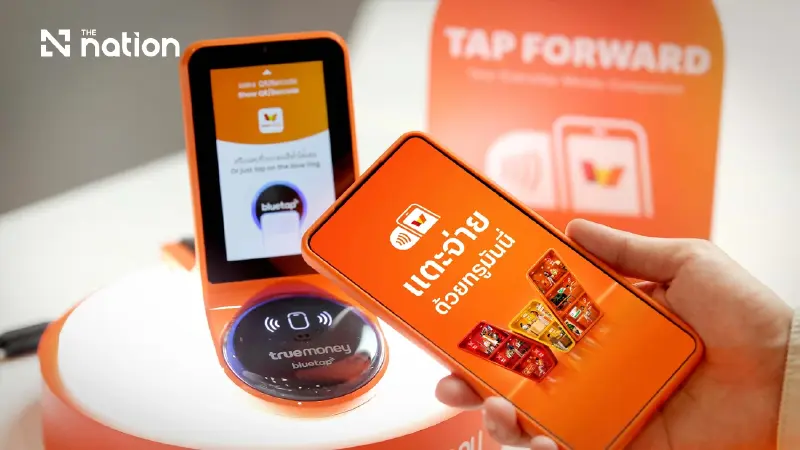


TrueMoney's new tap-to-pay strategy, and the virtual bank behind it, take aim at the millions of Thais that near-universal digital payments have still left without a credit card
- TrueMoney is launching a new tap-to-pay service that allows users to pay directly from their digital wallet, specifically targeting the majority of Thais who lack credit cards.
- The service, built with partners like Mastercard and Alipay+, removes the need for a physical card to make contactless payments and is expanding to nearly a million terminals nationwide.
- This initiative is part of a larger strategy linked to TrueMoney's upcoming virtual bank, which will use the card-less transaction data to offer credit services to the underbanked population.
TrueMoney's new tap-to-pay strategy, and the virtual bank behind it, take aim at the millions of Thais that near-universal digital payments have still left without a credit card.
Thailand's digital payments story is moving past the race for volume into a subtler contest: who still cannot fully take part. The country's PromptPay network already processes more than 74 million transactions a day across over 90 million registrations, according to Bank of Thailand data, making it one of the most digitally saturated payment markets in the world.
Yet for all that scale, one thing has remained stubbornly analogue: contactless tap-to-pay, the fastest checkout experience going, has been the preserve of the minority who own a credit card. TrueMoney's newly unveiled tap-to-pay strategy is a direct challenge to that residual divide.
The gap is real, if easy to overstate. Thailand's account ownership sits at 92 per cent of adults, among the highest in the developing world, according to the World Bank's Global Findex Database 2025.
But holding an account is not the same as holding a premium banking product: separate research by Macquarie estimates that around 63 per cent of Thai adults remain unbanked or underbanked in terms of formal credit access, while credit and charge card penetration stands at just 0.4 cards per 100 people, according to GlobalData. Tap-to-pay, historically gated by card ownership, has simply never reached most of the country.
TrueMoney's answer is BlueTap and a parallel "open loop" service built with Mastercard and Alipay+, letting users tap to pay directly from their TrueMoney wallet, with no card required.

"One of the biggest pain points in digital payments today is that consumers still need to go through multiple steps before completing a transaction," said Tanarat Thuvasujirake, the company's commercial director, at the launch event on Friday (July 17th).
What matters commercially is less about shaving seconds off checkout and more about who gets to check out this way at all: by removing both device restrictions and the credit card requirement, TrueMoney is extending a technology historically reserved for wealthier consumers to a far broader base.
Early adoption backs the pitch. Since a limited trial began in the first quarter of 2026, BlueTap has drawn more than 1.5 million users and over 5 million taps, one of TrueMoney's fastest-adopted products. One retail partner reported sales from TrueMoney users rising more than 50 per cent after installing BlueTap terminals, with average spend per user up roughly 14 to 15 per cent.
The service, so far concentrated at 7-Eleven and a handful of partners, is set to reach more than 50,000 payment points by September, while the Mastercard-powered open loop option will extend tap-to-pay to the country's roughly 900,000 existing EMV terminals and eventually more than 150 million worldwide.
Commercially, TrueMoney is positioning itself as something closer to a card issuer than a wallet, earning an interchange-like fee from merchants each time a customer taps, a fee the company says undercuts standard card charges, with savings partly redirected to customers as cashback.
Fees and transaction charges already make up roughly 80 per cent of TrueMoney's revenue, and further commercial terms for the tap-to-pay rewards programme are due to be announced in early August.

The tap-to-pay push is best understood alongside TrueMoney's other project: a licensed virtual bank, one of only three the Bank of Thailand approved from five applicants in 2025, expected to launch later this year.
"The Virtual Bank assessment is moving along smoothly according to the official timeline, and we are fully prepared," said Monsinee Nakapanant, co-president of Ascend Money, who added that fellow co-president Tanyapong Thamavaranukupt will oversee the new entity directly.
TrueMoney's existing AI-driven credit tools, built for products such as Pay Next and Pay Next Extra, are expected to underpin the bank's lending decisions, with the wallet's high-frequency, cardless transaction data doubling as a live credit-scoring feed for customers banks have traditionally found too costly to assess.
That ambition sits inside a wider pattern that has proved harder to execute than to announce: globally, digital-first banks typically take three to eight years to reach profitability, and only 61 per cent of the world's top 100 digital banks were profitable in 2025, up from 48 per cent the year before, according to Capco analysis. Thailand's regulators, having deliberately capped the market at three licences, are watching that arithmetic closely.
TrueMoney is also extending tap-to-pay into public transport. Roughly 6,000 Bangkok Mass Transit Authority buses already accept phone taps, with tap-at-gate entry to the MRT Blue and Purple Lines due by the fourth quarter of 2026, and the company plans reciprocal acceptance that would let Chinese Alipay+ users tap-pay at Thai BlueTap terminals.

Security, it says, rests on a "3X Protection" system that uses AI to screen transactions for fraud and so-called mule accounts; by its own account, TrueMoney ranks 13th among Thai financial apps by number of registered accounts, a scale it says its detection models are built to match.
The stakes reach beyond one company. Thailand's digital economy is projected to hit $56 billion in gross merchandise value this year, the second-largest in Southeast Asia, according to the Google-Temasek-Bain e-Conomy SEA 2025 report, and the government has long targeted a 25 per cent GDP contribution from the digital sector.
Whether tap-to-pay and a forthcoming virtual bank actually pull Thailand's cardless majority into that economy, rather than simply adding a faster lane for those already inside it, will be the real measure of whether this counts as inclusion or just better marketing for it.

