
Tokenisation Meets AI: Global Finance Leaders Warn of Fragmentation Risks as Digital Markets Advance
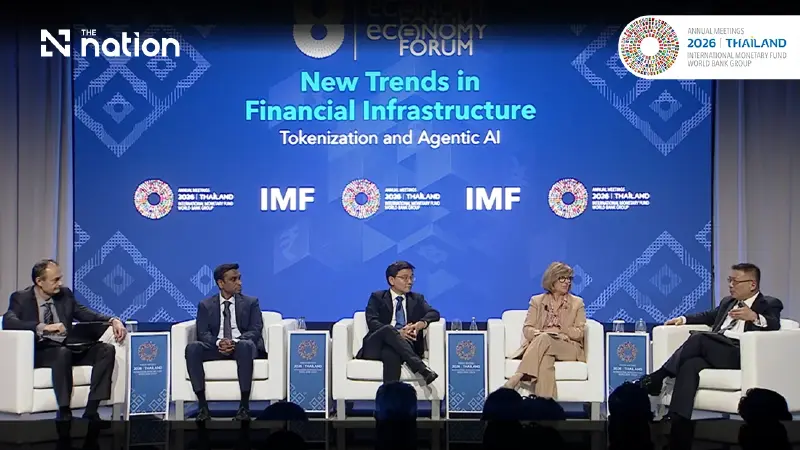


Global leaders from the IMF, MAS, Euroclear, Swift, and Standard Chartered call for common standards, trusted central bank money, and strict safeguards as tokenisation and autonomous AI trading enter live markets
- Global financial leaders from institutions like the IMF and MAS are warning that the live implementation of tokenisation and autonomous AI trading risks creating disconnected "digital islands," leading to severe market fragmentation.
- To counter this, they advocate for the urgent creation of common standards and interoperability protocols to connect multiple specialized networks, rather than expecting a single master ledger to emerge.
- Panelists stressed the need for strong regulatory safeguards, including anchoring settlement in trusted central bank money and maintaining human accountability, with financial institutions remaining fully liable for their AI agents' actions.
- Specific risks from AI agents, such as machine-speed liquidity drains, require new controls like "kill switches," pre-set spending limits, and full audit trails to ensure market stability.
Global leaders from the IMF, MAS, Euroclear, Swift, and Standard Chartered call for common standards, trusted central bank money, and strict safeguards as tokenisation and autonomous AI trading enter live markets.
Tokenisation is rapidly moving from pilot projects into live financial markets. However, with autonomous artificial intelligence (AI) agents preparing to execute trades across this new infrastructure, banking, market infrastructure, and regulatory leaders warn that global finance must urgently agree on rules and safeguards to prevent market fragmentation.
Opening the International Monetary Fund (IMF) New Economy Forum session, moderator Athanasios Vamvakidis, deputy director of the IMF’s Monetary and Capital Markets Department, observed that while autonomous digital trading once sounded like science fiction, it is now becoming an operational reality across global markets.

The Promise of Tokenised Markets
Tokenisation records asset ownership as a digital token on a shared ledger, creating programmable, round-the-clock markets.
Panellists highlighted key operational benefits:
Streamlined Settlement: Assets and cash move simultaneously on programmable networks, eliminating manual processing steps.
Continuous Liquidity: Naveen Mallela, Global Head of Payments at Standard Chartered, emphasised that the true value of tokenisation lies in 24/7 liquidity access rather than faster payments alone. He highlighted intraday dollar funding against Hong Kong or Singapore dollar positions using automated repos and swaps.
Eradicating Reconciliation: Every panellist—spanning banking, market infrastructure, and regulation—identified duplicate record-keeping across disparate systems as the primary inefficiency they aim to remove.

A Hybrid World Over a Single Ledger
Industry figures do not expect one master ledger to dominate. Valerie Urbain, CEO of Euroclear, explained that markets vary by jurisdiction, regulation, and asset class, pointing to a future of multiple specialised networks.
Euroclear holds around €45 trillion in custody assets, meaning traditional and digital systems must co-exist for the long term. The primary danger is a new form of market fragmentation.
Kevin Wong, Asia-Pacific Chief Executive at Swift, warned that disconnected "digital islands" could increase operational complexity, citing Swift research that estimated the cost of poorly connected platforms at up to 6 per cent of global gross domestic product annually.
Six Priorities for Digital Market Success
To build a connected digital ecosystem, the full panel outlined six key requirements:
Establish Common Standards: Networks must agree on shared operating rules, technical specifications, and dispute resolution mechanisms at connection points.
Alan Lim, director of the Financial Infrastructure and AI Office at the Monetary Authority of Singapore (MAS), pointed to the Global Layer 1 initiative, which aims to link ledgers without merging them.
Urbain added that platforms connecting with one another must settle legal finality, transaction reversal rules, and liability frameworks in advance.

Tokenise Entire Ecosystems: To avoid isolated issuers without investors, Urbain highlighted Euroclear’s project with the Banque de France to tokenise the entire €300 billion French commercial paper market, encompassing issuers, dealers, traders, and investors simultaneously.
Orchestrate Liquidity: Mallela stressed that because banks naturally follow liquidity across multiple rails, connective tissue that orchestrates capital movement across diverse networks will prove essential.
Anchor Settlement in Central Bank Money: While stablecoins offer reach and deposit tokens deliver legal certainty for large transactions, Lim stressed that central bank money must remain the ultimate monetary anchor to prevent closed, proprietary networks.
Wong added that assets and cash need not reside on the same ledger, provided real-time gross settlement systems can coordinate data transfer without manual re-entry.
Maintain Regulatory Guardrails: Panellists endorsed open, public networks operated by regulated institutions with verified counterparties.
Lim noted that regulatory focus belongs on access, liquidity, and controls rather than labels, while Urbain emphasised reproducing legal certainty and asset integrity regardless of underlying technology.
Adapt Central Bank Roles: Lim explained that public authorities should step in with neutral settlement infrastructure where market gaps exist, depending on local jurisdiction needs.

Governing Autonomous AI Agents
The second half of the forum focused on agentic AI—software capable of forming trading intent and executing transactions autonomously.
Mallela advocated granting AI agents autonomy within explicit mandates, pointing to an IMF model featuring probabilistic intent at the top, enforceable boundary controls in the middle, and deterministic execution at the bottom.
However, he warned that if multiple AI agents react to the same signal at once, markets risk a machine-speed liquidity drain, requiring kill switches and human oversight.
Regulators are acting quickly to set runtime guardrails. Lim stated that human accountability remains essential, noting that MAS recently published AI risk management guidelines and launched an initiative establishing agent identity protocols, pre-approved spending limits, aggregate exposure caps, and full audit trails.
Urbain stated that market infrastructures will process AI instructions like any other provided there is transparency, basic controls, and one non-negotiable condition: sponsoring financial institutions remain fully liable for the actions of their AI agents.
Looking to the future, panellists predicted that a significant portion of the securities lifecycle will eventually move on-chain across a multi-rail system. However, Wong warned against tokenising for its own sake, while Alan Lim urged the industry to move past discussing technology for its own sake and focus strictly on practical outcomes.
