
World Bank sees sustainability financing of businesses as pathway to net zero emissions
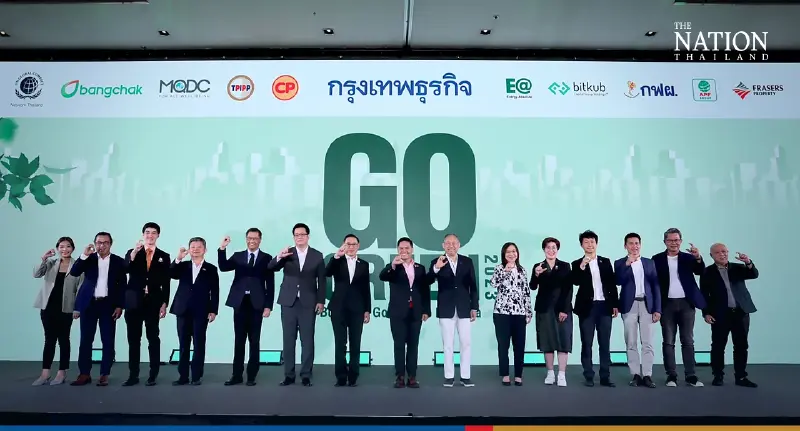


The World Bank is pushing for sustainability financing to achieve net zero carbon emissions by encouraging the business sector to go green.
Reiterating its business environmental objectives, the World Bank wants worldwide efforts to tackle climate change towards which all sectors make a contribution.
“Taking care of the environment is a shared responsibility. The great floods of 2011 inflicted losses of 1.44 trillion baht on Thailand,” said Ratchada Anantavrasilpa, senior financial specialist at World Bank Bangkok.
She was speaking at the “Go Green 2023 Business Goal for the Next Era” seminar organised by Bangkokbiznews on Thursday at Renaissance Bangkok Ratchaprasong Hotel.
Thailand and 197 other nations are signatories to the Paris Agreement, a United Nations Framework Convention on Climate Change pact that focuses on steps to reduce carbon dioxide emissions or greenhouse gases that have a significant impact on climate change, in order to prevent losses, Ratchada said.

“The World Bank sees the need to offer financial support to business owners who wish to invest in enhancing the operations of their companies and manufacturing procedures to lower greenhouse gas emissions and make Thai goods and services compliant with the standards of the modern world,” she said.
“Banks, in the future, will lend more money for initiatives to achieve this objective, and entrepreneurs themselves can issue bonds or other financial instruments for sustainability, like social impact bonds, and incorporate sustainability principles into their investment decisions,” said Ratchada.
“To meet the demands of a large number of investments, they will receive assistance through the issuance of green bonds [debentures that preserve forests and water],” she added.
Role of finance in sustainability
“We have to mainly look at sustainability financing in the long term and the entire private sector must have access to it,” said Ratchada.
She cited the example of the European Union’s Taxonomy, a classification system adopted in 2020 that establishes a list of environmentally sustainable economic activities, and the Central American Bank for Economic Integration's Blue Bonds Taxonomy, which enables funding to be directed toward environmentally friendly coastal initiatives while protecting the delicate marine ecosystem.
“Thailand has implemented this idea in the fields of transportation and energy,” she said.
Technology, according to Ratchada, is the main driver of change.
“Entrepreneurs can’t escape the necessity of using digital technology. In order to accomplish this, there must be a plan and according to the World Bank, a larger role will be played by sustainable financial products in a variety of forms,” she said.
“The sustainability finance industry would continue to grow because it would be necessary to evaluate environmental risks,” she added.

Five challenges
“I want entrepreneurs to see a new perspective,” said Thanyaporn Krichtitayawuth executive director at Global Compact Network Thailand.
“Change starts with having the correct perspective from the beginning and understanding how Thailand will move towards becoming net zero,” she said.
Sincerity and the conviction that it is feasible are what will enable it, according to Thanyaporn.
Achieving global waste reduction and carbon neutrality objectives should begin with reduction because recycling might not be the best option, as it would lead to increased production.
Thanyaporn pointed out five difficulties that businesses are currently dealing with: price volatility and inflation, employees lacking skills, health threats, climate change, and trade terms and regulations.
“We have to research, learn, and change in order to adjust,” she suggested.
“The good news is that governments, financiers and banks are moving more towards sustainable development. Institutions that take environmental concerns seriously would be encouraged and supported,” said Thanyaporn.
She tossed a couple of ideas for rumination.
“If Thailand's tourism industry, for instance, wants to use sustainability as a selling factor when developing the value of its products and services to attract customers, it must truly believe in that and act upon it,” she said.
“If we claim to be ecologically conscious because we drive electric vehicles, we also need to understand where our plugged-in energy comes from. Does it originate from coal, hydropower, or the wind?” she said.
“Being a low-carbon organisation or nation is not something that happens by chance, rather, it is something we choose to be or do out of our own will,” said Thanyaporn.
Related News
Thailand in need of labour reforms, wider access to green solutions: World Bank
Carbon Credits for Sustainable Development
Top Thai execs discuss sustainability and path to achieving net zero
