
Thailand Seeks 'Trusted Partner' Status Amidst Global Trade Shifts, Commerce Minister Says
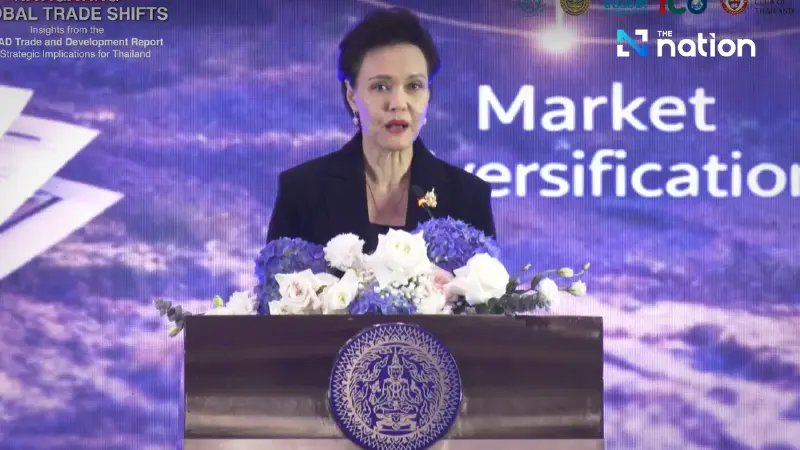


Minister Suphajee highlights record 1.8tn baht investment applications and ASEAN digital trade framework as key tools for economic resilience
- Commerce Minister Suphajee Suthumpun stated that Thailand must position itself as a "trusted partner" to navigate complex geopolitical shifts and build sustainable relationships in a polarized global economy.
- This strategy is supported by a record 1.8 trillion baht in investment applications in high-tech sectors and a shift to a "'Sell With, Sell Through'" model that leverages free trade agreements to integrate into global supply chains.
- Thailand is also a key facilitator of the ASEAN Digital Economy Framework Agreement (DEFA), which aims to create the world's first regional digital trade framework to boost economic integration and double intra-ASEAN trade.
Minister Suphajee highlights record 1.8tn baht investment applications and ASEAN digital trade framework as key tools for economic resilience.
Thailand must position itself as a "trusted partner" in an increasingly polarised world, where trade policy and foreign policy must work hand-in-hand to navigate complex geopolitical shifts, Commerce Minister Suphajee Suthumpun said on Monday.
Speaking at an international seminar hosted by the International Institute for Trade and Development (ITD) at the Ministry of Foreign Affairs, Suphajee emphasised that the country could no longer operate in isolation as global trade patterns undergo significant transformation.
"The most important currency in the world is trust currency," Suphajee told more than 150 attendees at the seminar, which focused on navigating global trade shifts based on UNCTAD's Trade and Development Report 2025. "If we provide trust as a trusted partner to all those who engage with us, I believe this is going to be a sustainable relationship instead of just a one-way relationship."
The minister acknowledged that Thailand faces a challenging environment shaped by geopolitical tensions, climate crisis, and technological disruption.
She stressed that trade has become "very vulnerable" and requires careful positioning in what she described as an increasingly multipolar world order marked by extreme polarisation.

Record Investment Applications Signal Confidence
Despite global uncertainties, Thailand recorded a milestone year for investment interest in 2024.
Suphajee revealed that applications for investment promotion under the Board of Investment (BOI) reached approximately 1.8 trillion baht last year, with foreign direct investment accounting for about 1.35-1.36 trillion baht of that total.
The investment requests span industries critical to Thailand's economic transformation, including data centres, artificial intelligence, advanced semiconductors, next-generation automotive technology, biotechnology, and future food processing—sectors the minister said would help position the country "to the next level of the newest S-curve."
'Sell With, Sell Through' Trade Strategy
Suphajee outlined a nuanced approach to international trade that moves beyond bilateral balances to focus on supply chain integration.
"Trading is not about sell to the country, but it could be sell with and sell through," she explained.
The minister emphasised Thailand's geographic advantage as the "heart of Asia," positioned at the centre of ASEAN and offering investors access to regional markets through 40 active free trade agreements, with three more signed but not yet in force and five currently under negotiation.
However, she acknowledged that many of these agreements require modernisation.
"Trade landscape has been changed quite a lot," Suphajee noted, pointing out that some FTAs have been in place for more than 30 years and lack provisions for critical areas such as digital trade.
She also revealed that none of Thailand's existing FTAs are utilised at 100%, with many private sector companies failing to take advantage of available benefits. The ministry plans to focus on training and awareness programmes to maximise FTA utilisation.

Digital Trade Framework Nears Completion
Suphajee highlighted significant progress on ASEAN's Digital Economy Framework Agreement (DEFA), which she described as an opportune development for regional integration.
Thailand, serving as facilitator, helped achieve 73% agreement on the framework during last year's ASEAN summit, with the figure reaching nearly 80% recently.
"By April, which is actually the target, we should be able to complete the text of this digital framework agreement for ASEAN," she said. "If we can complete this, it's going to be the first region in the world that has this digital trade framework among neighbouring countries or member states."
The framework is expected to be signed at this year's fourth-quarter ASEAN summit and aims to provide infrastructure, standards, regulations, and knowledge transfer that would particularly benefit small and medium enterprises.
The regional bloc has set an ambitious target to double intra-ASEAN trade from US$1 trillion to US$2 trillion.
Suphajee emphasised that the digital framework would allow Thai SMEs to access a market of more than 600 million people across ASEAN, compared to Thailand's declining population of just over 60 million.

'Team Thailand' Approach Essential
The minister stressed the importance of inter-ministerial coordination, with the Ministry of Commerce working closely with the Ministry of Foreign Affairs and the Ministry of Finance to ensure Thailand can attract and address investment interest.
"We cannot work in silo anymore," Suphajee said. "We actually have to work as Team Thailand."
The seminar, titled "Navigating Global Trade Shifts: Insights from the UNCTAD Trade and Development Report and Strategic Implications for Thailand," brought together government officials, ambassadors, and trade experts to analyse global economic trends and formulate Thailand's strategic response to a world in significant transition.
