
Suphajee: Thai–US talks on track; 19% tariff noted
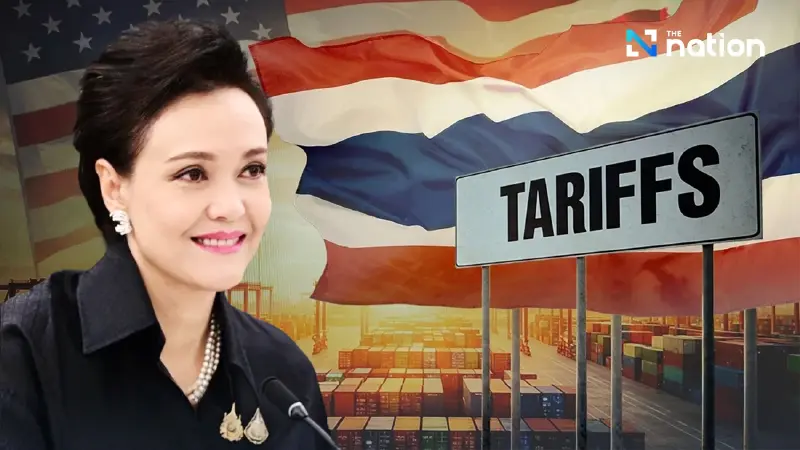


Commerce Minister Suphajee says Thai–US trade talks continue smoothly. Cabinet acknowledged a revised joint statement specifying a 19% reciprocal tariff.
Commerce Minister Suphajee Suthumpun gave an interview on progress under the Thailand–US trade framework, confirming that negotiations remain smooth and that there are no worrying signals from the US side.
She said the Ministry of Commerce updated the cabinet on the Joint Statement on the Framework for a United States–Thailand Agreement on Reciprocal Trade, explaining that this was a progress update based on the latest round of talks — not a new agreement. The reason it was submitted to the cabinet again was to add missing details and make the document more complete.
For example, the previous version did not specify the tariff rate the US would apply to Thai goods. This has now been inserted as 19%. However, the document remains only a draft joint statement and is not yet a formally binding agreement.
Asked whether Thailand’s talks with the US were moving too slowly — given that some countries, such as South Korea, had faced a higher tariff rate of 25% after the US viewed their process as delayed — Suphajee said there is currently no signal that the US is pressuring Thailand.
Discussions are continuing consistently and smoothly, and Thailand has not faced the kind of problem South Korea encountered. Thailand’s negotiating team is continuing talks within the normal framework, and everything remains in line with the agreed plan.

“Not at the moment. We are still negotiating and everything is smooth. Up to now, there has been no pressure signal from the US — no warnings or negative stance. Thailand’s negotiating team continues discussions under the normal framework,” Suphajee said.
A Government House source said the cabinet has acknowledged revisions to the draft Joint Statement on the Framework for a United States–Thailand Agreement on Reciprocal Trade, after the US proposed adjustments to certain substance and wording to better reflect facts and the status of implementation, as follows:
- Specifying the reciprocal tariff rate at 19%, which had not previously been stated.
- Adding clarification that the US will determine the list of products under Annex 3 of a presidential executive order dated 5 September 2025 on Potential Tariff Adjustments for Aligned Partners (PTAAP), for consideration of exemptions for partners that successfully conclude negotiations with the US — replacing the earlier, less specific reference.
- Removing the issue of rules of origin, as the US side is still considering the matter and there is not yet clarity on the approach.
- Tightening wording to better reflect the process, such as changing “will continue to finalise” to “will finalise”.
The Ministry of Commerce concluded that the US-proposed changes do not alter the draft joint statement in any material way. Rather, they add detail to improve clarity and align the text with current facts, and do not conflict with the principles the cabinet previously approved on 1 August 2025.
Finalising the joint statement with the US helps set Thailand’s reciprocal tariff rate at 19%, broadly in line with other countries in the ASEAN region, including Malaysia, Indonesia, the Philippines, Cambodia and Vietnam.
Thailand’s export sector — with exports to the US worth more than US$56 billion — benefits from the reciprocal tariff being reduced from 36% to 19% immediately. Meanwhile, Thailand’s own tariff reductions will not take effect until an agreement is concluded and subsequently approved by the cabinet and parliament.

