
Commerce minister outlines trade strategy amid global uncertainty
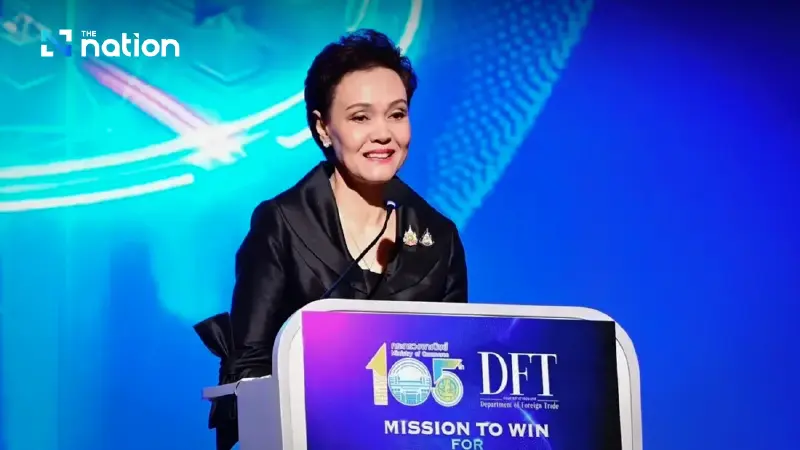


Suphajee Suthumpun said Thailand must move faster as global trade shifts, warning exports could slow this year while government pushes investment approvals and ASEAN’s DEFA talks.
- The government aims to accelerate investment by converting THB1.3 trillion in applications into at least THB480 billion of on-the-ground projects this year.
- The strategy involves strengthening Thailand's role as a regional hub within ASEAN and leading digital economy initiatives like the ASEAN Digital Economy Framework Agreement (DEFA).
- Key priorities for the Commerce Ministry include expanding markets through Free Trade Agreements (FTAs), protecting domestic industries, and using AI to upgrade workforce skills.
- A major focus will be placed on promoting sustainable trade and the green economy by supporting clean energy, green industries, and supply-chain cooperation.
Suphajee Suthumpun, Minister of Commerce, opened a seminar and delivered a special keynote on Monday (January 26) titled “Mission to Win for The Game Changer”, organised by the Department of Foreign Trade under the Ministry of Commerce.
Suphajee said the global economy is facing major shifts and heightened uncertainty, while Thailand’s economic growth last year remained sluggish at below 2%, lagging behind neighbouring countries and weighing on national competitiveness.
She noted that exports last year rose strongly, partly driven by accelerated shipments to the United States amid concerns over potential tariff measures.
However, she warned that exports this year could slow sharply, with growth at risk of nearing zero or even turning negative.
On investment, Suphajee said applications for investment promotion through the Board of Investment (BOI) now total THB1.3 trillion, including THB980 billion in foreign direct investment (FDI).
The government aims to push these commitments into real, on-the-ground investment of at least THB480 billion within the country this year.
She stressed that this will require close cooperation between the public and private sectors, given limited state budget capacity.
The government, she said, is ready to speed up approvals, licensing and regulatory processes so that investment applications translate into concrete projects.

Suphajee added that global trade dynamics are shifting from a bipolar world to a multipolar world, marked by deeper conflict and tougher competition.
Thailand must position itself carefully, she said, as international markets increasingly view Asia as an opportunity, and Thailand as a country many partners want to work with more closely.
Regionally, she said Thailand must strengthen its anchor within ASEAN, using the bloc’s market size and population as leverage, while also capitalising on Thailand’s geographic strengths as a regional hub.
She highlighted Thailand’s role as chair of ASEAN’s digital-economy economic negotiations, pushing forward the ASEAN Digital Economy Framework Agreement (DEFA).
The goal, she said, is to raise ASEAN’s digital-era trade, investment and economic connectivity from US$1 trillion to US$2 trillion by 2030.
Thailand must also apply AI to upgrade workforce skills (upskilling and reskilling) and strengthen business competitiveness, she said.
AI will not replace people, but people who can use AI will replace those who cannot.

For the Ministry of Commerce, Suphajee said priority work will focus on six main areas:
- Expanding new markets and fully leveraging FTAs
- Accelerating FTA negotiations and updating Thailand’s 14 existing FTAs to keep them modern
- Protecting domestic industries from unfair trade through trade measures
- Supporting responses when Thailand faces trade investigations
- Safeguarding Thai industrial interests by promoting local content
- Closing loopholes linked to import surges and upgrading product standards
She added that the ministry will intensify efforts against “front” businesses and nominee arrangements by using AI to connect data with relevant agencies, while building a business ecosystem that is transparent and fair.
The ministry will also prioritise sustainable trade and the green economy, supporting clean energy adoption, developing green industries, and promoting supply-chain cooperation based on shared benefits.
“In today’s world, trade cannot be viewed from a single point,” Suphajee said. “We must see it as a network and become a valuable piece of the global supply chain. If we succeed, Thailand will not merely follow the game; we will help shape it.”

