
Commerce Ministry urges fast JTEPA upgrade, courts Japan capital
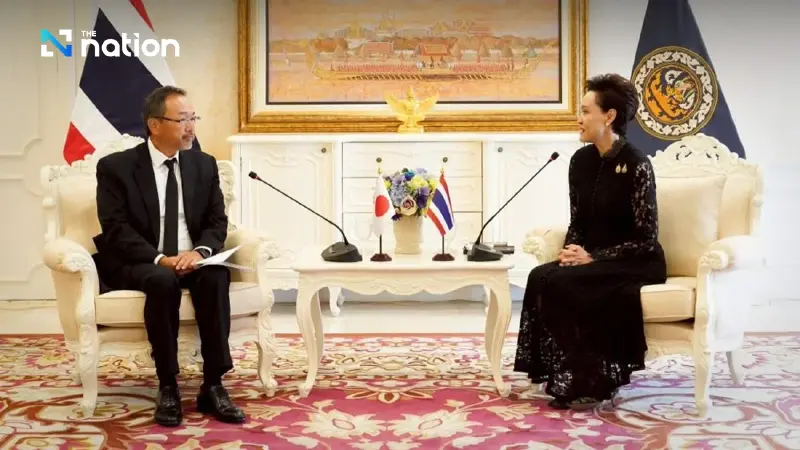


Commerce Minister Suphajee Suthumpun urges an upgraded JTEPA and more Japanese investment in New S-Curve sectors, including digital, AI and semiconductors
- The Commerce Ministry discussed with Japan’s ambassador and proposed an accelerated review and modernisation of the Thailand–Japan Economic Partnership Agreement (JTEPA) to expand trade and investment opportunities.
- Thailand invited Japanese investors to expand investment in future target industries (New S-Curve), especially digital, artificial intelligence, semiconductors and next-generation vehicles.
- Thailand asked Japan to increase imports of Thai agricultural and food products, and to coordinate with Japanese trading firms (Sogo Shosha) to help distribute Thai goods to global markets.
Commerce Minister Suphajee Suthumpun said she met Mr Otaka Masato, Japan’s Ambassador to Thailand, to discuss ways to strengthen economic, trade and investment cooperation as “comprehensive strategic partners”.

She said Thailand invited Japanese investors to expand investment in future industries, and proposed that both sides review the Thailand–Japan Economic Partnership Agreement (JTEPA) as soon as possible to better serve future trade needs.
Japan is Thailand’s third-largest trading partner, with supply chains that have complemented each other for many years. Suphajee said Thailand stands ready to be a source of high-quality agricultural and food products for Japan, including rice, processed chicken, and canned seafood. She also asked Japan to support increased imports of Thai rice as a gesture of goodwill.
She further asked the ambassador to help coordinate with Japanese trading firms in Thailand—the Sogo Shosha group—to distribute Thai products through their networks in Japan and worldwide.
On investment, she said Japan has consistently been Thailand’s top investor, with nearly 6,000 Japanese companies operating in Thailand. She invited Japanese investors and start-ups to invest in, or exchange knowledge in, Thailand—particularly in New S-Curve industries such as digital and AI, advanced semiconductors, next-generation vehicles, future food, clean energy, biotechnology, as well as health science and wellbeing. She also encouraged Japan to invest in R&D for hydrogen energy suited to tropical countries.

Suphajee added that Thailand and Japan already have a free trade agreement—JTEPA—which has been in force since 2007. Thai businesses have used JTEPA preferences for about 80% of the value of eligible exports to Japan. With JTEPA marking its 19th year this year, she said Thailand proposed that both sides modernise the agreement to reflect current and future economic trends, and use the opportunity to negotiate further market openings to expand trade and investment.
During the talks, both sides also supported cooperation on trade remedy measures, to exchange knowledge and experience in investigation procedures. Thailand said it is willing to provide training for Japanese investors on applying trade remedies to protect investors in Thailand affected by imports characterised by unfair trade—particularly in the automotive and auto parts industries—and said it would listen to private-sector views to improve enforcement effectiveness.
Suphajee noted that 2027 will mark the 140th anniversary of Thai–Japanese diplomatic relations, reflecting close ties at every level. She cited the Thai Kimono Project as an example of cooperation, combining Thai woven fabrics from the “Pha Thai Sai Hai Sanuk” initiative of HRH Princess Sirivannavari Nariratana Rajakanya with Japan’s kimono, under environmentally friendly production concepts aligned with the royal determination of Her Majesty Queen Sirikit The Queen Mother. She said Thai-fabric kimono collections have been well received by Japanese consumers and could lead to further cooperation in trade and contemporary product development.
On trade figures, she said that in 2024, Japan ranked as Thailand’s third-largest trading partner after China and the United States. Bilateral trade was worth US$52,010.66 million, with Thai exports to Japan at US$23,285.90 million and imports from Japan at US$28,724.75 million.
In the first 11 months of 2025 (January–November), two-way trade totalled US$48,782.99 million. Thai exports to Japan were US$21,659.75 million, while imports from Japan were US$27,123.24 million.
Key Thai exports included cars and parts, processed chicken, machinery and parts, electrical appliances and components, and chemicals. Key imports from Japan included machinery and parts, iron, steel and products, electrical machinery and components, vehicle parts and accessories, and printed circuit boards.
