
Thailand Launches Economic Diplomacy Strategy to Navigate 'Reglobalisation', Foreign Minister Says
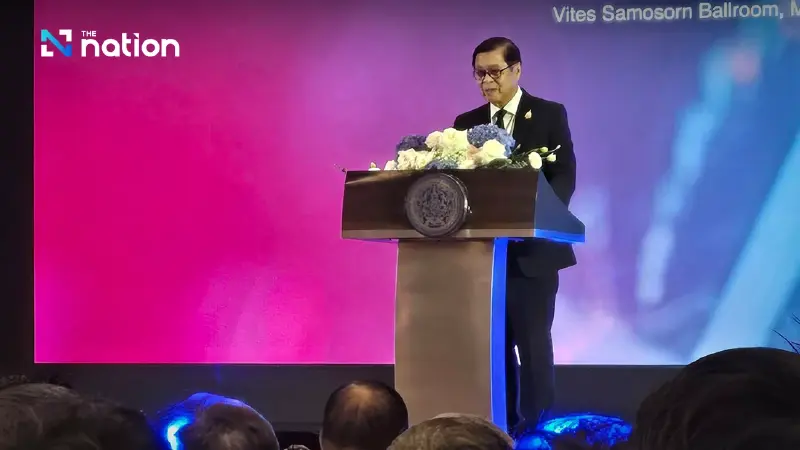


Sihasak unveils three-pillar approach focusing on confidence-building, competitiveness, and partnerships as global trade undergoes structural shift
- Thailand has launched a new economic diplomacy strategy to navigate what its Foreign Minister calls "reglobalisation"—a strategic realignment of global trade, production, and supply chains.
- The strategy is founded on a three-pillar approach: building international confidence in Thailand's stability and regulations, strengthening its economic competitiveness, and enhancing global partnerships.
- Key actions include modernizing regulations, mobilizing embassies to support Thai businesses, investing in future industries like the digital economy, and expanding engagement with new regions such as South Asia, Africa, and the Middle East.
- The plan emphasizes a "Team Thailand" approach, requiring close coordination between government
Sihasak unveils three-pillar approach focusing on confidence-building, competitiveness, and partnerships as global trade undergoes structural shift
Thailand is witnessing not deglobalisation but "reglobalisation"—a strategic realignment of trade, production, and finance—requiring the country to integrate its economic and foreign policies more closely than ever before, Foreign Affairs Minister Sihasak Phuangketkeow said on Monday.
Speaking at an international seminar co-hosted by UNCTAD, the Ministry of Commerce, the International Institute for Trade and Development (ITD), and the Harvard Club of Thailand, Sihasak outlined a comprehensive economic diplomacy strategy launched by his ministry last month to position Thailand advantageously in an increasingly complex global environment.
"In today's environment, economic policy and foreign policy can no longer work in silos; they must reinforce one another," the minister told more than 150 attendees at the Ministry of Foreign Affairs. "Foreign policy must start at home and ultimately deliver results at home by improving people's livelihood and strengthening Thailand's long-term competitiveness."

'Reglobalisation' Replaces Deglobalisation Narrative
Sihasak challenged the prevailing narrative of deglobalisation, arguing that whilst the global trade environment has become more fragmented and uncertain, trade volumes continue to grow.
What is changing, he said, is the structure around trade itself.
"Many have argued that these shifts point to deglobalisation. But global trade itself has not declined. Trade volumes continue to grow," he explained. "Instead, what is changing is the structure around it."

The minister noted that recent US trade policy shifts have triggered structural transformation in global supply chains and trade flows, characterising the phenomenon as "reglobalisation"—a strategic realignment that presents both risks and opportunities for Thailand.
He acknowledged the rise of inward-looking policies, increasing protectionism, and the growing use of economic tools such as tariffs for strategic purposes—a stark contrast to the global conversation two decades ago when Thailand hosted the 10th session of UNCTAD following the Asian financial crisis, when the focus centred on poverty reduction and building productive capacity.

Three-Pillar Economic Diplomacy Strategy
Sihasak detailed the three core goals of Thailand's economic diplomacy strategy, launched by the Ministry of Foreign Affairs last month.
The first pillar focuses on building confidence in Thailand.
"In today's environment, confidence matters as much as capacity," he said. "Investors and partners need confidence in rules, long-term direction and, most importantly, political stability."
Thailand is working to improve trade facilitation, modernise regulations, and align policies with international standards, including sustainability and human rights. The minister cited Thailand's OECD ascension journey as reflecting this commitment.
He also emphasised support for strengthening the rules-based system and reforming international financial architecture but stressed that trade governance cannot simply maintain the status quo.
"We also need new rules that reflect challenges and opportunities of changing times," Sihasak said, noting this would remain an important theme when Thailand hosts the IMF-World Bank Annual Meeting in Bangkok later this year.

The second pillar targets strengthening Thailand's competitiveness.
Sihasak outlined Thailand's vision to remain "a reliable, forward-looking partner in evolving supply chains," with embassies and consulates worldwide now mobilised to actively engage investors, open doors for Thai SMEs and startups, and connect Thai businesses with new opportunities.
The country is simultaneously investing in future industries including digital economy, aviation and logistics, medical and wellness services, biotechnology, and robotics, whilst strengthening skills and human capital.
The third pillar emphasises enhancing collaboration and partnerships. The minister noted that the UNCTAD report reminds countries that fragmentation carries real costs and that no country can manage global shifts alone.
Thailand is expanding engagement with South Asia, the Middle East, Africa, and Latin America—including through the Thailand-Africa Initiative—whilst continuing to strengthen regional cooperation through frameworks such as ACMECS, ACD, and BIMSTEC.

'Team Thailand' Inter-Ministerial Coordination
Sihasak stressed that achieving these goals requires coordination across government ministries.
"We'll be working closely with Minister Suphajee and the Ministry of Commerce as Team Thailand to ensure that our external engagement, trade policies, and economic vision move in the same direction," he said."Diplomacy can open doors whilst trade policy creates opportunities. Together, they help translate national strategy into real economic outcomes."

Trade and Finance Must Go Hand-in-Hand
The minister praised UNCTAD's Trade and Development Report 2025 as timely and insightful, particularly its message that trade and finance must go hand-in-hand.
He noted that many developing countries still face structural disadvantages in accessing finance, making stronger multilateral cooperation and a more integrated approach linking trade, finance, and development more important than ever.
Sihasak also paid tribute to former UNCTAD Secretary-General Dr Supachai Panitchpakdi, with whom he worked closely during his tenure as Thailand's Ambassador and Permanent Representative to the United Nations in Geneva, describing Dr Supachai as "a strong voice for developing countries and a consistent advocate for an international economic order that is free, fair, and just."
With less than five years remaining to achieve the Sustainable Development Goals and a significant financing gap still to close, Sihasak warned that time is of the essence.
"Institutions such as UNCTAD must adapt to remain responsive and relevant," he said. "Thailand stands ready to work with all partners to ensure that trade and development remain engines of shared prosperity."
The seminar, titled "Navigating Global Trade Shifts: Insights from the UNCTAD Trade and Development Report and Strategic Implications for Thailand," brought together government officials, ambassadors, and trade experts to analyse how Thailand should respond to profound changes in the global economic landscape.
