
Economic diplomacy crucial for Thailand’s economic success, says foreign minister
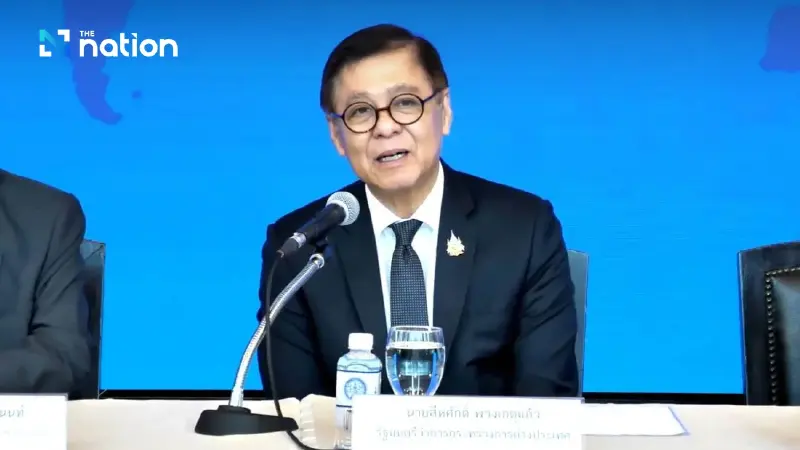


Foreign Minister Sihasak Phuangketkeow highlights the importance of economic diplomacy in driving Thailand’s growth amid global economic challenges and rising geopolitical tensions.
The advancement of economic diplomacy is key to driving Thailand's economic growth amid several challenges in the global economy, particularly geopolitical tensions, Foreign Minister Sihasak Phuangketkeow said on Friday.
He made this remark following a meeting with representatives from the Thai private sector to discuss advancing Thailand's economic diplomacy strategy.
The meeting, held at the Ministry of Foreign Affairs in Bangkok, was attended by key groups, including the Joint Standing Committee on Commerce, Industry, and Banking (JSCCIB), the Thai Chamber of Commerce, the Federation of Thai Industries, and the Thai Bankers' Association.
Sihasak explained that the Ministry of Foreign Affairs plays a vital role in supporting Thailand’s economic growth. "We cannot develop an economic diplomacy policy in isolation; it requires cooperation with the government sector," he stated. "But the most crucial factor is collaboration with the private sector to ensure we have clear goals."

Sihasak outlined three key goals of Thailand’s economic diplomacy:
- Confidence: Building confidence in Thailand as a trading and investment hub is essential. "If investors and partners don't trust Thailand, trade and investment opportunities will be limited," he said.
- Competitiveness: Strengthening Thailand’s competitiveness as the country transitions towards a digital economy, green economy, and innovation-driven growth. The ministry must help attract investments in technology to Thailand.
- Collaboration and Partnership: In a world where trade agreements and taxes are increasingly used as tools, forming partnerships to safeguard international agreements and explore new economic opportunities is vital.
Sihasak further explained that discussions with the private sector revealed key international markets and the obstacles they face. “We need to identify the challenges and opportunities in these markets, whether in terms of trade or investment,” he said.
The Foreign Minister also shared three target market strategies for Thailand’s diplomacy:
- Primary Markets: The United States and the European Union (EU), where efforts will focus on accelerating trade talks, especially the Free Trade Agreement (FTA) with the EU.
- Emerging Markets: The Middle East (Gulf Cooperation Council, GCC) and Kazakhstan, where the aim is to expand trade relations.
- New Markets: Africa and Latin America, focusing on involvement in infrastructure projects and development.
“We are committed to a serious approach to economic diplomacy,” Sihasak concluded. "Today marks the official launch of our economic diplomacy policy and our collaboration with the private sector."
Regarding the impact of geopolitics on trade, Sihasak highlighted that cooperation between the government and private sectors is essential to form a strategy that accounts for geopolitical dynamics, geoeconomics, and technology challenges.
"If we position ourselves correctly, it can become an opportunity for us," he noted.
Sihasak also addressed the Thailand-Cambodia tensions, stating that while the situation needs to be resolved, collaboration within ASEAN remains crucial. "This is not a bilateral issue but a matter for the broader ASEAN framework, where we must work together to ensure regional stability and economic integration."
He acknowledged that Vietnam has a trade advantage over Thailand due to its FTAs but emphasized that Vietnam is also a strategic partner. “Vietnam is not just a competitor; it is a crucial ally in many areas," he added.

Private sector's role in economic diplomacy
Poj Aramwattananont, Chair of JSCCIB, emphasized that economic diplomacy today is not just about international relations but also about trade. He explained that the Thai Chamber of Commerce, for example, hosts ambassadors from various countries solely to discuss trade.
"The focus is on how we can expand trade, not on anything else," he said. Poj noted that in today’s world, trade cannot progress through the Ministry of Commerce alone, as there are complex intergovernmental relationships and conflicts of interest between countries. Thus, commerce and diplomacy must work together closely.
Poj further outlined that while the main markets for Thai trade can still grow, such as in Europe where FTA is set to expand opportunities, the government’s role should include engaging in new markets.
He pointed out the significance of regions like Southeast Asia, Africa, and Latin America. Specifically, he recommended that Thailand focus on Myanmar, with its population of around 60 million, to counterbalance the impact of tensions with Cambodia.
He also noted that both Thailand and Vietnam are economic giants in ASEAN, and if both countries can work together in supply and demand chains, they will strengthen their global presence.
"Vietnam has what we lack, while Thailand possesses what Vietnam needs. This creates tremendous opportunities," he added.
The Thai-Africa Initiative: Unlocking new opportunities for collaboration
Urasa Mongkolnavin, Director-General, Department of South Asian, Middle East and African Affairs, outlined the Thai-Africa Initiative (TAI) as a core component of Thailand’s economic diplomacy, aiming to strengthen ties with African countries.
The initiative, established by the Foreign Minister Sihasak Phuangketkeow during his tenure as Permanent Secretary, has evolved to address global challenges and includes four key areas:
- Political Cooperation: Enhancing relations through high-level exchanges and increased engagement with regional and sub-regional organisations in Africa.
- Economic Cooperation: Expanding trade and investment with African nations, focusing on key markets and FTAs.
- Development Cooperation: Promoting sustainable development through knowledge exchange, particularly in areas like the sufficiency economy philosophy and human resource development.
- Strategic Partnerships: Supporting joint efforts in addressing global issues such as universal health coverage and combating online fraud.
Given Africa's vast and diverse landscape, with over 54 countries rich in natural resources and raw materials, it represents a major market for Thai exports, with a population exceeding 1.5 billion people.
Urasa has identified three key market groups for targeted efforts within the TAI:
- Core Markets: Thailand aims to strengthen relationships with countries like South Africa and Nigeria to boost trade and investment. The Ministry of Foreign Affairs plans two high-level engagements in 2026 and will promote the Thailand-South Africa FTA. Additionally, a Thailand Festival will be held to showcase Thailand’s tourism and medical services.
- Emerging Markets: Mozambique and Ghana present expanding political and economic opportunities. The Ministry is working to enhance market access in Mozambique and nearby landlocked countries, with trade missions planned to Ghana and Côte d'Ivoire in March.
- Rebuilding Countries: Countries like Sudan and Somalia, recovering from conflict, offer opportunities for Thai businesses to engage in infrastructure and development projects, supported by international reconstruction funding.
The TAI is a key part of Thailand’s broader economic diplomacy policy, which requires cooperation across all sectors.
Urasa confirmed that the Ministry of Foreign Affairs has worked to reduce barriers and risks for the private sector, creating a supportive environment for trade and investment. This includes fostering strong relationships, negotiating bilateral agreements, and helping Thai businesses expand into new markets.
The initiative also aims to support SMEs with financing, establish reliable payment systems between Thailand and African nations, and set up Thai distribution centres in key African ports. Additionally, it will promote Corporate Social Responsibility (CSR) projects.
“Thailand is ready to work hand-in-hand with Africa, harnessing its significant economic potential to achieve sustainable growth together,” Urasa said. Through the TAI, Thailand aims to stay on the radar of African countries, ensuring long-term mutual benefit and prosperity.
