
Thai exporters spooked as carriers halt bookings and sea freight rates surge
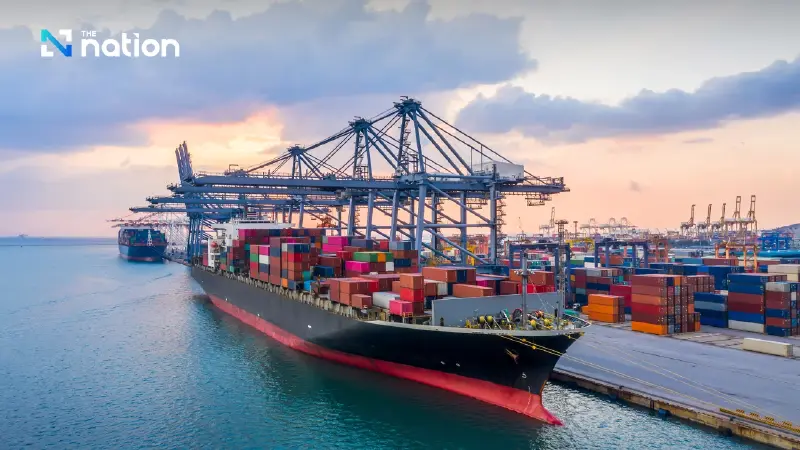


Closures of key maritime chokepoints have forced shipping lines to abandon usual routes, adding weeks to transit times and driving up freight, fuel and insurance costs across global supply chains.
- Conflict in the Middle East is disrupting key maritime chokepoints, including the Suez Canal and the Strait of Hormuz, forcing cargo ships to divert.
- Vessels are rerouting around Africa's Cape of Good Hope, adding approximately 7,500 kilometers to the journey and increasing transit times by about 15 days.
- The longer route significantly increases costs due to higher fuel consumption, freight rates, and additional war risk surcharges that can reach up to $3,500 per container.
- The rerouting affects global logistics, creating risks of product shortages, port congestion, and a scarcity of empty shipping containers in Asia.
Fighting in the Middle East, which began on February 28, when the United States and Israel attacked Iran, has escalated into Iranian strikes on US bases in several countries and an Iranian announcement to close the Strait of Hormuz, a key route for transporting oil and natural gas from major producing sources such as Qatar, Kuwait and Saudi Arabia.
The transport fallout is not limited to energy.
Rerouting by oil tankers, changes to insurance pricing, and the expansion of maritime risk zones are likely to push up freight rates for bulk commodities and containerised cargo, with knock-on effects for global logistics.
The Thai National Shippers’ Council (TNSC) said the core of the conflict lies in control of two global “maritime arteries” or chokepoints.
One is the Bab-el-Mandeb Strait and the Red Sea, a gateway to the Suez Canal that links Asia and Europe.
The route is currently under the influence of the Houthis and Hezbollah forces, described as Iranian proxies.
Under normal conditions, the Suez Canal handles about 10% of global trade, or around 1.2 billion tonnes a year.
The second is the Strait of Hormuz, which Iran has said it is closing.
The strait carries about 20% of the world’s oil, with crude flows averaging roughly 20 million barrels a day.
TNSC said Thai exporters could face significant impacts if shipping lines departing Asia, such as from China and Singapore, are forced to reroute around the Cape of Good Hope, and outlined the risks exporters would need to assess.
On the normal route via the Suez Canal and Red Sea, the distance is about 12,000 kilometres, with transit times of around 20–30 days, and freight rates at normal levels.

If vessels detour around the Cape of Good Hope, the journey adds about 7,500 kilometres and takes roughly 35–45 days, lifting freight rates, consuming far more fuel, increasing the risk of product shortages or full warehouses, and potentially undermining exporters’ net operating performance.
TNSC also warned that carriers may impose additional fees depending on decisions by their overseas headquarters, including Transit Disruption Surcharge (TDS), Peak Season Surcharge (PSS) and War Risk Premium.
The extra charges could reach US$1,500 per TEU or US$3,500 per reefer (refrigerated) container.
Thanakorn Kasetsuwan, chairman of TNSC, told Bangkokbiznews that the Middle East tensions were more likely to become a protracted risk that remains “manageable” than to expand into a full-scale war in the short term, though bouts of global economic volatility would continue.
He said there was a high chance the situation would drag on through periodic strategic retaliation, with each side seeking to maintain a balance of power and domestic support while avoiding widespread economic damage.
Thanakorn said the conflict could affect global trade in three main dimensions: first, global energy prices, as disruption to key oil routes such as Hormuz would push oil and gas prices up quickly; second, production and transport costs, as higher freight rates and insurance, particularly war-risk premiums, combine with financial-market instability, currency swings, a weaker baht, higher import costs and impacts on purchase orders; and third, Thai exports, because even though Thailand is not a direct party to the conflict, its reliance on trade and energy imports means shocks would be transmitted through higher production costs, volatile freight and insurance, and a baht that could weaken with global capital flows.
He said that if the situation remains contained, volatility could last around three to six months, but if it spreads across the region, the impact could extend beyond six months and weigh on the global economy.
Thanakorn said exporters should prepare proactively by managing freight-rate risk and delivery terms carefully, checking freight contract terms, considering short-term rate locks when increases appear likely and reviewing Incoterms to spread risk, while also using FX hedging and renegotiating long-term contract pricing if energy costs rise.
He urged exporters to allow an extra one to two weeks of shipping time, track carriers closely and review orders that must transit risk routes, diversify markets away from destinations highly sensitive to energy-price shocks by expanding into ASEAN, South Asia and the Far East, and prepare a contingency plan by setting up a weekly monitoring team, assessing worst-case cost scenarios and protecting financial liquidity.
He added that although Thailand is not directly involved, indirect impacts, especially through energy and shipping costs, can be felt quickly, and exporters should not wait for the situation to worsen before preparing.
Kongrit Chantrik, TNSC’s executive director, said that after Iran formally announced the closure of the Strait of Hormuz, the decision would affect oil transport, representing 20% of global volumes.
He said multiple countries use the route for shipping crude oil and natural gas, citing shares of total exports transported via Hormuz of around 70% for the United Arab Emirates, 90% for Saudi Arabia, and 75% for Iran.
He said Thai exporters would be hit by higher transport costs as shipping lines suspend voyages through the Hormuz route.
He added that in the Red Sea corridor, including the Bab-el-Mandeb Strait and the Suez Canal, many carriers that typically transit the Suez Canal have again had to reroute around the Cape of Good Hope for safety.
Kongrit said carriers have now stopped accepting new bookings for routes passing through risk areas, and are charging significantly higher fees on containers already loaded, up to US$3,000 per container, or two to three times normal levels.
Returning empty containers could cost about US$1,000 per container, he said, adding that exporters must negotiate with each carrier and monitor developments closely.
Visit Limlurcha, vice chairman of the Thai Chamber of Commerce and president of the Thai Future Food Trade Association, told Krungthep Turakij the Middle East situation had moved from geopolitical tension to practical disruption in shipping and energy.
Based on coordination with multiple international shipping lines, he said key routes in the Middle East were facing widespread disruption.
He said most carriers have stopped accepting bookings on routes covering the Middle East, the Persian Gulf, the Red Sea, and some countries in East Africa.
Only a limited number of lines, such as CMA CGM, are still taking bookings on some routes, but only for dry cargo, with a surcharge of around US$2,000 per 20-foot container and no guarantee of transit times.
Cargo may be held at hub ports awaiting transhipment, making delivery schedules uncertain.
On the Strait of Hormuz, he said the main shipping route is effectively blocked in practice, causing immediate disruption at key Middle East ports.
Even if there is no clear formal closure in legal terms, he said, commercial sailing is largely not possible under normal conditions.
He highlighted Jebel Ali Port in Dubai as a key transhipment hub in the area.
He said the immediate consequence is tighter global energy transport because the Strait of Hormuz carries one-fifth of global energy trade and is a main route for LNG from the Arabian Gulf.
Separately, he said risks in the Red Sea, after Houthi attacks on cargo vessels, have led many carriers to avoid the route and detour around the Cape of Good Hope.
This rerouting can delay shipments by two to three weeks and significantly increase fuel costs, driving wider impacts on trade between Asia, the Middle East and Europe, including surging costs, port congestion and the risk of empty-container shortages.
He said major hub ports were already congested, citing Durban on South Africa’s east coast and Tanger Med in northern Morocco, and warned that rising diverted volumes would further tighten global logistics.
He also warned that the return circulation of empty containers back into Asia would slow, potentially causing an empty-container shortage within the next three to four weeks if the situation does not ease.
For Thailand’s economy as a net energy importer, he said higher energy costs would feed through to electricity bills and domestic transport costs.
For exports, he said Thai operators would face higher freight rates and surcharges, uncertainty over delivery schedules, more complex inventory management and cash-flow risks, especially for SMEs, adding that prolonged disruption would worsen the impact.
He said the crisis represents a significant shock to global energy and logistics systems, and while it remains unclear whether it will be prolonged or short-lived, what is already clear is that energy and logistics costs are rising across the board.
He urged Thai businesses to monitor the situation closely and keep coordinating with shipping lines and trading partners to find alternative shipping options and manage risk.
Commerce Minister Suphajee Suthumpun said a March 2 meeting chaired by Prime Minister Anutin Charnvirakul on the Middle East unrest received information indicating the widening conflict has significant implications for global economic and trade stability, particularly in energy and maritime shipping, and requires close monitoring.
She said Thailand’s direct trade exposure to the conflict parties is not high.
In 2025, Thailand’s exports to the Middle East totalled US$12,475 million, accounting for 3.67% of total exports, and there were no significant signs yet of order cancellations or delays.
However, she said meaningful impacts were emerging at the regional level and across a tightening global economy, especially for countries dependent on shipping through key routes in the region.
She said route insecurity and restrictions have directly hit maritime transport, with many carriers rerouting and extending voyage times, pushing up freight rates, insurance costs and logistics expenses, alongside tighter container availability and vessel schedules on some routes that affect Thai exporters.
She added that volatility in global energy prices could feed into production and transport costs, and said the Commerce Ministry had set six proactive measures: closely managing consumer-goods prices and preventing profiteering, hoarding or unjustified price rises while tracking the pass-through from energy costs; securing alternative sources of raw materials and production inputs by surveying stocks with importers, diversifying away from risk areas and encouraging greater use of domestic inputs; supporting exporters and logistics management by working with the private sector to assess higher freight and insurance costs and providing deeper advice on cost management, delivery-term adjustments and market diversification; coordinating closely with shipping lines and logistics providers to monitor routes, port congestion and supply-chain continuity and assess impacts on export cost structures; mobilising commercial counsellors to report closely on trade conditions, importer confidence and related measures; and analysing impacts on inflation and price stability to develop targeted, timely policy proposals.
She said the government was preparing plans to support exporters in maintaining overseas markets amid global geopolitical volatility.
