
Tawandang Takes Its Draft Beer Beyond Bangkok in Landmark Pattaya Push
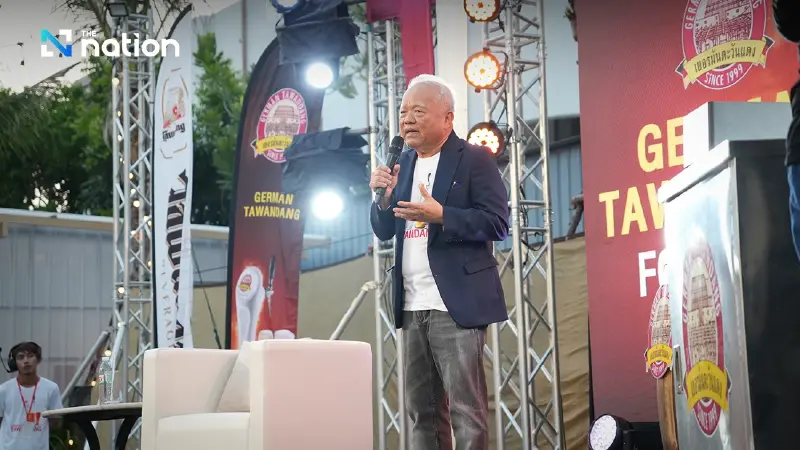


Carabao co-founder Sathien Sathientham bets on destination branding and Japanese-German draft technology to crack Thailand's 260-billion-baht beer market
- After 25 years, Tawandang German Brewery has launched its draft beer outside of Bangkok for the first time, with Pattaya selected as the initial market.
- The expansion is made possible by a new proprietary low-temperature tap system, developed with German and Japanese experts, that maintains brewery-grade quality and freshness.
- Pattaya was chosen for its economic strength, high volume of domestic and international tourists, and existing brand familiarity among residents of the Eastern Seaboard.
- This launch is the first step in a broader national strategy to install 2,000 tap points by the end of 2026, with Phuket planned as the next destination.
Carabao co-founder Sathien Sathientham bets on destination branding and Japanese-German draft technology to crack Thailand's 260-billion-baht beer market.
Sathien Sathientham stood on the breezy terrace of a beachfront bar at Dongtan Beach on Saturday evening and announced something his customers had been asking for since the late 1990s.
After 25 years and more than ten million visitors through the doors of his flagship Tawandang German Brewery in Bangkok, the co-founder and executive director of Carabao Group was finally ready to take his draught beer outside the capital.
The press conference, held on 14 March 2026 at the Folk restaurant in Pattaya marked the first time in the brewery's history that its draught product has been formally launched beyond Bangkok and its surrounding provinces.
Pattaya, Sathien declared, was the only logical starting point.
"Chonburi is close to Bangkok. In more than twenty years of operation, people from here have been making the trip to the brewery," he told reporters. "In terms of business expansion, we always look for cities with purchasing power, and Pattaya and Chonburi clearly have that."
Why Pattaya — and Why Now
The choice of Pattaya is less romantic than it appears. Chonburi province is one of Thailand's most economically productive regions, underpinned by the Eastern Economic Corridor, a dense industrial base and a tourism sector that draws both domestic and international visitors year-round.
As Thailand's most-visited resort city, Pattaya offers what strategists call a "revolving door" of consumers — a constant churn of hotel guests, expats and domestic weekend travellers who collectively represent a high-frequency, high-spending on-trade market.
There is also the question of brand familiarity. Residents of the Eastern Seaboard have long made the hour-long drive to Tawandang's Bangkok premises; the brand recognition needed to justify a regional entry was already in place. What was missing was the product itself.
That product is draught beer — and the technology behind its delivery outside a controlled brewery environment is, Sathien argues, what makes this moment different from any previous attempt.
“From a brewery legend to a new experience of freshness — the first time in history our draught beer is served outside the brewery,” Sathien stated.

Two Years of R&D: The Technology Behind the Pour
Sathien spent at least two years in research before committing to the external draught rollout, working alongside technical experts from both Germany and Japan.
The challenge was maintaining brewery-standard quality — temperature, carbonation, flavour integrity — once the product leaves a controlled production environment and travels through a distribution chain to a pub or hotel bar.
The solution is a proprietary low-temperature tap system that keeps the beer at brewery-grade conditions right up to the point of serving.
What elevates the experience further, however, is a piece of Japanese innovation that Sathien appeared particularly proud to demonstrate: a foam-printing capability that allows an operator to imprint artwork directly onto the fine microfoam head of a freshly poured pint — akin to the latte-art technology that transformed café culture a decade ago.
"The beer we are presenting today features foam so fine and soft that images can be printed directly onto it," he said.
The German side of the equation handles the liquid base and fermentation standards; the Japanese contribution is the foam engineering and the image-print hardware.
Each draught dispenser unit costs close to 100,000 baht. The machines must be ordered in batches, which constrains the pace of rollout — but also represents a deliberate scarcity strategy.
The target for 2026 is 2,000 installed tap points nationwide, with Bangkok and the Greater Metropolitan Area already seeded and Phuket next in the pipeline.

Phuket Next: The Destination Beer Playbook
Pattaya is, in one sense, a proof of concept for a broader destination-branding strategy that Carabao believes could fundamentally alter its position in the on-trade channel.
The group has already launched a "Pattaya Beer" — a 3.9% ABV lager engineered for all-day coastal consumption — and sales, Sathien noted, have exceeded expectations, reaching as far north as Chiang Mai and west to Hua Hin.
Phuket is next, and it will receive its own variant: a 4.2% ABV Weizen-style beer with a light fruity base, designed to suit the longer drinking sessions typical of international resort tourism. The difference in alcohol content is not accidental.
"Tourists drink throughout the day," Sathien explained, "so the beer needs to be lighter."
The Phuket variant is expected to launch later this year, concurrent with the tap rollout to the island's bars and hotels.

Breaking the Duopoly: The Bigger Picture
The Pattaya launch is a visible milestone in what is, by any measure, a long-term and expensive gamble.
Thailand's beer industry is worth approximately 260 billion baht a year and has for decades been dominated by two players whose combined market share exceeds 80 per cent.
Carabao Group entered the sector with a deliberate ambition to fracture that duopoly — not by undercutting on price, but by introducing product diversity that the market has never seen.
The group currently offers five core variants: Lager and Dunkel under the Carabao brand, targeting the economy and standard segments; and Weizen, Rosé and IPA under the Tawandang label, positioned in the standard-to-premium tier.
The philosophy, Sathien argues, is essentially an educational one.
"Just as you eat many different dishes, why not have choices when drinking beer?" he said. "Beer doesn't have just one taste or one brand. We want Thai consumers to understand that."
Monthly sales volumes for beer have now exceeded 300,000 cases — a figure Sathien cited as evidence that the strategy is working, even if the group's overall market share remains below two per cent.
Every variant in the portfolio is selling, he said, with figures improving month on month.
Manufacturing Muscle and the Tsingtao Alliance
Underpinning the expansion is a four-billion-baht manufacturing investment at Carabao’s Chainat facility, whose annual capacity was recently raised to 300 million litres.
To accelerate utilisation of that plant, the group has secured a landmark deal with Tsingtao, the Chinese brewing giant.
Thailand will become only the second country after Germany in which Tsingtao has agreed to have its beer produced under licence, with Carabao’s Chainat brewery serving as an OEM manufacturer for ASEAN export from 2026.
In return, Tsingtao will distribute Carabao energy drinks across its network in China’s Shandong and Yunnan provinces — a reciprocal arrangement that simultaneously fills idle capacity at home and opens a new channel into the world’s largest consumer market.
Headwinds the Group Cannot Ignore
The road ahead carries genuine risks. Logistics costs have risen sharply as crude oil prices approach the 100-dollar-a-barrel threshold, and fuel restrictions at some filling stations have created unpredictable delivery schedules and hidden costs for haulage operators.
Regulatory pressure is mounting too: Thailand’s revised Alcoholic Beverage Control Act, in force since November 2025, tightens advertising restrictions and reinforces the midnight sales ban, making the on-trade channel — hotels, restaurants and bars — even more critical for a brand with limited scope for above-the-line marketing.
Meanwhile, Carabao’s group market share in beer remains below two per cent, and the business recorded a combined loss of approximately one billion baht in its first two years in the sector. Management targets a return to profitability by the end of 2026.

The Road to 2026: Taps, Targets and a National Ambition
The three pillars of Carabao's near-term roadmap are straightforward: install 2,000 draught dispensers by year-end, extend the destination-beer programme to Phuket, and bed in the Tsingtao manufacturing alliance as a utilisation driver and revenue contributor.
Taken together, the group believes these initiatives will demonstrate that its model — brewery-grade quality distributed at industrial scale through a diversified portfolio — is viable at the national level.
The broader ambition is more sweeping. Sathien has made no secret of his desire to build Carabao into a global alcohol conglomerate.
The Tawandang German Brewery, with its 25-year heritage and ten million-strong loyal visitor base, is the brand anchor. The Chainat plant is the manufacturing engine. The Tsingtao alliance and the Cambodia facility are the international bridgeheads.
What Saturday's event in Pattaya represented was something simpler but perhaps more meaningful: proof, finally, that a beer born in a Bangkok warehouse in the late 1990s can travel — and that the draught experience that customers have been requesting for a quarter of a century is now, as Sathien put it, "no longer just a question."
