
Thai Export Giants Scramble as Cambodia Spat Halves Regional Sales
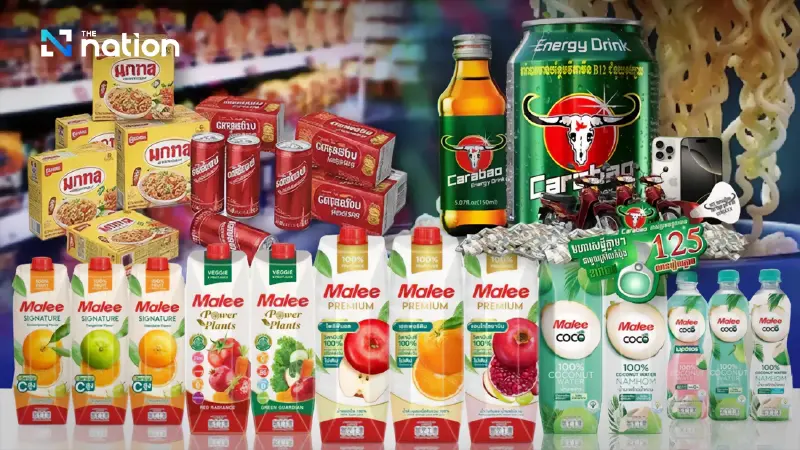


Major Thai corporations, from Carabao to Mama noodles, report substantial Q3 revenue losses due to rising Cambodian nationalism and border disruption
- A diplomatic conflict between Thailand and Cambodia has led to a major drop in Q3 sales for Thai export giants due to border disruptions and rising Cambodian nationalism.
- Major brands like Carabao and Mama noodles have been hit hard, with Carabao reporting a 44% sales drop in the CLMV region and Mama's international sales shrinking by nearly 30%.
- The disruption is driven by official border closures halting trade and by online influencers in Cambodia using nationalist sentiment to discourage the stocking of Thai products.
- In response, Thai firms are scrambling to find new markets, creating contingency plans, and even repackaging products with Khmer language to depoliticize their branding.
Major Thai corporations, from Carabao to Mama noodles, report substantial Q3 revenue losses due to rising Cambodian nationalism and border disruption.
Major Thai corporations are activating contingency plans after a five-month diplomatic conflict between Thailand and Cambodia led to a dramatic collapse in sales across the border.
Thai business is facing a clear impact in the third quarter, with large firms assessing lost revenue ranging from tens of millions to billions of baht.
The prolonged conflict has not only strained international relations but has severely disrupted commerce, affecting traditional border trade and the market for Thai goods popular in Cambodia.
Sathien Sathientham, CEO of Carabao Group, reported that while the "Carabao Daeng" energy drink achieved record domestic market share this year, the Cambodian market was hit hard.
He estimates lost sales running into "several hundred million baht," directly attributable to the conflict.
The digital landscape has amplified the issue.
According to Sathien, online influencers in Cambodia are using nationalist sentiment to question the loyalty of local shops stocking Thai products.
“Following the Thailand-Cambodia conflict, there was a rise in nationalism, which led to a decrease in our energy drink sales in Cambodia,” he confirmed.
Carabao Group's overall sales revenue rose 8% to 5.496 billion baht in Q3, but revenue from its own-branded products fell 5%.
The decline was driven by lower exports to the key Cambodian market.
Restrictions on land border crossings between the two nations have increased costs and delayed distribution, contributing to an astonishing 44% drop in overall sales across the company’s CLMV markets (Cambodia, Laos, Myanmar, and Vietnam).
Food and Dairy Producers Seek New Horizons
Pan Paniangvait, CEO of Thai President Foods PCL, the manufacturer of "Mama" instant noodles, confirmed that Cambodia is a major export market, accounting for 17-18% of the company's exports, alongside a long-established local production base.
The noodle giant saw Q3 sales drop 12.17% year-on-year, with international market sales shrinking by 29.58%.
The situation has forced the company to swiftly seek new export markets to generate growth.
Similarly, Ekarin Pinij, CEO of Malee Group PCL, which exports dairy, fruit juice, and coconut water, confirmed the closure of border crossings was severely affecting sales, particularly for their dairy line.
The company is now working closely with its Cambodian distributors on a contingency plan, preparing stock for immediate deployment once the situation improves.
“We are working closely with our distributor in Cambodia; we are not giving up. We are preparing stock for sale and hope this problem will be temporary,” Ekarin stated.
Beauty Exports Grind to a Halt
The beauty sector has also suffered major losses.
Wongwiwat Theekhakhirikul, managing director of Karmarts PCL, revealed that border closures have made exporting beauty products to Cambodia exceptionally difficult.
This resulted in a sales drop of approximately 7–8 million baht per month, with the last three months proving the toughest.
He noted that both official exports and unofficial sales—such as those channelled through the Thai-Cambodian border trade at the Rong Kluea Market—have been halted. Carmart hopes for a resolution through government negotiation next year.
The company is also facing a separate sales drop of 13–14 million baht per month in Myanmar.
In a significant adaptation effort, a source from a necessity goods company revealed that some Thai products, facing challenges in the Cambodian market, are now being packaged with Khmer language instead of Thai, indicating a strategic shift to depoliticise their branding.
