
Thai Petrochemical Giant Defend Proposed Joint Venture Against Monopoly Concerns


SCGC pushes back on domestic monopoly fears as a feasibility study for a landmark olefins joint venture gets under way, arguing that imports and free-market pricing cap their power
- SCG Chemicals (SCGC) defends its proposed merger by arguing that Thailand's free-trade framework and significant competition from imports, which account for 25-30% of consumption, prevent them from having price-setting power.
- The company asserts that prices are determined by regional market indices, not domestic producers, making any attempt to unfairly inflate prices counterproductive.
- The merger is positioned as a strategic necessity to enhance the global competitiveness and resilience of Thailand's petrochemical industry against increasing market volatility and geopolitical pressures.
SCGC pushes back on domestic monopoly fears as a feasibility study for a landmark olefins joint venture gets under way, arguing that imports and free-market pricing cap their power.
SCG Chemicals (SCGC) has moved to address growing speculation regarding market dominance following the announcement of a strategic feasibility study into a joint venture (JV) for their olefins and polyolefins businesses.
While the potential merger would create a formidable industrial titan, executives have been quick to dismiss fears of a domestic monopoly, arguing that the move is a vital necessity for survival in an increasingly volatile global market.

A Strategic Defence Against Global Volatility
Addressing concerns that a combined entity could unfairly dictate prices, SCG management pointed to Thailand’s “free trade” framework as a structural constraint on any prospective market power.
A merged business would command a significant share of the domestic market — exceeding 60 per cent for polyethylene (PE) and roughly 25 per cent for polypropylene (PP) — but executives maintain that scale does not translate into price-setting power.

“The market determines the price, not the producer,” said Thammasak Sethaudom, president and chief executive of SCG, at a media briefing on Thursday.
He noted that prices are pegged to regional indices and that imports already account for approximately 25 to 30 per cent of Thailand’s domestic consumption — a competitive check that would make any attempt to inflate prices counterproductive.
Sakchai Patiparnpreechavud, chief executive and president of SCGC, framed the collaboration in broader national terms.

“This collaboration will reinforce the strength of Thailand’s petrochemical industry while enhancing its resilience and global competitiveness,” he said, adding that it would support downstream industries and create long-term economic value.
Narongsak Jivakanun, chief executive of GC, struck a similar note in a filing to the Stock Exchange of Thailand, describing the objective as establishing “a leading petrochemical player in the region” that would reinforce Thailand’s integrated infrastructure, enhance operational efficiencies, and contribute to the country’s economic growth.
The Road Ahead: A Two-Year Timeline
The path to formalising the partnership remains rigorous. A feasibility study, currently under way using a neutral “Clean Team” to handle commercially sensitive data, is expected to conclude by the end of the third quarter of 2026.
Should the study proceed favourably, management confirmed it would take at least a further 12 months from any decision date to complete the complex transfer of assets and officially establish the new company.
Throughout that period, SCGC and GC will continue to operate as wholly independent entities. The combined venture would bring together approximately 6 million tonnes of PE and PP capacity and 7 million tonnes of upstream olefins capacity.

Navigating the Middle East Crisis
The push for consolidation is being accelerated by immediate geopolitical pressures. Conflict in the Middle East has driven Brent crude to $115 per barrel, disrupted global supply chains, and, according to SCG, destroyed roughly 20 per cent of global ethylene production capacity — damage that could take up to two years to repair.
For SCG, the exposure is acute: approximately 50 to 60 per cent of its raw materials must transit the Strait of Hormuz.
Two company vessels carrying around 55,000 tonnes of feedstock were caught in the conflict zone, though management confirmed they are expected to reach Thailand early next week.
In response, SCG has established a “Daily War Room” to monitor energy costs in real time and is actively diversifying procurement towards suppliers outside the region.

Plant Shutdowns and Domestic Supply Security
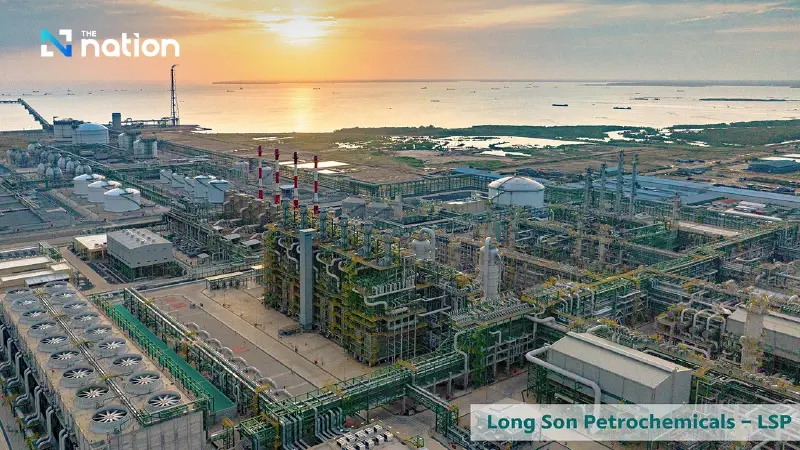
The supply crunch has forced SCGC to carry out temporary shutdowns at two plants: the Rayong Olefins (ROC) facility in Thailand and the Long Son Petrochemicals (LSP) complex in Vietnam.
Thammasak insisted, however, that domestic supply will not be curtailed, with the stoppages used in part to carry out maintenance and to accelerate preparations for an ethane feedstock enhancement project at the LSP site.
The LSP ethane project, 54 per cent complete, remains on course for commissioning by the end of 2027. Once operational, it is expected to deliver annual cost savings in excess of 6,000 million baht, reducing SCG’s vulnerability to volatile naphtha prices.

Financial Discipline Amid the Turbulence
The crisis is unfolding as SCG reports a stronger first quarter. The group posted revenue of 123,327 million baht and an adjusted cash EBITDA of 14,929 million baht for Q1 2026, a 17 per cent increase year on year.
Profit for the period stood at 6,223 million baht, while cash on hand improved to 67,137 million baht. The net debt-to-EBITDA ratio fell to 5.0 times from 5.5 times at the end of last year.
Operational restructuring and the elimination of unprofitable businesses have delivered cost savings of approximately 4,300 million baht so far in 2026, the company said, while capital expenditure was held at 5,482 million baht.
Thammasak said the first month of the second quarter had “not been bad,” but declined to offer a more upbeat assessment.
“Despite continued high volatility in both the Middle East and the global economic landscape, SCG will maintain strict financial discipline and accelerate efforts to strengthen the competitiveness of all businesses to be resilient,” he said.
Clean Energy and the ASEAN Opportunity
While the immediate focus is crisis containment, SCG is pressing ahead with longer-term structural shifts. Its clean energy unit, SCG Cleanergy, now has 141 megawatts of installed capacity and is expanding under power purchase agreements with both the public sector and private partners.
The group is also accelerating the roll-out of SCG Low Carbon Cement, which has already captured more than 80 per cent domestic market penetration.
Across ASEAN, where infrastructure investment and foreign direct investment continue to sustain product demand, SCG sees an opportunity to turn its diversified regional manufacturing base into a competitive advantage.
The question for the remainder of 2026 is whether its crisis playbook — war room, feedstock diversification, and financial discipline — will prove sufficient to weather a disruption that shows little sign of abating.
