
Sustenance to Science: Inside the Tech-Led Revolution of Thai Food Brands
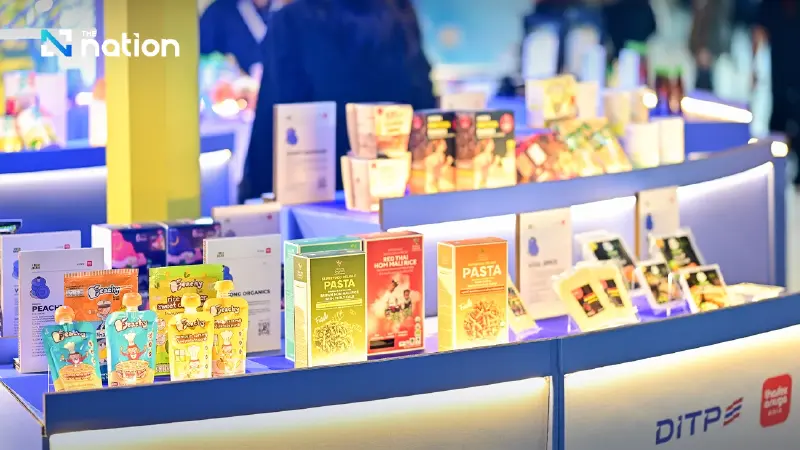


At Asia’s largest food trade show, Thai F&B players signalled a decisive shift from commodity producers to innovation-led global heavyweights—but the road ahead is far from smooth
- Thai food and beverage brands are strategically shifting from commodity producers to innovation-led global competitors, focusing on health-driven products and food-tech integration.
- Legacy companies are reinventing themselves by using technology like AI for consumer analytics and developing healthier alternatives, such as low-glycemic index sugar and allulose.
- The move towards science is exemplified by companies like Malee Group, which is developing proprietary nano-encapsulation delivery systems for vitamins and clinical-grade wellness ingredients.
- Even traditionally commoditized sectors like rice and sugar are being transformed, with companies creating premium branded products, value-added goods like rice bran oil, and biodegradable materials from agricultural supply chains.
At Asia’s largest food trade show, Thai F&B players signalled a decisive shift from commodity producers to innovation-led global heavyweights—but the road ahead is far from smooth.
When THAIFEX – Anuga Asia 2026 closed its doors on 30 May at IMPACT Muang Thong Thani in Bangkok, the five-day event left little doubt about where Thailand's food and beverage industry is heading.
The show's largest edition to date—spanning over 140,000 square metres across 12 halls, hosting more than 3,600 exhibitors from 56 countries and drawing upwards of 90,000 trade visitors from 140 markets—was not merely a showcase of products. It was a declaration of strategic intent, with Thai brands at its centre.
The overarching theme, ‘What's Next in F&B’, turned out to be less a question than a directive. Across the show floor, the response was uniform: health-driven innovation, food-tech integration, and a concerted push towards premium positioning in global markets.
The Market Is Ready—But So Is the Competition
The timing for this transformation is not incidental. The global functional and healthy food market, estimated at approximately $789.8 billion in 2025, is projected to reach $871.1 billion in 2026 and expand at a compound annual growth rate of 10.3 per cent through 2036, potentially topping $2.3 trillion.
These figures were cited during the event by executives from Thai Rung Ruang Industry, a sugar producer now pivoting into alternative sweeteners.
Domestically, Thailand's food processing sector generated $28 billion in exports in 2024, a figure supported by the country's long-standing identity as the ‘Kitchen of the World’. The food service market reached $35.4 billion in 2025 and is forecast to grow to over $51 billion by 2030.

Yet the competitive landscape has sharpened. Vietnam, Indonesia, and India are aggressively developing their own food export capabilities. Consumer preferences are fragmenting faster than supply chains can adapt.
Against this backdrop, THAIFEX 2026 functioned as a measuring stick for which Thai companies were genuinely transforming and which were simply rebranding.
Reinventing Legacy: From Herb Tonics to Rice Fields
The transformation impulse extended well beyond the beverage aisle. Penpark Beverage—a 109-year-old herbal drink maker—arrived announcing a full pivot into ready-to-drink (RTD) beverages, nutraceuticals, and original equipment manufacturer (OEM) manufacturing, with AI-driven consumer analytics now guiding product development.
Commercial director Praiya Thaichart reported 20 per cent growth in its non-alcoholic segment in Q1 2026, with targets of 40 per cent growth in alcoholic beverages for the year. A signed memorandum of understanding (MOU) with media company Fatu Media to co-develop a new beverage brand underlines the logic: in a crowded health-drink market, distribution partnerships matter as much as the formula in the bottle.

Two other sectors showed how deeply the innovation imperative has penetrated traditionally commoditised Thai agriculture: rice and cooking oil.
CMP Group, positioning itself as a ‘Premium Rice Specialist’ after decades as a conventional exporter, used THAIFEX to present what its managing director, Prapaiphan Manathanya described as a strategy of ‘Generations of Trust, Future of Rice’.

The group showcased organic rice solutions, OEM and private-label development capabilities, and forward-looking rice product concepts to international buyers.
With its export-to-import ratio split evenly at 50/50, CMP is betting that Thai rice's recognised quality—superior texture and aroma versus regional competitors—can command a premium if paired with stronger branding and product development.
LPP Group, a rice milling and agro-industrial conglomerate, is making a different but equally deliberate pivot. Its rice bran oil business—only four years old—generated approximately 700 million baht ($19.2 million) in revenue in 2025 and is targeting 1 billion baht ($27.4 million) in 2026.
The company plans to invest 400–500 million baht in capacity expansion and has set a long-term goal of listing its LPP Oil subsidiary on the stock exchange by 2030–31.
Japan, where rice bran oil already accounts for over 20 per cent of cooking oil consumption, and South Korea are its primary export markets, but LPP is now pushing its brand into the Thai domestic consumer market – historically underserved by locally produced premium oils.

The Sugar Sector Reinvents Its Value Chain
Thailand's sugar industry, facing downward pressure from global health trends and domestic sugar tax regulations, is using foodtech to reposition itself rather than retreat.
Mitr Phol, the world's fourth-largest sugar producer, launched a Low GI (glycaemic index) natural cane sugar—with an index score of 52—at the show. The product, which undergoes no bleaching and dissolves cleanly, targets health-conscious consumers and food manufacturers seeking reformulation ingredients.
Simultaneously, the group showcased biodegradable biomaterial solutions (CaneX, PlaneX) from sugarcane and cassava that decompose within six months, as well as prebiotic fibre products and a range of skincare lines—a deliberate effort to extract multiple revenue streams from a single agricultural supply chain.
Thai Rung Ruang Industry took a different route, introducing Delite+ Pure Allulose, a rare sugar sourced from the United States and the first of its kind to receive Thai FDA approval. Allulose delivers just 0.4 kilocalories per gram, does not spike blood sugar or insulin, and lacks the bitter aftertaste associated with many synthetic sweeteners.
The company is targeting B2B channels including restaurants, bakeries, and functional food manufacturers—recognising that the fastest commercial adoption of novel ingredients comes through professionals, not retail shelves.

Malee and the Science-Backed Wellbeing Play
Malee Group, Thailand's leading premium juice producer and dominant player in the South Korean coconut water market under its Malee COCO brand, arrived with a different kind of ambition: becoming a ‘Global Wellbeing Company’ by 2028. The company presented innovations including Malee COCO Coconut Matcha, combining Thai coconut water with Japanese Uji matcha—a product that carries the hallmarks of the current health-beverage trend: EGCG catechins, high potassium, zero fat, and only 25 kilocalories per bottle.
More substantively, Malee's Applied Sciences division (MAS) unveiled proprietary delivery technology—‘LIPOPLEX Dualsphere’—a nano-encapsulation system that enhances the absorption and stability of vitamins and active compounds including liposomal Vitamin C and glutathione.
MAS also introduced UVABLOX, PHEONIQUE, and POMECAP: clinical-grade ingredients targeting UV protection, skin brightening, and anti-ageing—products aimed squarely at the premium wellness ingredients market in Asia, Europe, and America.
The pivot from juice to science-backed ingredient supplier reflects an understanding that the highest margins in food innovation no longer lie in commodities.

Snacks, Protein, and the Export Sprint
KCG Corporation, Thailand's number-one butter brand for a decade, reported record revenues of 8.645 billion baht (£187 million / $237 million) in 2025—up 11.6 per cent year-on-year—with net profit growth of 24 per cent. The company's THAIFEX presentation positioned it as a ‘Seamless Solution Provider’ for B2B operators across Southeast Asia, developing localised product formulations for Vietnam, Japan, and the Philippines to underpin a stated commitment to Net Zero emissions by 2050.
CHAO (Chaosua Foods Industry), the snack maker, used THAIFEX to pursue global distribution for its 58-SKU portfolio spanning rice snacks, meat snacks, and healthy crackers. Its pivot centres on translating Thai flavours—Pad Thai rice crisps, mango sticky rice chips—into universal snack formats palatable to Chinese and US markets while developing non-pork protein lines (fish, shrimp, chicken) to address halal and import-restricted markets.
SAPPE, whose Mogu Mogu brand reaches over 1 million stores across 100 countries, was candid about 2025 difficulties, where sales fell approximately 13 per cent amid weakened purchasing power in key markets. However, the company returned to 13 per cent growth in Q1 2026, driven by a 25 per cent surge in international revenue. Its response is a multi-hundred-million baht global campaign and a pipeline of at least 15 new products for 2026.

Challenges That Innovation Cannot Fully Solve
The optimism on the exhibition floor did not entirely mask structural pressures. Logistics costs remain elevated due to Middle East instability, affecting companies like SAPPE and Sahafarm.
The latter, which logged record export volumes of 220,000 tonnes of processed chicken in 2025, flagged near-100 per cent increases in plastic packaging costs and rising animal feed prices in 2026.
Thai Coconut, re-entering the domestic market after 12 years of focusing exclusively on exports to over 100 countries, estimated the Thai coconut water market at 1.5 billion baht ($41.1 million), growing at 20 per cent annually—but acknowledged intensifying domestic competition.
The broader structural challenge is one of scale and perception. Many Thai F&B brands remain strong in ASEAN and niche diaspora markets but lack the brand equity to command premium pricing in high-income Western markets.
The shift from commodity exporter to branded innovator requires sustained investment in R&D, regulatory compliance across varied international jurisdictions, and marketing spend that many mid-sized operators strain to justify.

A Procurement Platform, Not Just a Fair
THAIFEX's own evolution mirrors the industry it serves. This year's edition introduced Hall 4 as a dedicated innovation hub—consolidating the New-to-Market Street, startup pitching, and the TasteInnovation Show, where 10 winning products, including an egg-white ice cream, chicken-protein noodles, and an edible wafer cup, were recognised.
The show is progressively repositioning itself as a global procurement platform and innovation incubator, not simply a sales exhibition.
For Thailand, the stakes are tangible. With food processing exports at $28 billion and a government target to cement its status as a global food hub, the country's ability to sustain competitive advantage depends on whether its food companies can match the pace of global health and technology trends—not merely respond to them. THAIFEX 2026 suggested more Thai players are asking the right questions. Whether the answers are coming fast enough is the test that follows.
